| Record Information |
|---|
| Version | 1.0 |
|---|
| Creation Date | 2016-09-30 22:27:21 UTC |
|---|
| Update Date | 2020-05-21 16:28:41 UTC |
|---|
| BMDB ID | BMDB0000247 |
|---|
| Secondary Accession Numbers | |
|---|
| Metabolite Identification |
|---|
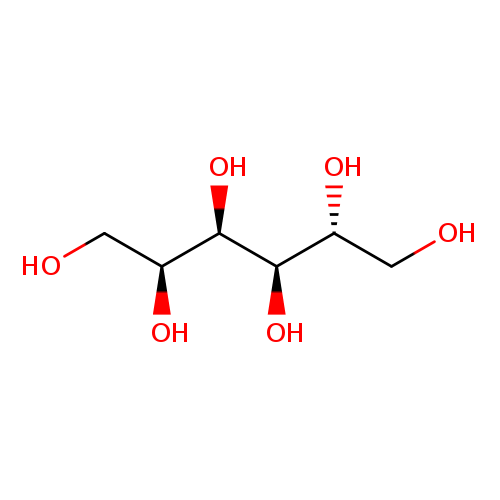
| Common Name | Sorbitol |
|---|
| Description | Sorbitolol, also known as sorbitolol or Sorbitolol, belongs to the class of organic compounds known as sugar alcohols. These are hydrogenated forms of carbohydrate in which the carbonyl group (aldehyde or ketone, reducing sugar) has been reduced to a primary or secondary hydroxyl group. Sorbitolol is a drug which is used as a non-stimulant laxative via an oral suspension or enema. Sorbitolol exists as a solid, possibly soluble (in water), and an extremely weak basic (essentially neutral) compound (based on its pKa) molecule. Sorbitolol exists in all living species, ranging from bacteria to humans. Sorbitolol participates in a number of enzymatic reactions, within cattle. In particular, D-Galactose and sorbitolol can be converted into melibiitol; which is mediated by the enzyme Alpha-galactosidase a. In addition, Sorbitolol can be converted into Alpha-D-glucose; which is catalyzed by the enzyme aldose reductase. In cattle, sorbitolol is involved in a couple of metabolic pathways, which include the galactose metabolism pathway and the fructose and mannose degradation pathway. |
|---|
| Structure | |
|---|
| Synonyms | | Value | Source |
|---|
| (-)-Sorbitol | ChEBI | | (2R,3R,4R,5S)-Hexane-1,2,3,4,5,6-hexol | ChEBI | | D-(-)-Sorbitol | ChEBI | | D-Sorbit | ChEBI | | D-SORBITOL | ChEBI | | e 420 | ChEBI | | e-420 | ChEBI | | e420 | ChEBI | | g-Ol | ChEBI | | GLC-Ol | ChEBI | | L-Gulitol | ChEBI | | D-Glucitol | Kegg | | Sorbitol 3% in plastic container | Kegg | | D-Sorbol | HMDB | | Diakarmon | HMDB | | Esasorb | HMDB | | Foodol D 70 | HMDB | | Glucarine | HMDB | | Glucitol | HMDB | | Karion | HMDB | | Karion instant | HMDB | | Kyowa powder 50m | HMDB | | Multitol | HMDB | | Neosorb | HMDB | | Neosorb 20/60dC | HMDB | | Neosorb 70/02 | HMDB | | Neosorb 70/70 | HMDB | | Neosorb p 20/60 | HMDB | | Neosorb p 60 | HMDB | | Neosorb p 60W | HMDB | | Nivitin | HMDB | | Resulax | HMDB | | Sionit | HMDB | | Sionit K | HMDB | | Sionite | HMDB | | Sionon | HMDB | | Siosan | HMDB | | Sorbex m | HMDB | | Sorbex R | HMDB | | Sorbex RP | HMDB | | Sorbex S | HMDB | | Sorbex X | HMDB | | Sorbilande | HMDB | | Sorbilax | HMDB | | Sorbit | HMDB | | Sorbit D 70 | HMDB | | Sorbit D-powder | HMDB | | Sorbit DP | HMDB | | Sorbit DP 50 | HMDB | | Sorbit kyowa powder 50m | HMDB | | Sorbit L 70 | HMDB | | Sorbit S | HMDB | | Sorbit T 70 | HMDB | | Sorbit W 70 | HMDB | | Sorbit W-powder | HMDB | | Sorbit W-powder 50 | HMDB | | Sorbit WP | HMDB | | Sorbite | HMDB | | Sorbitol F | HMDB | | Sorbitol FK | HMDB | | Sorbitol FP | HMDB | | Sorbitol S | HMDB | | Sorbitol syrup C | HMDB | | Sorbitur | HMDB | | Sorbo | HMDB | | Sorbogem 712 | HMDB | | Sorbol | HMDB | | Sorbostyl | HMDB | | Medefield brand OF sorbitol | HMDB | | Sorbitol pfizer brand | HMDB | | Yal | HMDB | | Klysma sorbit | HMDB | | Medevac | HMDB | | Trommsdorff brand OF sorbitol | HMDB | | Baxter brand OF sorbitol | HMDB | | Pfizer brand OF sorbitol | HMDB |
|
|---|
| Chemical Formula | C6H14O6 |
|---|
| Average Molecular Weight | 182.1718 |
|---|
| Monoisotopic Molecular Weight | 182.07903818 |
|---|
| IUPAC Name | (2R,3R,4R,5S)-hexane-1,2,3,4,5,6-hexol |
|---|
| Traditional Name | D-sorbitol |
|---|
| CAS Registry Number | 50-70-4 |
|---|
| SMILES | OC[C@H](O)[C@@H](O)[C@H](O)[C@H](O)CO |
|---|
| InChI Identifier | InChI=1S/C6H14O6/c7-1-3(9)5(11)6(12)4(10)2-8/h3-12H,1-2H2/t3-,4+,5-,6-/m1/s1 |
|---|
| InChI Key | FBPFZTCFMRRESA-JGWLITMVSA-N |
|---|
| Chemical Taxonomy |
|---|
| Description | belongs to the class of organic compounds known as sugar alcohols. These are hydrogenated forms of carbohydrate in which the carbonyl group (aldehyde or ketone, reducing sugar) has been reduced to a primary or secondary hydroxyl group. |
|---|
| Kingdom | Organic compounds |
|---|
| Super Class | Organic oxygen compounds |
|---|
| Class | Organooxygen compounds |
|---|
| Sub Class | Carbohydrates and carbohydrate conjugates |
|---|
| Direct Parent | Sugar alcohols |
|---|
| Alternative Parents | |
|---|
| Substituents | - Sugar alcohol
- Monosaccharide
- Secondary alcohol
- Polyol
- Hydrocarbon derivative
- Primary alcohol
- Alcohol
- Aliphatic acyclic compound
|
|---|
| Molecular Framework | Aliphatic acyclic compounds |
|---|
| External Descriptors | |
|---|
| Ontology |
|---|
| Status | Detected but not Quantified |
|---|
| Origin | |
|---|
| Biofunction | Not Available |
|---|
| Application | Not Available |
|---|
| Cellular locations | |
|---|
| Physical Properties |
|---|
| State | Liquid |
|---|
| Experimental Properties | | Property | Value | Reference |
|---|
| Melting Point | 11 °C | Not Available | | Boiling Point | Not Available | Not Available | | Water Solubility | 2750.0 mg/mL | Not Available | | LogP | -2.2 | SANGSTER (1994) |
|
|---|
| Predicted Properties | |
|---|
| Spectra |
|---|
| Spectra | |
|---|