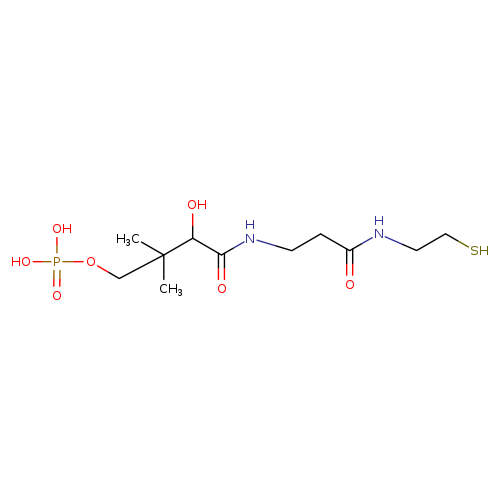
Pantetheine 4'-phosphate, also known as Pantetheine 4'-phosphate or PSH-4'-p, belongs to the class of organic compounds known as monoalkyl phosphates. These are organic compounds containing a phosphate group that is linked to exactly one alkyl chain. Pantetheine 4'-phosphate is possibly soluble (in water) and an extremely weak basic (essentially neutral) compound (based on its pKa). Pantetheine 4'-phosphate exists in all living species, ranging from bacteria to humans. Pantetheine 4'-phosphate participates in a number of enzymatic reactions, within cattle. In particular, Pantetheine 4'-phosphate can be biosynthesized from pantetheine through the action of the enzyme pantothenate kinase 1. In addition, Pantetheine 4'-phosphate can be biosynthesized from 4'-phosphopantothenoylcysteine through its interaction with the enzyme phosphopantothenoylcysteine decarboxylase. In cattle, pantetheine 4'-phosphate is involved in the metabolic pathway called pantothenate and CoA biosynthesis pathway.
belongs to the class of organic compounds known as monoalkyl phosphates. These are organic compounds containing a phosphate group that is linked to exactly one alkyl chain.
Furthermore, about 85 of the dietary pantothenic acid is in CoA or phosphopentetheine forms, which is hydrolyzed by the ruminal microbiota into phosphopantetheine and pantetheine for energy provision.
Written in the paper as “phosphopentetheine” and “energy provision”
Furthermore, about 85 of the dietary pantothenic acid is in CoA or phosphopentetheine forms, which is hydrolyzed by the ruminal microbiota into phosphopantetheine and pantetheine for energy provision.
Written in the paper as “phosphopantetheine” and “energy provision”
The chemical reactions and pathways involving fatty acids, aliphatic monocarboxylic acids liberated from naturally occurring fats and oils by hydrolysis.
Pantothenic acid or vitamin B5, has considerable metabolic importance in production of energy from carbohydrates, fatty acids, and AAs as it is an integral part of CoA, phosphopantetheine, and acyl-carrier-protein (ACP), all of which are involved in fatty acid metabolism (61).
Written in the paper as “phosphopantetheine” and “fatty acid metabolism”
The group includes Vitamin B5 used for fortification or enrichment of foods. Pantothenic acid, also called pantothenate or vitamin B5 (a B vitamin), is a water-soluble vitamin. For many animals, pantothenic acid is an essential nutrient] and [https://en.wikipedia.org/wiki/Vitamin_B5_]
Furthermore, about 85 of the dietary pantothenic acid is in CoA or phosphopentetheine forms, which is hydrolyzed by the ruminal microbiota into phosphopantetheine and pantetheine for energy provision.
Written in the paper as “phosphopentetheine” and “dietary pantothenic acid”
Several other metabolites of uncertain significance specifically accumulated in PEsen cells when compared with both the growing and growth-arrested controls (Supplementary Fig. S9, Supplementary Table S6a); these included a xenobiotic (presumably derived from the foetal bovine serum) methyl glucopyranoside (alpha and beta), a neurotransmitter (acetylcholine), an aminosugar (N-acetyl-glucosamine 1-phosphate) and a co-factor/vitamin (phosphopantetheine).
Written in the paper as “phosphopantetheine” and “co-factor/vitamin”
Secondary metabolites biosynthesis, transport and catabolism
Specific function:
Fatty acid synthetase catalyzes the formation of long-chain fatty acids from acetyl-CoA, malonyl-CoA and NADPH. This multifunctional protein has 7 catalytic activities as an acyl carrier protein.
Carrier of the growing fatty acid chain in fatty acid biosynthesis (PubMed:1907568). Accessory and non-catalytic subunit of the mitochondrial membrane respiratory chain NADH dehydrogenase (Complex I), which functions in the transfer of electrons from NADH to the respiratory chain (PubMed:1907568, PubMed:10852722, PubMed:18721790).
Hydrolase that metabolizes extracellular nucleotides, including ATP, GTP, UTP and CTP (By similarity). Limits mast cell and basophil responses during inflammation and during the chronic phases of allergic responses by eliminating the extracellular ATP that functions as signaling molecule and activates basophils and mast cells and induces the release of inflammatory cytokines. Metabolizes extracellular ATP in the lumen of the small intestine, and thereby prevents ATP-induced apoptosis of intestinal plasmacytoid dendritic cells (By similarity). Has also alkaline phosphodiesterase activity (By similarity).