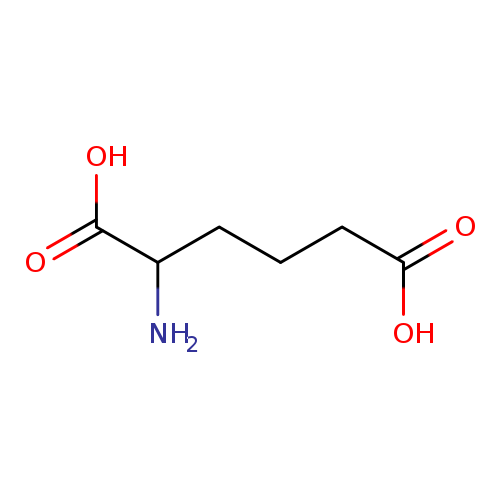
Aminoadipic acid, also known as aminoadipic acid or Aminoadipic acid, belongs to the class of organic compounds known as alpha amino acids. These are amino acids in which the amino group is attached to the carbon atom immediately adjacent to the carboxylate group (alpha carbon). Aminoadipic acid exists as a solid, very hydrophobic, practically insoluble (in water), and relatively neutral molecule. Aminoadipic acid exists in all eukaryotes, ranging from yeast to humans. Aminoadipic acid participates in a number of enzymatic reactions, within cattle. In particular, Aminoadipic acid can be biosynthesized from allysine through the action of the enzyme Alpha-aminoadipic semialdehyde dehydrogenase. In addition, Aminoadipic acid and oxoglutaric acid can be converted into oxoadipic acid and L-glutamic acid through its interaction with the enzyme kynurenine/alphaminoadipic acid aminotransferase, mitochondrial. In cattle, aminoadipic acid is involved in the metabolic pathway called the lysine degradation pathway. Aminoadipic acid is a potentially toxic compound.
belongs to the class of organic compounds known as alpha amino acids. These are amino acids in which the amino group is attached to the carbon atom immediately adjacent to the carboxylate group (alpha carbon).
5-Aminovaleric acid and a-aminoadipic acid, the only two metabolites related to RFI in a feeding level-independent manner, showed moderate (0.59) to high repeatability (0.65), respectively.
Written in the paper as “a-aminoadipic acid” and “plasma”
Supplementation resulted in increased levels of lysine degradation products, such as saccharopine, a-amino adipic acid, and glutamate, the latter being one of the most important taste-improving amino acids in meat [24].
Written in the paper as “a-amino adipic acid” and “lysine degradation”
Indeed, \documentclass[12pt]{minimal} \setlength{\oddsidemargin}{-69pt} a-aminoadipic acid, a product of lysine degradation, has been previously reported as a pre-diabetic biomarker in rodents and humans35 as well as in dairy cows18.
Written in the paper as “a-aminoadipic acid” and “lysine degradation”
The enzymatic release of energy from inorganic and organic compounds (especially carbohydrates and fats) which either requires oxygen (aerobic respiration) or does not (anaerobic respiration).
These prenatal supplementation strategies influenced the abundance of specific metabolites, including glycine, hydroxytetradecadienylcarnitine, aminoadipic acid, and carnosine, primarily affecting the oxidative metabolism of the offspring.
Written in the paper as “aminoadipic acid” and “oxidative metabolism”
The process in which a relatively unspecialized cell acquires specialized features of an adipocyte, an animal connective tissue cell specialized for the synthesis and storage of fat.
Lee et al.45 reported that a-amino adipic acid is correlated with adipogenic differentiation, and that the a-amino adipic acid levels were increased in cell and mouse models of obesity-related insulin resistance.
Written in the paper as “a-amino adipic acid” and “adipogenic differentiation”
The regulated release of proinsulin from secretory granules accompanied by cleavage of proinsulin to form mature insulin. In vertebrates, insulin is secreted from B granules in the B cells of the vertebrate pancreas and from insulin-producing cells in insects.
Postprandial BCAA and 2-aminoadipic acid levels have been associated with increased insulin secretion, making red meat intake an important consideration for consumers with glycemic control concerns [20,21].
Written in the paper as “2-aminoadipic acid” and “insulin secretion”
Production Traits
Relation
Term
Definition
Sources
Associated withIs biomarker ofPositively associated with
Only two metabolites, α-aminoadipic acid for Group A and 5-aminovaleric acid for Group B, were associated with RFI independent of feed intake level (FDR < 0.05), demonstrating moderate-to-high repeatability across feeding levels (intraclass correlation coefficient ≥ 0.59).
Written in the paper as “α-aminoadipic acid” and “residual feed intake”
In summary, our study revealed that metabolites belonging to the lysine degradation pathway, including a-aminoadipic acid and 5-aminovaleric acid, emerged as consistent and repeatable biomarkers for RFI.
Written in the paper as “a-aminoadipic acid” and “residual feed intake”
In group A animals, the plasma concentrations of three amino acid-related metabolites (alpha-aminoadipic acid, asymmetric dimethylarginine and carnosine) along with three amino acids (methionine, alanine and isoleucine) and one hormone (IGF-1) were lower (P < 0.05) in efficient compared to inefficient RFI counterparts (Table 6).
Written in the paper as “alpha-aminoadipic acid” and “residual feed intake”
At the mid lactation stage, a set of 10 metabolites (acetyl-ornithine, methylhistidine, alpha-aminoadipic acid, lysoPC a C14:0, lysoPC a C28:0, betaine, C16:1-OH, C8, C18 and Trimethylamine N-oxide) predicted RFI with model R2 = 0.76 and R2val = 0.68, RMSE = 1.78.
Written in the paper as “alpha-aminoadipic acid” and “residual feed intake”
The distance between the surfaces of the respiratory muscles that arise from the lower border of one rib and insert into the upper border of the adjoining rib.
The blood aspartic acid had a positive correlation with rib thickness and BMS, and a-amino adipic acid, 1-methylhistidine, and hydroxyproline showed a strong positive correlation with rib thickness in T1.
Written in the paper as “a-amino adipic acid” and “rib thickness”
Both lower concentrations of a-aminoadipic acid and higher concentrations of spermidine were associated with higher milk protein content in Holstein cows [147].
Written in the paper as “a-aminoadipic acid” and “milk protein content”
Khan, Naseem H.; Ali, Mohd.; Panda, H.; Rakhshinda. Synthesis of a-aminoadipic acid. Journal of the Indian Chemical Society (1982), 59(9), 1077-8.
Material Safety Data Sheet (MSDS)
Not Available
General References
Klein MS, Almstetter MF, Schlamberger G, Nurnberger N, Dettmer K, Oefner PJ, Meyer HH, Wiedemann S, Gronwald W: Nuclear magnetic resonance and mass spectrometry-based milk metabolomics in dairy cows during early and late lactation. J Dairy Sci. 2010 Apr;93(4):1539-50. doi: 10.3168/jds.2009-2563. [PubMed:20338431 ]
Melzer N, Wittenburg D, Hartwig S, Jakubowski S, Kesting U, Willmitzer L, Lisec J, Reinsch N, Repsilber D: Investigating associations between milk metabolite profiles and milk traits of Holstein cows. J Dairy Sci. 2013 Mar;96(3):1521-34. doi: 10.3168/jds.2012-5743. [PubMed:23438684 ]
Mung D, Li L: Development of Chemical Isotope Labeling LC-MS for Milk Metabolomics: Comprehensive and Quantitative Profiling of the Amine/Phenol Submetabolome. Anal Chem. 2017 Apr 18;89(8):4435-4443. doi: 10.1021/acs.analchem.6b03737. Epub 2017 Mar 28. [PubMed:28306241 ]
Mung D, Li L: Applying quantitative metabolomics based on chemical isotope labeling LC-MS for detecting potential milk adulterant in human milk. Anal Chim Acta. 2018 Feb 25;1001:78-85. doi: 10.1016/j.aca.2017.11.019. Epub 2017 Nov 14. [PubMed:29291809 ]
A. Foroutan et al. (2019). A. Foroutan et al. The Chemical Composition of Commercial Cow's Milk (in preparation). Journal of Agricultural and Food Chemistry.
Transaminase with broad substrate specificity. Has transaminase activity towards aminoadipate, kynurenine, methionine and glutamate. Shows activity also towards tryptophan, aspartate and hydroxykynurenine. Accepts a variety of oxo-acids as amino-group acceptors, with a preference for 2-oxoglutarate, 2-oxocaproic acid, phenylpyruvate and alpha-oxo-gamma-methiol butyric acid. Can also use glyoxylate as amino-group acceptor (in vitro) (By similarity).
Multifunctional enzyme mediating important protective effects. Metabolizes betaine aldehyde to betaine, an important cellular osmolyte and methyl donor. Protects cells from oxidative stress by metabolizing a number of lipid peroxidation-derived aldehydes. Involved in lysine catabolism (By similarity).