| Record Information |
|---|
| Version | 1.0 |
|---|
| Creation Date | 2016-09-30 22:30:36 UTC |
|---|
| Update Date | 2020-06-04 20:43:46 UTC |
|---|
| BMDB ID | BMDB0000429 |
|---|
| Secondary Accession Numbers | |
|---|
| Metabolite Identification |
|---|
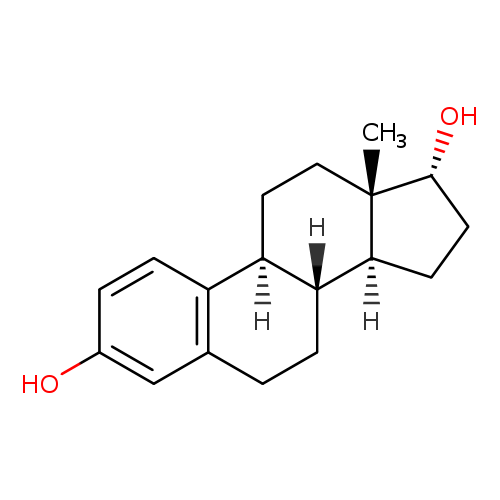
| Common Name | 17a-Estradiol |
|---|
| Description | 17a-Estradiol, also known as alpha-estradiol or estradiol-17alpha, belongs to the class of organic compounds known as estrogens and derivatives. These are steroids with a structure containing a 3-hydroxylated estrane. Thus, 17a-estradiol is considered to be a steroid lipid molecule. 17a-Estradiol exists as a solid, very hydrophobic, practically insoluble (in water), and relatively neutral molecule. 17a-Estradiol is a potentially toxic compound. 17a-Estradiol has been linked to the inborn metabolic disorders including glutaryl-coa dehydrogenase deficiency (gdhd). |
|---|
| Structure | |
|---|
| Synonyms | | Value | Source |
|---|
| Alfatradiol | ChEBI | | alpha-Estradiol | ChEBI | | Estra-1,3,5(10)trien-3,17alpha-diol | ChEBI | | Estradiol-17alpha | ChEBI | | a-Estradiol | Generator | | Α-estradiol | Generator | | Estra-1,3,5(10)trien-3,17a-diol | Generator | | Estra-1,3,5(10)trien-3,17α-diol | Generator | | Estradiol-17a | Generator | | Estradiol-17α | Generator | | 17a-Estradiol | Generator | | 17Α-estradiol | Generator | | 1,3,5-Estratriene-3,17a-diol | HMDB | | 13b-Methyl-1,3,5(10)-gonatriene-3,17a-diol | HMDB | | 17-Epiestradiol | HMDB | | 17a-Oestradiol | HMDB | | 3,17-Dihydroxyestratriene | HMDB | | 3,17a-Dihydroxyestra-1,3,5(10)-triene | HMDB | | 3,17a-Dihydroxyoestra-1,3,5(10)-triene | HMDB | | Epiestradiol | HMDB | | Epiestrol | HMDB | | Estra-1,3,5(10)-triene-3,17a-diol | HMDB | | Oestra-1,3,5(10)-triene-3,17a-diol | HMDB | | 17alpha-Estradiol | KEGG |
|
|---|
| Chemical Formula | C18H24O2 |
|---|
| Average Molecular Weight | 272.382 |
|---|
| Monoisotopic Molecular Weight | 272.177630012 |
|---|
| IUPAC Name | (1S,10R,11S,14R,15S)-15-methyltetracyclo[8.7.0.0^{2,7}.0^{11,15}]heptadeca-2(7),3,5-triene-5,14-diol |
|---|
| Traditional Name | (1S,10R,11S,14R,15S)-15-methyltetracyclo[8.7.0.0^{2,7}.0^{11,15}]heptadeca-2(7),3,5-triene-5,14-diol |
|---|
| CAS Registry Number | 57-91-0 |
|---|
| SMILES | [H][C@@]12CC[C@@H](O)[C@@]1(C)CC[C@]1([H])C3=C(CC[C@@]21[H])C=C(O)C=C3 |
|---|
| InChI Identifier | InChI=1S/C18H24O2/c1-18-9-8-14-13-5-3-12(19)10-11(13)2-4-15(14)16(18)6-7-17(18)20/h3,5,10,14-17,19-20H,2,4,6-9H2,1H3/t14-,15-,16+,17-,18+/m1/s1 |
|---|
| InChI Key | VOXZDWNPVJITMN-SFFUCWETSA-N |
|---|
| Chemical Taxonomy |
|---|
| Description | belongs to the class of organic compounds known as estrogens and derivatives. These are steroids with a structure containing a 3-hydroxylated estrane. |
|---|
| Kingdom | Organic compounds |
|---|
| Super Class | Lipids and lipid-like molecules |
|---|
| Class | Steroids and steroid derivatives |
|---|
| Sub Class | Estrane steroids |
|---|
| Direct Parent | Estrogens and derivatives |
|---|
| Alternative Parents | |
|---|
| Substituents | - Estrogen-skeleton
- 17-hydroxysteroid
- Hydroxysteroid
- 3-hydroxysteroid
- Phenanthrene
- Tetralin
- 1-hydroxy-2-unsubstituted benzenoid
- Benzenoid
- Cyclic alcohol
- Secondary alcohol
- Organic oxygen compound
- Hydrocarbon derivative
- Organooxygen compound
- Alcohol
- Aromatic homopolycyclic compound
|
|---|
| Molecular Framework | Aromatic homopolycyclic compounds |
|---|
| External Descriptors | |
|---|
| Ontology |
|---|
| Status | Detected and Quantified |
|---|
| Origin | |
|---|
| Biofunction | Not Available |
|---|
| Application | Not Available |
|---|
| Cellular locations | - Cell membrane
- Cytoplasm
- Membrane
|
|---|
| Physical Properties |
|---|
| State | Solid |
|---|
| Experimental Properties | | Property | Value | Reference |
|---|
| Melting Point | 216 - 219 °C | Not Available | | Boiling Point | Not Available | Not Available | | Water Solubility | 0.0039 mg/mL | Not Available | | LogP | Not Available | Not Available |
|
|---|
| Predicted Properties | |
|---|
| Spectra |
|---|
| Spectra | |
|---|
| General References | - Courant F, Antignac JP, Maume D, Monteau F, Andre F, Le Bizec B: Determination of naturally occurring oestrogens and androgens in retail samples of milk and eggs. Food Addit Contam. 2007 Dec;24(12):1358-66. doi: 10.1080/02652030701329637. [PubMed:17852390 ]
- Colazo MG, Ambrose DJ, Kastelic JP, Small JA: Comparison of 2 enzyme immunoassays and a radioimmunoassay for measurement of progesterone concentrations in bovine plasma, skim milk, and whole milk. Can J Vet Res. 2008 Jan;72(1):32-6. [PubMed:18214159 ]
- Courant F, Antignac JP, Laille J, Monteau F, Andre F, Le Bizec B: Exposure assessment of prepubertal children to steroid endocrine disruptors. 2. Determination of steroid hormones in milk, egg, and meat samples. J Agric Food Chem. 2008 May 14;56(9):3176-84. doi: 10.1021/jf800096f. Epub 2008 Apr 16. [PubMed:18412364 ]
- Melzer N, Wittenburg D, Hartwig S, Jakubowski S, Kesting U, Willmitzer L, Lisec J, Reinsch N, Repsilber D: Investigating associations between milk metabolite profiles and milk traits of Holstein cows. J Dairy Sci. 2013 Mar;96(3):1521-34. doi: 10.3168/jds.2012-5743. [PubMed:23438684 ]
|
|---|