| Record Information |
|---|
| Version | 1.0 |
|---|
| Creation Date | 2016-09-30 22:27:40 UTC |
|---|
| Update Date | 2020-05-21 16:28:59 UTC |
|---|
| BMDB ID | BMDB0000269 |
|---|
| Secondary Accession Numbers | |
|---|
| Metabolite Identification |
|---|
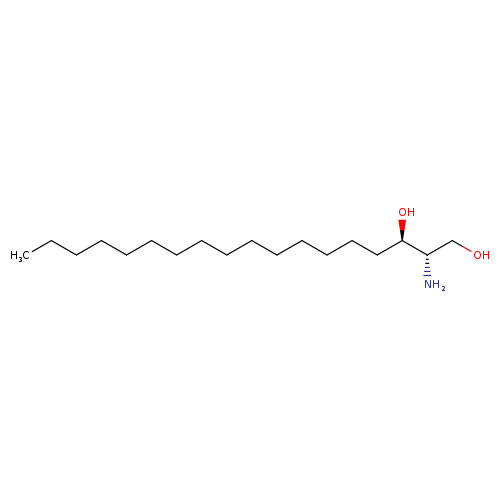
| Common Name | Sphinganine |
|---|
| Description | Sphinganine, also known as D18:0 or safingol, belongs to the class of organic compounds known as 1,2-aminoalcohols. These are organic compounds containing an alkyl chain with an amine group bound to the C1 atom and an alcohol group bound to the C2 atom. Thus, sphinganine is considered to be a sphingoid base lipid molecule. Sphinganine is a very hydrophobic molecule, practically insoluble (in water), and relatively neutral. Sphinganine exists in all living species, ranging from bacteria to humans. |
|---|
| Structure | |
|---|
| Synonyms | | Value | Source |
|---|
| (2S,3R)-2-Amino-1,3-octadecanediol | ChEBI | | (2S,3R)-2-Aminooctadecane-1,3-diol | ChEBI | | (R-(R*,s*))-2-aminooctadecane-1,3-diol | ChEBI | | 2-Amino-1,3-dihydroxyoctadecane | ChEBI | | C18-Dihydrosphingosine | ChEBI | | C18-Sphinganine | ChEBI | | D-Erythro-1,3-dihydroxy-2-aminooctadecane | ChEBI | | D-Erythro-2-amino-1,3-octadecanediol | ChEBI | | D-Erythro-C18-dihydrosphingosine | ChEBI | | D18:0 | ChEBI | | Dihydrosphingosine | ChEBI | | Octadecasphinganine | ChEBI | | Safingol | ChEBI | | Erythro-D-sphinganine | HMDB | | 2-Aminooctadecane-1,3-diol | HMDB | | Threo-dihydrosphingosine | HMDB | | 2-Amino-D-erythro-1,3-octadecanediol | HMDB | | C18-Dihydro-sphingosine | HMDB | | D-Erythro-sphinganine | HMDB | | Dihydro-C18-sphingosine | HMDB | | Erythro-sphinganine | HMDB | | [R-(R*,s*)]-2-amino-1,3-octadecanediol | HMDB | | (2S,3R)-Sphinganine | HMDB | | D-Erythro-dihydrosphingosine | HMDB | | SP(D18:0) | HMDB | | Sphinganine | HMDB |
|
|---|
| Chemical Formula | C18H39NO2 |
|---|
| Average Molecular Weight | 301.5078 |
|---|
| Monoisotopic Molecular Weight | 301.298079497 |
|---|
| IUPAC Name | (2S,3R)-2-aminooctadecane-1,3-diol |
|---|
| Traditional Name | sphinganine |
|---|
| CAS Registry Number | 764-22-7 |
|---|
| SMILES | CCCCCCCCCCCCCCC[C@@H](O)[C@@H](N)CO |
|---|
| InChI Identifier | InChI=1S/C18H39NO2/c1-2-3-4-5-6-7-8-9-10-11-12-13-14-15-18(21)17(19)16-20/h17-18,20-21H,2-16,19H2,1H3/t17-,18+/m0/s1 |
|---|
| InChI Key | OTKJDMGTUTTYMP-ZWKOTPCHSA-N |
|---|
| Chemical Taxonomy |
|---|
| Description | belongs to the class of organic compounds known as 1,2-aminoalcohols. These are organic compounds containing an alkyl chain with an amine group bound to the C1 atom and an alcohol group bound to the C2 atom. |
|---|
| Kingdom | Organic compounds |
|---|
| Super Class | Organic nitrogen compounds |
|---|
| Class | Organonitrogen compounds |
|---|
| Sub Class | Amines |
|---|
| Direct Parent | 1,2-aminoalcohols |
|---|
| Alternative Parents | |
|---|
| Substituents | - Secondary alcohol
- 1,2-aminoalcohol
- Organic oxygen compound
- Organopnictogen compound
- Hydrocarbon derivative
- Primary amine
- Primary alcohol
- Organooxygen compound
- Primary aliphatic amine
- Alcohol
- Aliphatic acyclic compound
|
|---|
| Molecular Framework | Aliphatic acyclic compounds |
|---|
| External Descriptors | |
|---|
| Ontology |
|---|
| Status | Detected but not Quantified |
|---|
| Origin | |
|---|
| Biofunction | Not Available |
|---|
| Application | Not Available |
|---|
| Cellular locations | - Cell membrane
- Cytoplasm
- Endoplasmic reticulum
- Membrane
|
|---|
| Physical Properties |
|---|
| State | Solid |
|---|
| Experimental Properties | | Property | Value | Reference |
|---|
| Melting Point | Not Available | Not Available | | Boiling Point | Not Available | Not Available | | Water Solubility | Not Available | Not Available | | LogP | Not Available | Not Available |
|
|---|
| Predicted Properties | |
|---|
| Spectra |
|---|
| Spectra | |
|---|