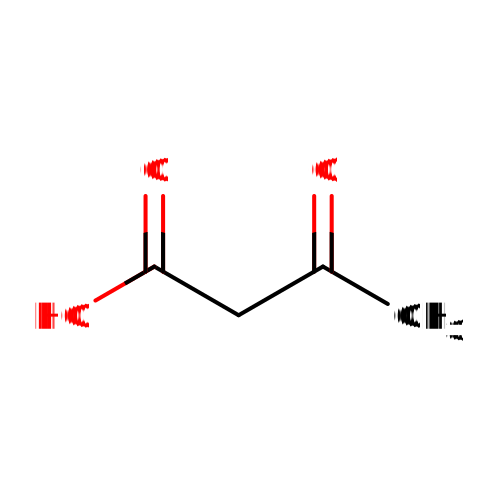
Acetoacetic acid, also known as 3-oxobutyrate or 3-oxobutanoic acid, belongs to the class of organic compounds known as short-chain keto acids and derivatives. These are keto acids with an alkyl chain the contains less than 6 carbon atoms. Acetoacetic acid exists as a solid, very hydrophobic, practically insoluble (in water), and relatively neutral molecule. Acetoacetic acid exists in all living species, ranging from bacteria to humans. Acetoacetic acid is a potentially toxic compound. Acetoacetic acid has been found to be associated with several diseases known as ketoacidosis, irritable bowel syndrome, anoxia, and diabetes mellitus type 2; also acetoacetic acid has been linked to the inborn metabolic disorders including glucose transporter type 1 deficiency syndrome.
belongs to the class of organic compounds known as short-chain keto acids and derivatives. These are keto acids with an alkyl chain the contains less than 6 carbon atoms.
The colostrum metabolites associated with the feeding included fucose, tryptophan, acetic acid and cytidine, whereas those associated with the season included valine, pantothenic acid, isoleucine, caprylic acid, capric acid, lactose, acetoacetic acid, malonic acid, acetylcholine, phosphocholine, creatinine, betaine, aspartic acid and cytidine.
Written in the paper as “acetoacetic acid” and “colostrum”
Despite being established metabolites in mature milk, pantothenic acid, ethanol, butyric acid, acetylcholine, acetoacetic acid, glutamine, aspartic acid, dimethyl sulfone, methanol, galactose, cytidine, tyrosine, uracil, tryptophan and histidine were identified and quantified in cow colostrum for the first time.
Written in the paper as “acetoacetic acid” and “colostrum”
As the supply of NEFA is overloaded, the production of ketone bodies (acetoacetic acid, acetone and b-hydroxybutyrate (BHB)) in the liver increases (Chilliard et al., 2000; Veerkamp et al., 2003; Esposito et al., 2014).
Written in the paper as “acetoacetic acid” and “liver”
This period of negative nutrient balance is characterized by the increased mobilization of body reserves, such as non-esterified fatty acids (NEFA) from adipose tissue, that is metabolized into ketone bodies (i.e., b-hydroxybutyrate [BHB], acetoacetic acid, and acetone) providing an alternative source of energy to peripheral tissues [4].
Written in the paper as “acetoacetic acid” and “peripheral tissues”
The rumen epithelium is the tissue which lines the largest of the four fore stomachs in the ruminant animal -cows and sheep. Rumen epithelial cells are important because they are responsible for the absorption of nutrients from the rumen into the blood.
In the rumen epithelium, butyric acid and acetic acid are metabolized to the ketone bodies acetoacetic acid (AcAc) and b-hydroxybutyric acid (BHB) through ketogenesis (Figure 3) [4,44,45].
Written in the paper as “acetoacetic acid” and “rumen epithelium”
The ruminal microbiome converts cellulose and starch to volatile fatty acids (e.g., acetic acid, propionic acid, and butyric acid), and ruminal epithelial cells metabolize these short-chain fatty acids and generate large amounts of D-b-hydroxybutyric acid, acetoacetic acid, and lactic acid9.
Written in the paper as “acetoacetic acid” and “ruminal epithelial cells”
The concentration of urine acetone and acetoacetic acid was determined semi-quantitatively with commercial urine sticks (Medi-Test Keton, Macherey-Nagel, Hoerdt, France).
Written in the paper as “acetoacetic acid” and “Urine”
This condition is characterized by the increased concentration of ketone bodies such as acetone, acetoacetic acid and b-hydroxybutric acid (bHBA) in blood, milk, urine [66].
Written in the paper as “acetoacetic acid” and “ketosis”
Animals with acetoacetic acid concentrations above 10 mmol/L but without concomitant clinical signs were considered to be subclinically ketotic and were treated orally with 250 mL propylene glycol twice daily, administered by drench gun until ketosis resolved.
Written in the paper as “acetoacetic acid” and “ketosis”
The metabolic pathways related left displacement of the abomasum and the importance of the relevant metabolitesMetabolic pathway log (P)ImpactRelevant metabolitesNameImportanceSynthesis and degradation of ketone bodies1.680.6Acetoacetic acid0.6Linoleic acid metabolism1.681Linoleic acid1Arachidonic acid metabolism1.750.35Arachidonic acid0.33Prostaglandin E20.02Leukotriene D40Histidine metabolism0.820.27L-Histidine0.27Vitamin B6 metabolism3.040.57Pyridoxine0.08Pyridoxal0.49Tyrosine metabolism3.730.16L-Tyrosine0.145Homogentisic acid0.017Gentisic acid0Homovanillic acid0.002Acetoacetic acid0Tryptophan metabolism1.490.26L-Tryptophan0.17Tryptamine0.06L-Kynurenine0.03Valine, leucine and isoleucine biosynthesis2.670.33L-Leucine0334-Methyl-2-oxopentanoate0Citrate cycle2.020.44Citric acid0.294cis-Aconitic acid0.148Phenylalanine, tyrosine and tryptophan biosynthesis1.890.50L-Tyrosine0.5Pyrimidine metabolism0.810.10Cytidine0.01Uracil0.09Arginine and proline metabolism0.620.10Citrulline0.03L-Arginine0.07Butanoate metabolism0.570.10Acetoacetic acid0.10-log (P) is calculated by the enrichment analysis, and Impact is generated by the pathway topology analysis..
Written in the paper as “Acetoacetic acid” and “left displacement of the abomasum”
Compared with healthy postpartum dairy cows, a significantly elevated circulating level of acetoacetic acid was found in postpartum LDA dairy cows, and its involvement in the synthesis and degradation pathways of ketone bodies suggested a higher level of circulating ketone bodies.
Written in the paper as “acetoacetic acid” and “left displacement of the abomasum”
The chemical reactions and pathways resulting in the formation of ketone bodies, any one of the three substances: acetoacetate, D-3-hydroxybutyrate (beta-hydroxybutyrate) or acetone. Biosynthesis involves the formation of hydroxymethylglutaryl-CoA, which is cleaved to acetate and acetyl-CoA.
In the rumen epithelium, butyric acid and acetic acid are metabolized to the ketone bodies acetoacetic acid (AcAc) and b-hydroxybutyric acid (BHB) through ketogenesis (Figure 3) [4,44,45].
Written in the paper as “acetoacetic acid” and “ketogenesis”
As the supply of NEFA is overloaded, the production of ketone bodies (acetoacetic acid, acetone and b-hydroxybutyrate (BHB)) in the liver increases (Chilliard et al., 2000; Veerkamp et al., 2003; Esposito et al., 2014).
Written in the paper as “acetoacetic acid” and “production of ketone bodies”
The S1-M vs. S2-M and S1-M vs. S4-M comparisons showed overlapping pathways of butanoate metabolism and the synthesis and degradation of ketone bodies, which included the differential metabolites (R)-3-hydroxybutanoate and acetoacetic acid.
Written in the paper as “acetoacetic acid” and “butanoate metabolism”
A process that is carried out at the cellular level which results in the assembly, arrangement of constituent parts, or disassembly of a mitochondrion; includes mitochondrial morphogenesis and distribution, and replication of the mitochondrial genome as well as synthesis of new mitochondrial components.
In addition, BMEC treatment with high levels of acetoacetic acid also led to significantly increased ROS levels; an attenuated MMP; decreased expression of PGC-1a, TFAM, and NRF1 mRNA; reduced mtDNA and ATP contents; and disruption of the steady state of mitochondrial biogenesis [69].
Written in the paper as “acetoacetic acid” and “mitochondrial biogenesis”
The S1-M vs. S2-M and S1-M vs. S4-M comparisons showed overlapping pathways of butanoate metabolism and the synthesis and degradation of ketone bodies, which included the differential metabolites (R)-3-hydroxybutanoate and acetoacetic acid.
Written in the paper as “acetoacetic acid” and “synthesis and degradation of ketone bodies”
Involved in
synthesis and degradation pathways of ketone bodies
Compared with healthy postpartum dairy cows, a significantly elevated circulating level of acetoacetic acid was found in postpartum LDA dairy cows, and its involvement in the synthesis and degradation pathways of ketone bodies suggested a higher level of circulating ketone bodies.
Written in the paper as “acetoacetic acid” and “synthesis and degradation pathways of ketone bodies”
The AcAc concentration in the HCS group was significantly (P<0.05) higher and tended (P=0.06) to be higher compared to that of the NCS group during the middle and early lactation stages, respectively (Fig. 2).
Written in the paper as “acetoacetic acid” and “corn silage”
This period of negative nutrient balance is characterized by the increased mobilization of body reserves, such as non-esterified fatty acids (NEFA) from adipose tissue, that is metabolized into ketone bodies (i.e., b-hydroxybutyrate [BHB], acetoacetic acid, and acetone) providing an alternative source of energy to peripheral tissues [4].
Written in the paper as “acetoacetic acid” and “alternative source of energy”
Lopez-Soriano, F. J.; Argiles, J. M. A simple method for the preparation of acetoacetate. Analytical Letters (1985), 18(B5), 589-92.
Material Safety Data Sheet (MSDS)
Not Available
General References
Enjalbert F, Nicot MC, Bayourthe C, Moncoulon R: Ketone bodies in milk and blood of dairy cows: relationship between concentrations and utilization for detection of subclinical ketosis. J Dairy Sci. 2001 Mar;84(3):583-9. doi: 10.3168/jds.S0022-0302(01)74511-0. [PubMed:11286410 ]
Klein MS, Buttchereit N, Miemczyk SP, Immervoll AK, Louis C, Wiedemann S, Junge W, Thaller G, Oefner PJ, Gronwald W: NMR metabolomic analysis of dairy cows reveals milk glycerophosphocholine to phosphocholine ratio as prognostic biomarker for risk of ketosis. J Proteome Res. 2012 Feb 3;11(2):1373-81. doi: 10.1021/pr201017n. Epub 2011 Dec 9. [PubMed:22098372 ]
Lu J, Antunes Fernandes E, Paez Cano AE, Vinitwatanakhun J, Boeren S, van Hooijdonk T, van Knegsel A, Vervoort J, Hettinga KA: Changes in milk proteome and metabolome associated with dry period length, energy balance, and lactation stage in postparturient dairy cows. J Proteome Res. 2013 Jul 5;12(7):3288-96. doi: 10.1021/pr4001306. Epub 2013 Jun 5. [PubMed:23738862 ]
Antunes-Fernandes EC, van Gastelen S, Dijkstra J, Hettinga KA, Vervoort J: Milk metabolome relates enteric methane emission to milk synthesis and energy metabolism pathways. J Dairy Sci. 2016 Aug;99(8):6251-6262. doi: 10.3168/jds.2015-10248. Epub 2016 May 26. [PubMed:27236769 ]
Secondary metabolites biosynthesis, transport and catabolism
Specific function:
Fatty acid synthetase catalyzes the formation of long-chain fatty acids from acetyl-CoA, malonyl-CoA and NADPH. This multifunctional protein has 7 catalytic activities as an acyl carrier protein.
Catalyzes the cofactor-independent reversible oxidation of gamma-hydroxybutyrate (GHB) to succinic semialdehyde (SSA) coupled to reduction of 2-ketoglutarate (2-KG) to D-2-hydroxyglutarate (D-2-HG). L-3-hydroxybutyrate (L-3-OHB) is also a substrate for HOT when using 2-KG as hydrogen acceptor, resulting in the formation of D-2-HG (By similarity).
Dehydrogenase that mediates the formation of 2,5-dihydroxybenzoic acid (2,5-DHBA), a siderophore that shares structural similarities with bacterial enterobactin and associates with LCN2, thereby playing a key role in iron assimilation and homeostasis. Plays a role in susceptibility to bacterial infection by providing an assimilable source of iron that is exploited by pathogenic bacteria (By similarity). Also acts as a 3-hydroxybutyrate dehydrogenase (By similarity).
Mitochondrial 3-hydroxymethyl-3-methylglutaryl-CoA lyase that catalyzes a cation-dependent cleavage of (S)-3-hydroxy-3-methylglutaryl-CoA into acetyl-CoA and acetoacetate, a key step in ketogenesis. Terminal step in leucine catabolism. Ketone bodies (beta-hydroxybutyrate, acetoacetate and acetone) are essential as an alternative source of energy to glucose, as lipid precursors and as regulators of metabolism.
Key enzyme for ketone body catabolism. Transfers the CoA moiety from succinate to acetoacetate. Formation of the enzyme-CoA intermediate proceeds via an unstable anhydride species formed between the carboxylate groups of the enzyme and substrate.