| Record Information |
|---|
| Version | 1.0 |
|---|
| Creation Date | 2020-05-05 15:49:12 UTC |
|---|
| Update Date | 2020-05-05 18:38:57 UTC |
|---|
| BMDB ID | BMDB0109653 |
|---|
| Secondary Accession Numbers | None |
|---|
| Metabolite Identification |
|---|
| Common Name | Carglumic acid |
|---|
| Description | Carglumic acid, also known as carbaglu or carbamylglutamate, belongs to the class of organic compounds known as glutamic acid and derivatives. Glutamic acid and derivatives are compounds containing glutamic acid or a derivative thereof resulting from reaction of glutamic acid at the amino group or the carboxy group, or from the replacement of any hydrogen of glycine by a heteroatom. The daily dose of carglumic acid ranges from 100 to 250 mg/kg and this does are normally adjusted to maintain normal plasma levels of ammonia. Carglumic acid is a drug which is used for the treatment of acute and chronic hyperammonaemia in patients with n-acetylglutamate synthase (nags) deficiency. this enzyme is an important component of the urea cycle to prevent build up of neurotoxic ammonium in the blood. . Carglumic acid is an extremely weak basic (essentially neutral) compound (based on its pKa). Carglumic acid is an orphan drug used for the treatment of hyperammonaemia in patients with N-acetylglutamate synthase deficiency. The likely end product of carglumic acid metabolism is carbon dioxide, eliminated through the lungs. The median Tmax of Carglumic acid was 3 hours (range: 2-4). Carglumic acid is a drug used for the treatment of hyperammonemia in patients with a deficiency in N-acetyl glutamate synthase. A proportion of carglumic acid may be metabolized by the intestinal bacterial flora. |
|---|
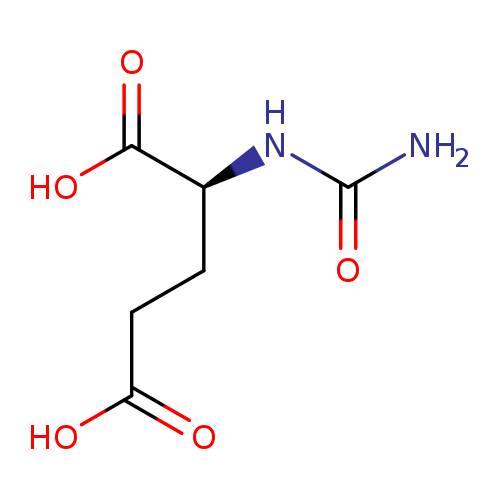
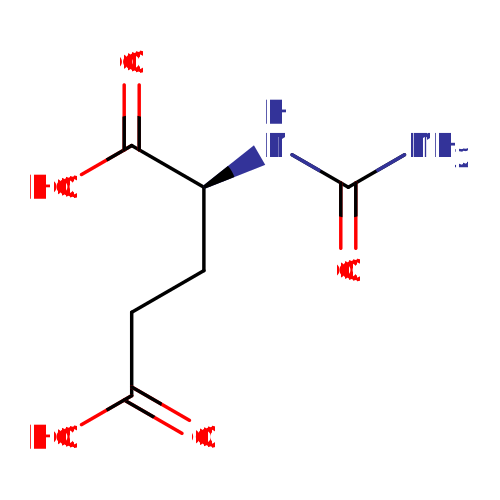
| Structure | |
|---|
| Synonyms | | Value | Source |
|---|
| (2S)-2-(Carbamoylamino)pentanedioic acid | ChEBI | | Acide carglumique | ChEBI | | Acido carglumico | ChEBI | | Acidum carglumicum | ChEBI | | Carbaglu | ChEBI | | Carbamino-L-glutamic acid | ChEBI | | Carbamylglutamic acid | ChEBI | | L-N-Carbamoylglutamic acid | ChEBI | | Ureidoglutaric acid | ChEBI | | (2S)-2-(Carbamoylamino)pentanedioate | Generator | | Carbamino-L-glutamate | Generator | | Carbamylglutamate | Generator | | L-N-Carbamoylglutamate | Generator | | Ureidoglutarate | Generator | | Carglumate | Generator | | (S)-2-Ureidopentanedioic acid | HMDB | | N-Carbamoyl-L-glutamic acid | HMDB | | N-Carbamyl-L-glutamate | HMDB | | N-Carbamylglutamate | HMDB | | N-Carbamoyl-L-glutamate | HMDB | | N-Carbamoylglutamate | HMDB |
|
|---|
| Chemical Formula | C6H10N2O5 |
|---|
| Average Molecular Weight | 190.154 |
|---|
| Monoisotopic Molecular Weight | 190.05897144 |
|---|
| IUPAC Name | (2S)-2-(carbamoylamino)pentanedioic acid |
|---|
| Traditional Name | carglumic acid |
|---|
| CAS Registry Number | Not Available |
|---|
| SMILES | NC(=O)N[C@@H](CCC(O)=O)C(O)=O |
|---|
| InChI Identifier | InChI=1S/C6H10N2O5/c7-6(13)8-3(5(11)12)1-2-4(9)10/h3H,1-2H2,(H,9,10)(H,11,12)(H3,7,8,13)/t3-/m0/s1 |
|---|
| InChI Key | LCQLHJZYVOQKHU-VKHMYHEASA-N |
|---|
| Chemical Taxonomy |
|---|
| Description | belongs to the class of organic compounds known as glutamic acid and derivatives. Glutamic acid and derivatives are compounds containing glutamic acid or a derivative thereof resulting from reaction of glutamic acid at the amino group or the carboxy group, or from the replacement of any hydrogen of glycine by a heteroatom. |
|---|
| Kingdom | Organic compounds |
|---|
| Super Class | Organic acids and derivatives |
|---|
| Class | Carboxylic acids and derivatives |
|---|
| Sub Class | Amino acids, peptides, and analogues |
|---|
| Direct Parent | Glutamic acid and derivatives |
|---|
| Alternative Parents | |
|---|
| Substituents | - Glutamic acid or derivatives
- Dicarboxylic acid or derivatives
- Fatty acid
- Isourea
- Carboximidamide
- Carboxylic acid
- Carboximidic acid derivative
- Organic oxide
- Organic nitrogen compound
- Hydrocarbon derivative
- Carbonyl group
- Organooxygen compound
- Organonitrogen compound
- Imine
- Organopnictogen compound
- Organic oxygen compound
- Aliphatic acyclic compound
|
|---|
| Molecular Framework | Aliphatic acyclic compounds |
|---|
| External Descriptors | |
|---|
| Ontology |
|---|
| Status | Detected but not Quantified |
|---|
| Origin | Not Available |
|---|
| Biofunction | Not Available |
|---|
| Application | Not Available |
|---|
| Cellular locations | Not Available |
|---|
| Physical Properties |
|---|
| State | Not Available |
|---|
| Experimental Properties | | Property | Value | Reference |
|---|
| Melting Point | Not Available | Not Available | | Boiling Point | Not Available | Not Available | | Water Solubility | Not Available | Not Available | | LogP | Not Available | Not Available |
|
|---|
| Predicted Properties | |
|---|
| Spectra |
|---|
| Spectra | |
|---|