| Record Information |
|---|
| Version | 1.0 |
|---|
| Creation Date | 2020-03-10 17:03:23 UTC |
|---|
| Update Date | 2020-04-22 18:56:54 UTC |
|---|
| BMDB ID | BMDB0096233 |
|---|
| Secondary Accession Numbers | |
|---|
| Metabolite Identification |
|---|
| Common Name | alpha-CEHC glucuronide |
|---|
| Description | alpha-CEHC glucuronide, also known as α-cehc glucuronide, belongs to the class of organic compounds known as phenolic glycosides. These are organic compounds containing a phenolic structure attached to a glycosyl moiety. Some examples of phenolic structures include lignans, and flavonoids. Among the sugar units found in natural glycosides are D-glucose, L-Fructose, and L rhamnose. Based on a literature review a significant number of articles have been published on alpha-CEHC glucuronide. |
|---|
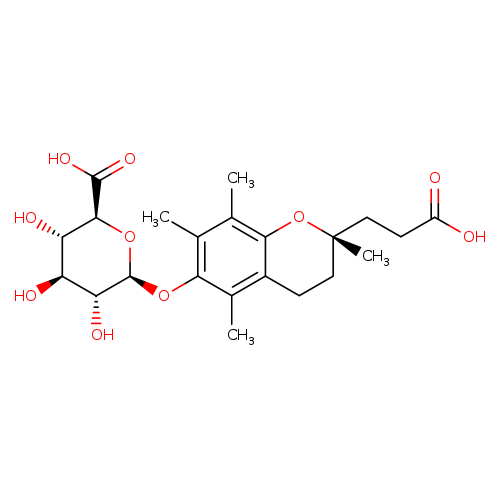
| Structure | |
|---|
| Synonyms | | Value | Source |
|---|
| a-CEHC glucuronide | Generator | | Α-cehc glucuronide | Generator | | α-Carboxyethyl hydrochroman glucuronide | HMDB | | alpha-Carboxyethyl hydrochroman glucuronide | HMDB |
|
|---|
| Chemical Formula | C22H30O10 |
|---|
| Average Molecular Weight | 454.472 |
|---|
| Monoisotopic Molecular Weight | 454.183897166 |
|---|
| IUPAC Name | (2S,3S,4S,5R,6S)-6-{[(2S)-2-(2-carboxyethyl)-2,5,7,8-tetramethyl-3,4-dihydro-2H-1-benzopyran-6-yl]oxy}-3,4,5-trihydroxyoxane-2-carboxylic acid |
|---|
| Traditional Name | (2S,3S,4S,5R,6S)-6-{[(2S)-2-(2-carboxyethyl)-2,5,7,8-tetramethyl-3,4-dihydro-1-benzopyran-6-yl]oxy}-3,4,5-trihydroxyoxane-2-carboxylic acid |
|---|
| CAS Registry Number | Not Available |
|---|
| SMILES | CC1=C(O[C@@H]2O[C@@H]([C@@H](O)[C@H](O)[C@H]2O)C(O)=O)C(C)=C2CC[C@@](C)(CCC(O)=O)OC2=C1C |
|---|
| InChI Identifier | InChI=1S/C22H30O10/c1-9-10(2)18-12(5-7-22(4,32-18)8-6-13(23)24)11(3)17(9)30-21-16(27)14(25)15(26)19(31-21)20(28)29/h14-16,19,21,25-27H,5-8H2,1-4H3,(H,23,24)(H,28,29)/t14-,15-,16+,19-,21+,22-/m0/s1 |
|---|
| InChI Key | MWDYOFPRWKTECC-XOIOWARXSA-N |
|---|
| Chemical Taxonomy |
|---|
| Description | belongs to the class of organic compounds known as phenolic glycosides. These are organic compounds containing a phenolic structure attached to a glycosyl moiety. Some examples of phenolic structures include lignans, and flavonoids. Among the sugar units found in natural glycosides are D-glucose, L-Fructose, and L rhamnose. |
|---|
| Kingdom | Organic compounds |
|---|
| Super Class | Organic oxygen compounds |
|---|
| Class | Organooxygen compounds |
|---|
| Sub Class | Carbohydrates and carbohydrate conjugates |
|---|
| Direct Parent | Phenolic glycosides |
|---|
| Alternative Parents | |
|---|
| Substituents | - Phenolic glycoside
- O-glucuronide
- 1-o-glucuronide
- Glucuronic acid or derivatives
- Hexose monosaccharide
- O-glycosyl compound
- 1-benzopyran
- Benzopyran
- Chromane
- Beta-hydroxy acid
- Alkyl aryl ether
- Benzenoid
- Pyran
- Oxane
- Monosaccharide
- Hydroxy acid
- Dicarboxylic acid or derivatives
- Secondary alcohol
- Oxacycle
- Organoheterocyclic compound
- Polyol
- Ether
- Carboxylic acid
- Carboxylic acid derivative
- Acetal
- Organic oxide
- Hydrocarbon derivative
- Carbonyl group
- Alcohol
- Aromatic heteropolycyclic compound
|
|---|
| Molecular Framework | Aromatic heteropolycyclic compounds |
|---|
| External Descriptors | Not Available |
|---|
| Ontology |
|---|
| Status | Expected but not Quantified |
|---|
| Origin | |
|---|
| Biofunction | Not Available |
|---|
| Application | Not Available |
|---|
| Cellular locations | Not Available |
|---|
| Physical Properties |
|---|
| State | Not Available |
|---|
| Experimental Properties | | Property | Value | Reference |
|---|
| Melting Point | Not Available | Not Available | | Boiling Point | Not Available | Not Available | | Water Solubility | Not Available | Not Available | | LogP | Not Available | Not Available |
|
|---|
| Predicted Properties | |
|---|
| Spectra |
|---|
| Spectra | |
|---|