| Record Information |
|---|
| Version | 1.0 |
|---|
| Creation Date | 2020-03-10 17:00:47 UTC |
|---|
| Update Date | 2020-04-22 18:55:54 UTC |
|---|
| BMDB ID | BMDB0096075 |
|---|
| Secondary Accession Numbers | |
|---|
| Metabolite Identification |
|---|
| Common Name | 1,4-Dithiothreitol |
|---|
| Description | 1,4-Dithiothreitol, also known as L-DTT, belongs to the class of organic compounds known as 1,2-diols. These are polyols containing an alcohol group at two adjacent positions. 1,4-Dithiothreitol exists in all living organisms, ranging from bacteria to humans. In cattle, 1,4-dithiothreitol is involved in the metabolic pathway called the vitamin k metabolism pathway. Based on a literature review a significant number of articles have been published on 1,4-Dithiothreitol. |
|---|
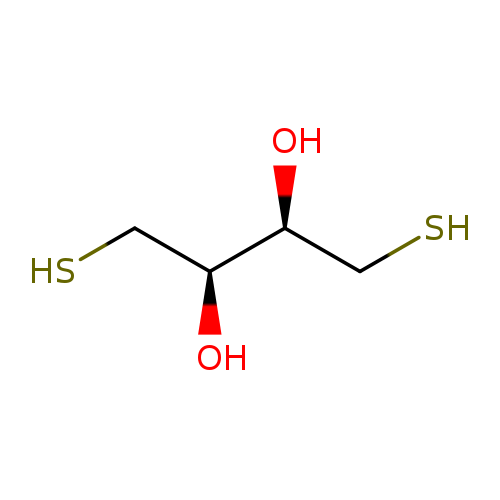
| Structure | |
|---|
| Synonyms | | Value | Source |
|---|
| (2R,3R)-1,4-Dimercaptobutane-2,3-diol | ChEBI | | 2,3-DIHYDROXY-1,4-dithiobutane | ChEBI | | DL-Threo-1,4-dimercapto-2,3-butanediol | ChEBI | | L-Dithiothreitol | ChEBI | | L-DTT | ChEBI | | L-Threo-1,4-dimercapto-2,3-butanediol | ChEBI | | Threo-1,4-dimercapto-2,3-butanediol | ChEBI | | Dithiothreitol | MeSH, HMDB | | Sputolysin | MeSH, HMDB | | Clelands reagent | MeSH, HMDB | | Cleland reagent | MeSH, HMDB | | Cleland's reagent | MeSH, HMDB | | Reagent, cleland | MeSH, HMDB | | Reagent, cleland's | MeSH, HMDB |
|
|---|
| Chemical Formula | C4H10O2S2 |
|---|
| Average Molecular Weight | 154.251 |
|---|
| Monoisotopic Molecular Weight | 154.012220944 |
|---|
| IUPAC Name | (2R,3R)-1,4-disulfanylbutane-2,3-diol |
|---|
| Traditional Name | L-dithiothreitol |
|---|
| CAS Registry Number | Not Available |
|---|
| SMILES | O[C@@H](CS)[C@@H](O)CS |
|---|
| InChI Identifier | InChI=1S/C4H10O2S2/c5-3(1-7)4(6)2-8/h3-8H,1-2H2/t3-,4-/m0/s1 |
|---|
| InChI Key | VHJLVAABSRFDPM-IMJSIDKUSA-N |
|---|
| Chemical Taxonomy |
|---|
| Description | belongs to the class of organic compounds known as 1,2-diols. These are polyols containing an alcohol group at two adjacent positions. |
|---|
| Kingdom | Organic compounds |
|---|
| Super Class | Organic oxygen compounds |
|---|
| Class | Organooxygen compounds |
|---|
| Sub Class | Alcohols and polyols |
|---|
| Direct Parent | 1,2-diols |
|---|
| Alternative Parents | |
|---|
| Substituents | - Secondary alcohol
- 1,2-diol
- Alkylthiol
- Hydrocarbon derivative
- Organosulfur compound
- Aliphatic acyclic compound
|
|---|
| Molecular Framework | Aliphatic acyclic compounds |
|---|
| External Descriptors | |
|---|
| Ontology |
|---|
| Status | Expected but not Quantified |
|---|
| Origin | |
|---|
| Biofunction | Not Available |
|---|
| Application | Not Available |
|---|
| Cellular locations | Not Available |
|---|
| Physical Properties |
|---|
| State | Not Available |
|---|
| Experimental Properties | | Property | Value | Reference |
|---|
| Melting Point | Not Available | Not Available | | Boiling Point | Not Available | Not Available | | Water Solubility | Not Available | Not Available | | LogP | Not Available | Not Available |
|
|---|
| Predicted Properties | |
|---|
| Spectra |
|---|
| Spectra | |
|---|