| Record Information |
|---|
| Version | 1.0 |
|---|
| Creation Date | 2020-03-03 19:27:53 UTC |
|---|
| Update Date | 2020-04-22 15:55:41 UTC |
|---|
| BMDB ID | BMDB0063879 |
|---|
| Secondary Accession Numbers | |
|---|
| Metabolite Identification |
|---|
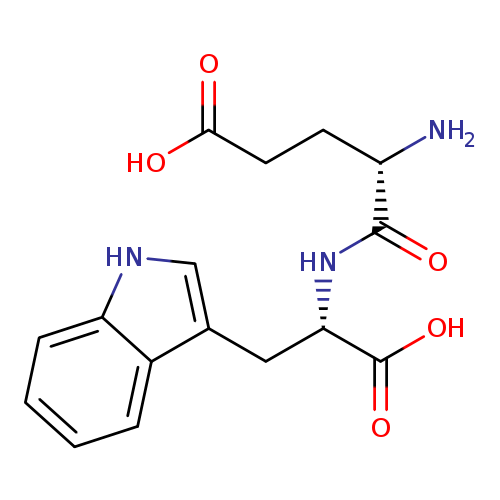
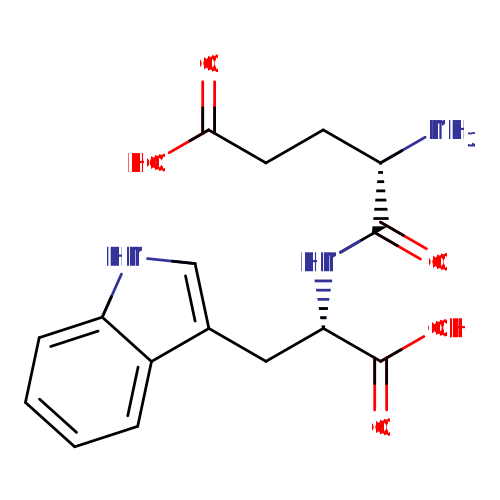
| Common Name | Glutamyltryptophan |
|---|
| Description | Glutamyltryptophan, also known as alpha-glu-TRP or e-W dipeptide, belongs to the class of organic compounds known as peptides. Peptides are compounds containing an amide derived from two or more amino carboxylic acid molecules (the same or different) by formation of a covalent bond from the carbonyl carbon of one to the nitrogen atom of another. Based on a literature review a significant number of articles have been published on Glutamyltryptophan. |
|---|
| Structure | |
|---|
| Synonyms | | Value | Source |
|---|
| alpha-Glu-TRP | ChEBI | | alpha-Glutamyltryptophan | ChEBI | | L-alpha-Glu-L-TRP | ChEBI | | L-Glu-L-TRP | ChEBI | | Oglufanide | ChEBI | | a-Glu-TRP | Generator | | Α-glu-TRP | Generator | | a-Glutamyltryptophan | Generator | | Α-glutamyltryptophan | Generator | | L-a-Glu-L-TRP | Generator | | L-Α-glu-L-TRP | Generator | | Glu-TRP | HMDB | | L-alpha-Glutamyl-L-tryptophan | HMDB | | Α-L-glu-L-TRP | HMDB | | Α-L-glutamyl-L-tryptophan | HMDB | | L-Α-glutamyl-L-tryptophan | HMDB | | N-Α-glutamyltryptophan | HMDB | | N-Α-L-glutamyl-L-tryptophan | HMDB | | N-L-Α-glutamyltryptophan | HMDB | | N-L-Α-glutamyl-L-tryptophan | HMDB | | alpha-L-Glu-L-TRP | HMDB | | alpha-L-Glutamyl-L-tryptophan | HMDB | | N-alpha-Glutamyltryptophan | HMDB | | N-alpha-L-Glutamyl-L-tryptophan | HMDB | | N-L-alpha-Glutamyltryptophan | HMDB | | N-L-alpha-Glutamyl-L-tryptophan | HMDB | | IM 862 | HMDB | | NSC 334073 | HMDB | | Thymogen | HMDB | | Timogen | HMDB | | L-Glutamyl-L-tryptophan | HMDB | | N-Glutamyltryptophan | HMDB | | N-L-Glutamyl-L-tryptophan | HMDB | | Glutamyl-tryptophan | HMDB | | Glutamic acid tryptophan dipeptide | HMDB | | Glutamate tryptophan dipeptide | HMDB | | Glutamic acid-tryptophan dipeptide | HMDB | | Glutamate-tryptophan dipeptide | HMDB | | e-W Dipeptide | HMDB | | EW dipeptide | HMDB | | Glutamyltryptophan | HMDB, ChEBI |
|
|---|
| Chemical Formula | C16H19N3O5 |
|---|
| Average Molecular Weight | 333.344 |
|---|
| Monoisotopic Molecular Weight | 333.132470724 |
|---|
| IUPAC Name | (4S)-4-amino-4-{[(1S)-1-carboxy-2-(1H-indol-3-yl)ethyl]carbamoyl}butanoic acid |
|---|
| Traditional Name | (4S)-4-amino-4-{[(1S)-1-carboxy-2-(1H-indol-3-yl)ethyl]carbamoyl}butanoic acid |
|---|
| CAS Registry Number | Not Available |
|---|
| SMILES | N[C@@H](CCC(O)=O)C(=O)N[C@@H](CC1=CNC2=CC=CC=C12)C(O)=O |
|---|
| InChI Identifier | InChI=1S/C16H19N3O5/c17-11(5-6-14(20)21)15(22)19-13(16(23)24)7-9-8-18-12-4-2-1-3-10(9)12/h1-4,8,11,13,18H,5-7,17H2,(H,19,22)(H,20,21)(H,23,24)/t11-,13-/m0/s1 |
|---|
| InChI Key | LLEUXCDZPQOJMY-AAEUAGOBSA-N |
|---|
| Chemical Taxonomy |
|---|
| Description | belongs to the class of organic compounds known as peptides. Peptides are compounds containing an amide derived from two or more amino carboxylic acid molecules (the same or different) by formation of a covalent bond from the carbonyl carbon of one to the nitrogen atom of another. |
|---|
| Kingdom | Organic compounds |
|---|
| Super Class | Organic acids and derivatives |
|---|
| Class | Carboxylic acids and derivatives |
|---|
| Sub Class | Amino acids, peptides, and analogues |
|---|
| Direct Parent | Peptides |
|---|
| Alternative Parents | |
|---|
| Substituents | - Alpha peptide
- N-acyl-alpha-amino acid
- N-acyl-alpha amino acid or derivatives
- Gamma amino acid or derivatives
- Alpha-amino acid or derivatives
- 3-alkylindole
- Indole
- Indole or derivatives
- Amino fatty acid
- Dicarboxylic acid or derivatives
- Substituted pyrrole
- Fatty acyl
- Benzenoid
- Pyrrole
- Heteroaromatic compound
- Amino acid or derivatives
- Amino acid
- Organoheterocyclic compound
- Organic 1,3-dipolar compound
- Azacycle
- Propargyl-type 1,3-dipolar organic compound
- Carboximidic acid
- Carboximidic acid derivative
- Carboxylic acid
- Amine
- Organic oxide
- Organopnictogen compound
- Organic nitrogen compound
- Primary aliphatic amine
- Hydrocarbon derivative
- Organonitrogen compound
- Carbonyl group
- Organic oxygen compound
- Organooxygen compound
- Primary amine
- Aromatic heteropolycyclic compound
|
|---|
| Molecular Framework | Aromatic heteropolycyclic compounds |
|---|
| External Descriptors | |
|---|
| Ontology |
|---|
| Status | Expected but not Quantified |
|---|
| Origin | |
|---|
| Biofunction | Not Available |
|---|
| Application | Not Available |
|---|
| Cellular locations | Not Available |
|---|
| Physical Properties |
|---|
| State | Not Available |
|---|
| Experimental Properties | | Property | Value | Reference |
|---|
| Melting Point | Not Available | Not Available | | Boiling Point | Not Available | Not Available | | Water Solubility | Not Available | Not Available | | LogP | Not Available | Not Available |
|
|---|
| Predicted Properties | |
|---|
| Spectra |
|---|
| Spectra | |
|---|