Record Information
Version1.0
Creation Date2018-06-25 21:45:58 UTC
Update Date2020-05-05 18:40:37 UTC
BMDB IDBMDB0062039
Secondary Accession Numbers
  • BMDB62039
Metabolite Identification
Common Name2,4-Diaminobutyric acid
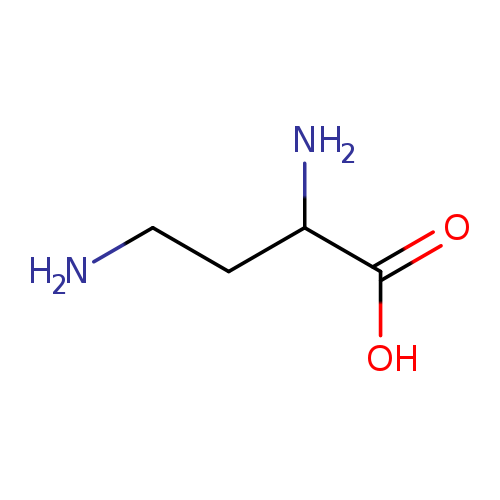
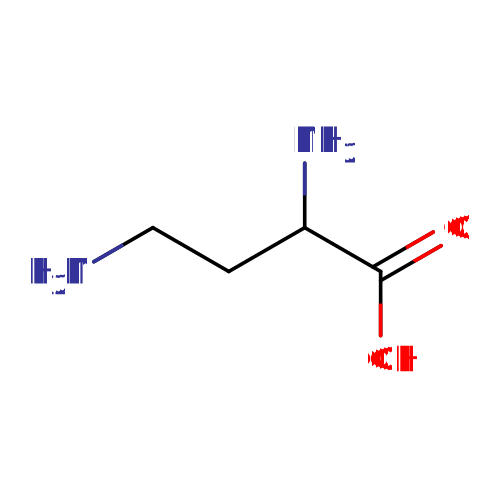
Description2,4-Diaminobutyric acid, also known as 2,4-diaminobutanoate or Dbu, belongs to the class of organic compounds known as alpha amino acids. These are amino acids in which the amino group is attached to the carbon atom immediately adjacent to the carboxylate group (alpha carbon). 2,4-Diaminobutyric acid is a very hydrophobic molecule, practically insoluble (in water), and relatively neutral. 2,4-Diaminobutyric acid exists in all living organisms, ranging from bacteria to humans.
Structure
Thumb
Synonyms
ValueSource
2,4-Diaminobutanoic acidChEBI
alpha,gamma-Diaminobutanoic acidChEBI
alpha,gamma-Diaminobutyric acidChEBI
DbuChEBI
2,4-DiaminobutanoateGenerator
a,g-DiaminobutanoateGenerator
a,g-Diaminobutanoic acidGenerator
alpha,gamma-DiaminobutanoateGenerator
Α,γ-diaminobutanoateGenerator
Α,γ-diaminobutanoic acidGenerator
a,g-DiaminobutyrateGenerator
a,g-Diaminobutyric acidGenerator
alpha,gamma-DiaminobutyrateGenerator
Α,γ-diaminobutyrateGenerator
Α,γ-diaminobutyric acidGenerator
2,4-DiaminobutyrateGenerator
(RS)-2,4-Diaminobutyric acidHMDB
2,4-diamino-ButanoateHMDB
2,4-diamino-Butanoic acidHMDB
2,4-diamino-Butyric acidHMDB
2,4-diamino-N-Butyric acidHMDB
DL-2,4-diamino-N-Butyric acidHMDB
DL-2,4-DiaminobutanoateHMDB
DL-2,4-Diaminobutanoic acidHMDB
DL-2,4-Diaminobutyric acidHMDB
DL-alpha,gamma-Diaminobutyric acidHMDB
2,4-Diaminobutyric acid dihydrochloride, (+-)-isomerMeSH, HMDB
2,4-Diaminobutyric acid monohydrochloride, (S)-isomerMeSH, HMDB
2,4-Diaminobutyric acid, (+)-isomerMeSH, HMDB
2,4-Diaminobutyric acid, (+-)-isomerMeSH, HMDB
2,4-Diaminobutyric acid, (R)-isomerMeSH, HMDB
2,4-Diaminobutyric acid, (S)-isomerMeSH, HMDB
L-2,4-Diaminobutyric acidMeSH, HMDB
2,4-Diaminobutyric acid dihydrochloride, (S)-isomerMeSH, HMDB
2,4-Diaminobutyric acid monohydrochloride, (+-)-isomerMeSH, HMDB
2,4-Diamino-butyrateGenerator, HMDB
2,4-Diaminobutyric acidMeSH
Chemical FormulaC4H10N2O2
Average Molecular Weight118.1344
Monoisotopic Molecular Weight118.074227574
IUPAC Name2,4-diaminobutanoic acid
Traditional Name2,4-diaminobutanoic acid
CAS Registry Number305-62-4
SMILES
NCCC(N)C(O)=O
InChI Identifier
InChI=1S/C4H10N2O2/c5-2-1-3(6)4(7)8/h3H,1-2,5-6H2,(H,7,8)
InChI KeyOGNSCSPNOLGXSM-UHFFFAOYSA-N
Chemical Taxonomy
Description belongs to the class of organic compounds known as alpha amino acids. These are amino acids in which the amino group is attached to the carbon atom immediately adjacent to the carboxylate group (alpha carbon).
KingdomOrganic compounds
Super ClassOrganic acids and derivatives
ClassCarboxylic acids and derivatives
Sub ClassAmino acids, peptides, and analogues
Direct ParentAlpha amino acids
Alternative Parents
Substituents
  • Alpha-amino acid
  • Amino fatty acid
  • Fatty acid
  • Fatty acyl
  • Amino acid
  • Carboxylic acid
  • Monocarboxylic acid or derivatives
  • Organic nitrogen compound
  • Hydrocarbon derivative
  • Primary amine
  • Organooxygen compound
  • Organonitrogen compound
  • Organic oxide
  • Primary aliphatic amine
  • Organopnictogen compound
  • Carbonyl group
  • Organic oxygen compound
  • Amine
  • Aliphatic acyclic compound
Molecular FrameworkAliphatic acyclic compounds
External Descriptors
Ontology
StatusDetected but not Quantified
Origin
  • Exogenous
BiofunctionNot Available
ApplicationNot Available
Cellular locations
  • Cytoplasm
Physical Properties
StateSolid
Experimental Properties
PropertyValueReference
Melting PointNot AvailableNot Available
Boiling PointNot AvailableNot Available
Water SolubilityNot AvailableNot Available
LogP-4.64HANSCH,C ET AL. (1995)
Predicted Properties
PropertyValueSource
logP-3.7ALOGPS
logP-4ChemAxon
logS0.36ALOGPS
pKa (Strongest Acidic)2.55ChemAxon
pKa (Strongest Basic)9.95ChemAxon
Physiological Charge1ChemAxon
Hydrogen Acceptor Count4ChemAxon
Hydrogen Donor Count3ChemAxon
Polar Surface Area89.34 ŲChemAxon
Rotatable Bond Count3ChemAxon
Refractivity28.56 m³·mol⁻¹ChemAxon
Polarizability11.79 ųChemAxon
Number of Rings0ChemAxon
BioavailabilityYesChemAxon
Rule of FiveYesChemAxon
Ghose FilterYesChemAxon
Veber's RuleYesChemAxon
MDDR-like RuleYesChemAxon
Spectra
Spectra
Biological Properties
Cellular Locations
  • Cytoplasm
Biospecimen Locations
  • Liver
  • Mammary Gland
  • Milk
Pathways
Normal Concentrations
BiospecimenStatusValueAgeSexConditionReferenceDetails
LiverDetected but not QuantifiedNot QuantifiedNot SpecifiedNot Specified
Normal
details
LiverDetected but not QuantifiedNot QuantifiedNot SpecifiedNot Specified
Normal
details
Mammary GlandDetected but not QuantifiedNot QuantifiedNot SpecifiedNot Specified
Normal
details
Mammary GlandDetected but not QuantifiedNot QuantifiedNot SpecifiedNot Specified
Normal
details
MilkDetected but not QuantifiedNot QuantifiedNot SpecifiedNot Specified
Normal
details
MilkDetected but not QuantifiedNot QuantifiedNot SpecifiedNot Specified
Normal
details
MilkDetected but not QuantifiedNot QuantifiedNot SpecifiedNot SpecifiedNormal details
Abnormal Concentrations
Not Available
HMDB IDHMDB0002362
DrugBank IDNot Available
Phenol Explorer Compound IDNot Available
FooDB IDFDB022978
KNApSAcK IDC00034868
Chemspider ID457
KEGG Compound IDNot Available
BioCyc IDNot Available
BiGG IDNot Available
Wikipedia LinkNot Available
METLIN IDNot Available
PubChem Compound470
PDB IDNot Available
ChEBI ID64307
References
Synthesis ReferenceTalbot, Guy; Gaudry, Roger; Berlinguet, Louis. Synthesis of 4-aminobutyric acid and 2,4-diaminobutyric acid from butyrolactone. Canadian Journal of Chemistry (1958), 36 593-6.
Material Safety Data Sheet (MSDS)Not Available
General References
  1. Melzer N, Wittenburg D, Hartwig S, Jakubowski S, Kesting U, Willmitzer L, Lisec J, Reinsch N, Repsilber D: Investigating associations between milk metabolite profiles and milk traits of Holstein cows. J Dairy Sci. 2013 Mar;96(3):1521-34. doi: 10.3168/jds.2012-5743. [PubMed:23438684 ]
  2. Mung D, Li L: Development of Chemical Isotope Labeling LC-MS for Milk Metabolomics: Comprehensive and Quantitative Profiling of the Amine/Phenol Submetabolome. Anal Chem. 2017 Apr 18;89(8):4435-4443. doi: 10.1021/acs.analchem.6b03737. Epub 2017 Mar 28. [PubMed:28306241 ]
  3. Sun HZ, Shi K, Wu XH, Xue MY, Wei ZH, Liu JX, Liu HY: Lactation-related metabolic mechanism investigated based on mammary gland metabolomics and 4 biofluids' metabolomics relationships in dairy cows. BMC Genomics. 2017 Dec 2;18(1):936. doi: 10.1186/s12864-017-4314-1. [PubMed:29197344 ]