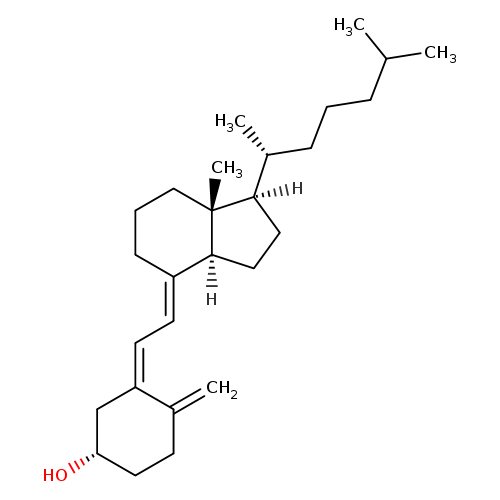
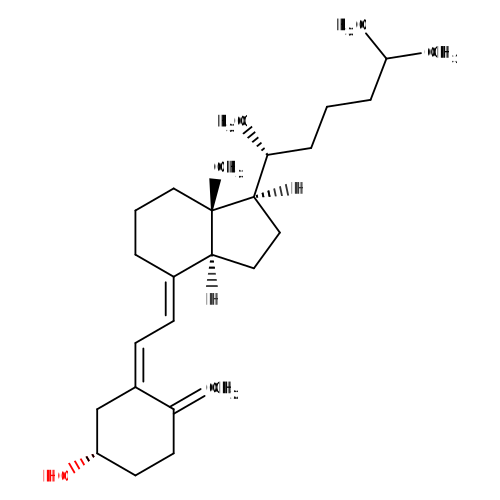
Vitamin D3, also known as cholecalciferol or Delta-D, belongs to the class of organic compounds known as vitamin d and derivatives. Vitamin D and derivatives are compounds containing a secosteroid backbone, usually secoergostane or secocholestane. Thus, vitamin D3 is considered to be a secosteroid lipid molecule. Vitamin D3 is a very hydrophobic molecule, practically insoluble (in water), and relatively neutral. Vitamin D3 is a potentially toxic compound.
belongs to the class of organic compounds known as vitamin d and derivatives. Vitamin D and derivatives are compounds containing a secosteroid backbone, usually secoergostane or secocholestane.
In relation to human nutrition, milk and dairy products are one of the main sources of high-quality protein; vitamins A, D3, B1, B2, B6, and B12; and other micronutrients such as calcium, phosphorus, selenium, and potassium [3,4].
Lower quantities of vitamin D3 and its metabolite, 25-hydroxyvitamin D3, are found in meat, eggs [15,16] and other foods of animal origin, including milk and dairy products.
Cow milk and its products are considered a valuable source of vitamins in the human diet, such as retinol (vitamin A), vitamin D3 (cholecalciferol), tocopherol (vitamin E), vitamin K2 (menaquinone), and b-carotene (provitamin A) [2,4,5,147,148,149,150].
In relation to nursing infants, cow s milk contains similar concentrations of vitamin D3 and 1,25 (OH) vitamin D3 (the active form of vitamin D3) compared to breast milk and can cause the same desired effect [40].
Milk is not only a rich source of calcium and vitamin D3 but also contains different minerals and proteins, such as lactoferrin and whey proteins that are involved in bone remodeling processes [142,143,144,145].
Written in the paper as “vitamin D3” and “milk”
Produced byTaken up by
Skin
Any portion of the organ that covers that body and consists of a layer of epidermis and a layer of dermis.
Vitamin D3 (cholecalciferol) is produced in the epidermis of the skin upon exposure to ultraviolet radiation (sunlight) and can also be obtained through dietary intake, whereas vitamin D2 (ergocalciferol) is obtained almost exclusively through supplementation.
Cattle naturally rely on endogenous synthesis of vitamin D3 in their skin for acquisition of vitamin D [7,8], however, cattle in regions such as North America or Europe often do not receive adequate sun exposure to maintain serum 25(OH)D3 concentrations >20 ng/mL [9].
Overall, cattle naturally acquire vitamin D as vitamin D2 (from plant-associated fungi) or as vitamin D3 (synthesized endogenously in sun-exposed skin from 7-dehydrocholesterol).
Animal derived vitamin D3 originates from 7-dehydrocholesterol and can be absorbed through the diet or converted in the skin through exposure to ultraviolet rays from sunlight.
Even though they all remained above physiological plasma levels (1,25D: 0.05-0.12 nM; 25D: 20 90 nM; D: 4 nM, Tiraboschi et al., 2023), substantially supraphysiological concentrations posing a risk of hypercalcemia were avoided.
Vitamin D3 (cholecalciferol) is produced in the epidermis of the skin upon exposure to ultraviolet radiation (sunlight) and can also be obtained through dietary intake, whereas vitamin D2 (ergocalciferol) is obtained almost exclusively through supplementation.
Written in the paper as “vitamin D3” and “epidermis”
Importantly, dietary nutrients, such as vitamin D3 and Ca can modulate the immune response under similar scenarios of leaky gut induction in rodents [14], while others such as vitamin E and Se were shown to improve the integrity of the gut lining while reduce oxidative stress under heat stress [15].
Written in the paper as “vitamin D3” and “immune response”
In the case of animals spending time at pasture, ultraviolet (UV) rays from sunlight induce the synthesis of vitamin D3 from 7-dehydrosterol present in the skin.
Written in the paper as “Vitamin D3” and “synthesis of vitamin D3”
Cattle naturally rely on endogenous synthesis of vitamin D3 in their skin for acquisition of vitamin D [7,8], however, cattle in regions such as North America or Europe often do not receive adequate sun exposure to maintain serum 25(OH)D3 concentrations >20 ng/mL [9].
Written in the paper as “vitamin D3” and “endogenous synthesis of vitamin D3”
Dietary supplements like fatty acids and cholecalciferol regulate adhesion gene expression as well as bacteria internalization in non-professional phagocytic cells.
Written in the paper as “cholecalciferol” and “adhesion gene expression”
Both vitamin D2 and vitamin D3 undergo bioactivation, starting with hydroxylation in the liver to 25-hydroxyvitamin D2 [25 (OH) D2] and 25-hydroxyvitamin D3 [25 (OH) D3] and both have epimers that are present in human serum at about 5 of the concentration of the nonepimeric form.
Written in the paper as “vitamin D3” and “bioactivation”
Involved in
biological process involved in symbiotic interaction GO:0044403
A process carried out by gene products in an organism that enable the organism to engage in a symbiotic relationship, a more or less intimate association, with another organism. The various forms of symbiosis include parasitism, in which the association is disadvantageous or destructive to one of the organisms; mutualism, in which the association is advantageous, or often necessary to one or both and not harmful to either; and commensalism, in which one member of the association benefits while the other is not affected. However, mutualism, parasitism, and commensalism are often not discrete categories of interactions and should rather be perceived as a continuum of interaction ranging from parasitism to mutualism. In fact, the direction of a symbiotic interaction can change during the lifetime of the symbionts due to developmental changes as well as changes in the biotic/abiotic environment in which the interaction occurs. Microscopic symbionts are often referred to as endosymbionts.
VD3 is not only a hormone precursor that regulates calcium-phosphorus metabolism and bone health but also acts locally as an immunomodulator and cellular signaling molecule, participating in mammary gland development, immune homeostasis, and stress adaptation through endocrine or paracrine pathways (43).
Written in the paper as “vitamin D3” and “bone health”
Although traditionally known for its role in calcium and phosphorus homeostasis, vitamin D (cholecalciferol) also regulates innate and adaptive immune responses through the activation of the vitamin D receptor (VDR), a ligand-dependent transcription factor expressed in bovine mammary epithelial cells.
Written in the paper as “cholecalciferol” and “calcium and phosphorus homeostasis”
VD3 is not only a hormone precursor that regulates calcium-phosphorus metabolism and bone health but also acts locally as an immunomodulator and cellular signaling molecule, participating in mammary gland development, immune homeostasis, and stress adaptation through endocrine or paracrine pathways (43).
Written in the paper as “vitamin D3” and “calcium-phosphorus metabolism”
The process in which a cell irreversibly increases in size over time by accretion and biosynthetic production of matter similar to that already present.
Vitamin D3 has a well-known role in regulation of calcium and phosphate homeostasisis, but is also involved in cellular growth, intracellular metabolism as well as innate and adaptive immunity [17-18].
Written in the paper as “vitamin D3” and “cellular growth”
Both vitamin D2 and vitamin D3 undergo bioactivation, starting with hydroxylation in the liver to 25-hydroxyvitamin D2 [25 (OH) D2] and 25-hydroxyvitamin D3 [25 (OH) D3] and both have epimers that are present in human serum at about 5 of the concentration of the nonepimeric form.
Written in the paper as “vitamin D3” and “hydroxylation in the liver”
Based on previous evidence of immunomodulation induced by vitamin D3, especially in cases of bacterial infection, we hypothesized in the present study that 25(OH)D3 or 1,25(OH)2D3 treatment of bovine MDM-PBMC co-cultures would elicit protective immune responses that contribute to disease resolution upon re-exposure to MAP.
Written in the paper as “vitamin D3” and “immunomodulation”
The immediate defensive reaction (by vertebrate tissue) to infection or injury caused by chemical or physical agents. The process is characterized by local vasodilation, extravasation of plasma into intercellular spaces and accumulation of white blood cells and macrophages.
Although traditionally known for its role in calcium and phosphorus homeostasis, vitamin D (cholecalciferol) also regulates innate and adaptive immune responses through the activation of the vitamin D receptor (VDR), a ligand-dependent transcription factor expressed in bovine mammary epithelial cells.
Written in the paper as “cholecalciferol” and “innate and adaptive immune responses”
Vitamin D3 has a well-known role in regulation of calcium and phosphate homeostasisis, but is also involved in cellular growth, intracellular metabolism as well as innate and adaptive immunity [17-18].
Written in the paper as “vitamin D3” and “innate and adaptive immunity”
Vitamin D3 has a well-known role in regulation of calcium and phosphate homeostasisis, but is also involved in cellular growth, intracellular metabolism as well as innate and adaptive immunity [17-18].
Written in the paper as “vitamin D3” and “intracellular metabolism”
The process of regulating the proliferation and elimination of cells of the immune system such that the total number of cells of a particular cell type within a whole or part of an organism is stable over time in the absence of an outside stimulus.
VD3 is not only a hormone precursor that regulates calcium-phosphorus metabolism and bone health but also acts locally as an immunomodulator and cellular signaling molecule, participating in mammary gland development, immune homeostasis, and stress adaptation through endocrine or paracrine pathways (43).
Written in the paper as “vitamin D3” and “immune homeostasis”
The process whose specific outcome is the progression of the mammary gland over time, from its formation to the mature structure. The mammary gland is a large compound sebaceous gland that in female mammals is modified to secrete milk. Its development starts with the formation of the mammary line and ends as the mature gland cycles between nursing and weaning stages.
VD3 is not only a hormone precursor that regulates calcium-phosphorus metabolism and bone health but also acts locally as an immunomodulator and cellular signaling molecule, participating in mammary gland development, immune homeostasis, and stress adaptation through endocrine or paracrine pathways (43).
Written in the paper as “vitamin D3” and “mammary gland development”
Increased rates of MAP phagocytosis are also evident in bovine macrophages treated with vitamin D3, accompanied by changes in phenotypic markers CD80 and CD163.
Written in the paper as “vitamin D3” and “Mycobacterium avium subspecies paratuberculosis phagocytosis”
The chemical reactions and pathways resulting in the formation of nitric oxide, nitrogen monoxide (NO), a colorless gas only slightly soluble in water.
In addition to the previously discussed cathelicidin induction, human tuberculosis patients also observe increased nitric oxide production in alveolar macrophages following treatment with vitamin D3, but this mechanism is not thought to be regulated by TLR signaling [203].
Written in the paper as “vitamin D3” and “nitric oxide production”
The internalization of bacteria, immune complexes and other particulate matter or of an apoptotic cell by phagocytosis, including the membrane and cytoskeletal processes required, which involves one of three mechanisms: zippering of pseudopods around a target via repeated receptor-ligand interactions, sinking of the target directly into plasma membrane of the phagocytosing cell, or induced uptake via an enhanced membrane ruffling of the phagocytosing cell similar to macropinocytosis.
Dietary supplements like fatty acids and cholecalciferol regulate adhesion gene expression as well as bacteria internalization in non-professional phagocytic cells.
Written in the paper as “cholecalciferol” and “bacteria internalization”
Vitamin D3 has a well-known role in regulation of calcium and phosphate homeostasisis, but is also involved in cellular growth, intracellular metabolism as well as innate and adaptive immunity [17-18].
Written in the paper as “vitamin D3” and “regulation of calcium and phosphate homeostasisis”
VD3 is not only a hormone precursor that regulates calcium-phosphorus metabolism and bone health but also acts locally as an immunomodulator and cellular signaling molecule, participating in mammary gland development, immune homeostasis, and stress adaptation through endocrine or paracrine pathways (43).
Written in the paper as “vitamin D3” and “stress adaptation”
These findings indicate that the aforementioned categories of metabolites collectively constitute a multidimensional molecular network regulating lactation performance.
Written in the paper as “Vitamin D3” and “lactation performance”
Premix contained (per kg of premix): 420,000 IU of vitamin A, 110,000 IU of vitamin D3, 4,200 IU of vitamin E, 2620 mg of Fe, 155 g of Ca, 30 g of P, 820 mg of Cu, 1,800 mg of Mn, 3,500 mg of Zn, 30 mg of I, 35 mg of Se, and 22 mg of Co.
Per kg of premix included the following: VitA 200 000 IU, VitD3 25 000 IU, VitE 4 000 IU, Fe 3,500 mg, Mn 2000 mg, Zn 1,500 mg, Cu 550 mg, I 30 mg, Se 15 mg, Co 15 mg, Ca 150 g, P 60 g.
The premix (per kg of diet) is: 80000 IU of vitamin A, 20000 IU of vitamin D3, 280 mg of vitamin E, 4100 mg of Fe, 1100 mg of Mn, 800 mg of Zn, 265 mg of Cu, 120 g of Ca and 35 g of P
Written in the paper as “vitamin D3” and “Premix”
Is component of
38120 - combination of vitamin and mineral only supplements (efsa foodex2) FOODON:03543812
The group includes all supplements based only on formulations including both minerals (normally salts of different chemical elements) and vitamins. If relevant, all the characterising ingredients should be reported with additional facet descriptors. The part consumed/analysed is by default the whole marketed unit or a homogeneous representative portion.[https://en.wikipedia.org/wiki/Dietary_supplement] and [https://www.google.co.uk/search?tbm=isch&q=multi vitamin and mineral supplements]
Provided per kilogram of diet: vitamin A 400,000 IU, vitamin E 100,000 IU, vitamin D3 1000 mg, I 200mg, Se 25mg, Co 60mg, Cu 1500mg, Zn 6000mg, and Mn 5500 mg.
Written in the paper as “vitamin D3” and “Vitamin and minerals premix”
The vitamin + mineral mix contained 21 Ca, 0.01 P, 21 NaCl, 0.20 K, 0.10 Mg, 0.045 Cu, 0.001 Se, 0.280 Zn, 220,000 IU/kg of vitamin A, 19,800 IU/kg of vitamin D3, and 3,500 IU/kg of vitamin E (Anipro Xtraperformance Feeds, College Station, TX).
Written in the paper as “vitamin D3” and “vitamin + mineral mix”
Every kilogram of mineral-vitamin premix contained the following: 3500 IU Vitamin A, 3000 IU Vitamin D3, 45 IU Vitamin E, 63 mg Zn, 60 mg Fe, 98.6 mg Mn, 20 mg Cu, 1.1 mg I, 0.50 mg Se, and 0.45 mg Co.
Written in the paper as “Vitamin D3” and “mineral-vitamin premix”
In addition, each kilogram of milk replacer was enriched with 25,000 IU Vitamin A, 5.000 IU Vitamin D3, 300 mg of Vitamin E, 0.3 mg of selenium, 10 mg of copper and 90 mg of iron.
Written in the paper as “Vitamin D3” and “milk replacer”
Results from a more recent study [76] suggest that vitamin D status of preruminant calves can also be manipulated by feeding custom-formulated milk replacers supplemented with varying amounts of vitamin D3.
Written in the paper as “vitamin D3” and “milk replacers”
Dry cow premix: 1 kg of premix included vitamin A 918,750 IU, vitamin D3 253,125 IU, vitamin E 8,066 mg, niacin 6,650 mg, Ca 35 g, P 20 g, Cu 1146 mg, Mn 4248 mg, Zn 5362 mg, I 45 mg, Se 36 mg.
Written in the paper as “vitamin D3” and “Dry cow premix”
7Premix P2, SALVANA Rinderstolz 9848 GF 600 (SALVANA Tiernahrung GmbH) containing (per kg): 336 g RaPass, 334 g calcium salts of palm oil fatty acids, 87 g calcium carbonate, 86 g sodium chloride, 56 g monocalciumphosphat, 30 g magnesiumoxid, 12 g sugar beet molasses,190,000 IU vitamin A, 19,000 IU vitamin D3, 1,500 mg vitamin E, 288 mg Cu as CuSO4x5H2O, 72 mg Cu as Cu2(OH)3Cl, 1,100 mg Zn as ZnO, 300 mg Zn as ZnCl(OH)xH2O, 100 mg Zn as glycin zinc chelate hydrate, 1,140 mg Mn as MgO2, 14 mg I as Ca(IO3)2, 6 mg Se as Na2SeO3, 4 mg Se as rumen-protected Na2SeO3, 9 mg Co as CoCO3xH2O, and 33 x 109 KBE Saccharomyces cerevisiae
Written in the paper as “vitamin D3” and “SALVANA Rinderstolz 9848 GF 600”
Animal derived vitamin D3 originates from 7-dehydrocholesterol and can be absorbed through the diet or converted in the skin through exposure to ultraviolet rays from sunlight.
Written in the paper as “vitamin D3” and “diet”
Is component of
38090 - vitamin and mineral supplements (efsa foodex2) FOODON:03543809
The group includes any type of supplements based on vitamins and minerals, excluding those claimed for sporting people and the carbohydrate-electrolyte solutions, addressed by a specific group. The part consumed/analysed is by default the whole marketed unit or a homogeneous representative portion.[https://en.wikipedia.org/wiki/Dietary_supplement] and [https://www.google.co.uk/search?tbm=isch&q=Vitamin and mineral supplements]
Food material which can be used to meet nutritional requirements of animals, particularly livestock such as cattle, goats, sheep, horses, chickens and pigs.
Per 1 kg of premix contained 12,000 IU of vitamin A, 3,500 IU of vitamin D3, 40 mg of vitamin E, 3,139 mg of Mn, 4,550 mg of Zn, 1,729 mg of Cu, 1.82 mg of I, 2,197 mg of Fe, 0.62 mg of Se, and 0.04 mg of Co
Written in the paper as “vitamin D3” and “basal diet”
For the nonfortified food matrices investigated, only vitamin D3 and 25 (OH) D3 were present in quantifiable amounts, and 3-epi-25 (OH) D3 was not detected.
Written in the paper as “vitamin D3” and “food matrices”
Milking cow premix: 1 kg of premix included vitamin A 440,000 IU, vitamin D3 110,000 IU, vitamin E 4000 IU, niacin 400 mg, Ca 152 g, P 41 g, Cu 750 mg, Mn 1140 mg, Zn 2970 mg, I 30 mg, Se 24 mg.
Written in the paper as “vitamin D3” and “Milking cow premix”
Vitamin premix: Vit A (IU) = 1,150,000, Vit D3 (IU) = 80,000, Vit E (IU) = 6700, Vit B1(ppm) = 880, Vit B2 (ppm) = 850, Vit B3 (ppm) = 1740, Vit B5 (ppm) = 1346, Vit B6 (ppm) = 873, Vit B9 (ppm) = 77, Vit B12 (ppm) = 9.3, Vit C (ppm) = 16,500, Biotin (ppm) = 13.5, Choline (ppm) = 7500.
Written in the paper as “Vit D3” and “Vitamin premix”
7Premix P2, SALVANA Rinderstolz 9848 GF 600 (SALVANA Tiernahrung GmbH) containing (per kg): 336 g RaPass, 334 g calcium salts of palm oil fatty acids, 87 g calcium carbonate, 86 g sodium chloride, 56 g monocalciumphosphat, 30 g magnesiumoxid, 12 g sugar beet molasses,190,000 IU vitamin A, 19,000 IU vitamin D3, 1,500 mg vitamin E, 288 mg Cu as CuSO4x5H2O, 72 mg Cu as Cu2(OH)3Cl, 1,100 mg Zn as ZnO, 300 mg Zn as ZnCl(OH)xH2O, 100 mg Zn as glycin zinc chelate hydrate, 1,140 mg Mn as MgO2, 14 mg I as Ca(IO3)2, 6 mg Se as Na2SeO3, 4 mg Se as rumen-protected Na2SeO3, 9 mg Co as CoCO3xH2O, and 33 x 109 KBE Saccharomyces cerevisiae
Written in the paper as “vitamin D3” and “Premix P2”
The vitamin-trace mineral premix was formulated to contain the following (perkilogram of premix): vitamin A, 600 KIU; vitamin D3, 150 KIU; vitamin E, 5 KIU; niacin, 2 g; Ca, 176.5 g; P, 85 g; Zn, 2480 mg; Mn, 2260 mg; Cu, 955.5 mg; I, 45 mg; Se, 30 mg.
Written in the paper as “vitamin D3” and “vitamin-trace mineral premix”
VD3 is not only a hormone precursor that regulates calcium-phosphorus metabolism and bone health but also acts locally as an immunomodulator and cellular signaling molecule, participating in mammary gland development, immune homeostasis, and stress adaptation through endocrine or paracrine pathways (43).
Written in the paper as “vitamin D3” and “immunomodulator”
The immunomodulatory role of vitamin D3 in infectious disease has been well established in humans, particularly in Mycobacterium tuberculosis infection.
Written in the paper as “vitamin D3” and “immunomodulatory role”
Any intra-glandular substance that acts as a precursor of a hormone, usually having minimal hormonal effect itself. Prohormones generally help in amplifying the effect of existing hormones.
VD3 is not only a hormone precursor that regulates calcium-phosphorus metabolism and bone health but also acts locally as an immunomodulator and cellular signaling molecule, participating in mammary gland development, immune homeostasis, and stress adaptation through endocrine or paracrine pathways (43).
Written in the paper as “vitamin D3” and “hormone precursor”
A molecular messenger in which the molecule is specifically involved in transmitting information between cells. Such molecules are released from the cell sending the signal, cross over the gap between cells by diffusion, and interact with specific receptors in another cell, triggering a response in that cell by activating a series of enzyme controlled reactions which lead to changes inside the cell.
VD3 is not only a hormone precursor that regulates calcium-phosphorus metabolism and bone health but also acts locally as an immunomodulator and cellular signaling molecule, participating in mammary gland development, immune homeostasis, and stress adaptation through endocrine or paracrine pathways (43).
Written in the paper as “vitamin D3” and “cellular signaling molecule”