| Record Information |
|---|
| Version | 1.0 |
|---|
| Creation Date | 2016-10-03 18:40:36 UTC |
|---|
| Update Date | 2020-06-04 19:28:23 UTC |
|---|
| BMDB ID | BMDB0013724 |
|---|
| Secondary Accession Numbers | |
|---|
| Metabolite Identification |
|---|
| Common Name | Thallium |
|---|
| Description | Thallium, also known as [TLCL] or thallous chloride, belongs to the class of inorganic compounds known as post-transition metal chlorides. These are inorganic compounds in which the largest halogen atom is Chlorine, and the heaviest metal atom is a post-transition metal. Thallium is a drug which is used for use as a diagnostic radiopharmaceutical.
it is indicated to help diagnose heart disease (eg, coronary artery disease, heart attack). it is also used for the diagnosis of parathyroid problems. . In cattle, thallium is involved in the metabolic pathway called the fatty acid biosynthesis pathway. Based on a literature review a significant number of articles have been published on Thallium. |
|---|
| Structure | |
|---|
| Synonyms | | Value | Source |
|---|
| [TLCL] | ChEBI | | Thallium chloride | ChEBI | | Thallous chloride | ChEBI | | TLCL | ChEBI | | 81TL | HMDB | | Talio | HMDB | | Thallous chloride TL 201 | HMDB | | Tl | HMDB | | Thallium chloride, (201)TL-labeled | HMDB | | Thallium chloride, (203)TL,(35)CL-labeled | HMDB | | Thallium chloride, (205)TL,(35)CL-labeled | HMDB | | Thallium monochloride | HMDB | | Thallium chloride, (205)TL,(37)CL-labeled | HMDB | | Thallium chloride, (203)TL,(37)CL-labeled | HMDB |
|
|---|
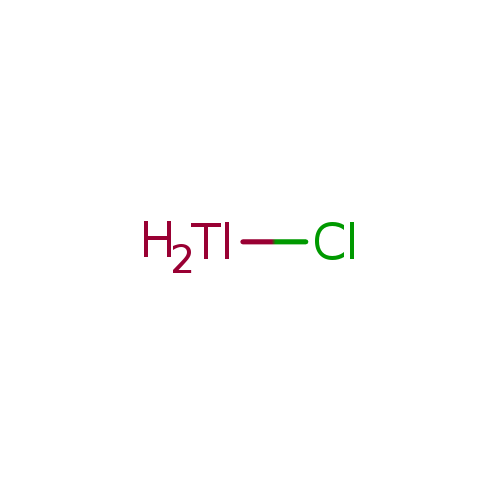
| Chemical Formula | ClTl |
|---|
| Average Molecular Weight | 239.83 |
|---|
| Monoisotopic Molecular Weight | 239.943281 |
|---|
| IUPAC Name | chlorothallane |
|---|
| Traditional Name | thallous chloride |
|---|
| CAS Registry Number | 7791-12-0 |
|---|
| SMILES | Cl[Tl] |
|---|
| InChI Identifier | InChI=1S/ClH.Tl/h1H;/q;+1/p-1 |
|---|
| InChI Key | GBECUEIQVRDUKB-UHFFFAOYSA-M |
|---|
| Chemical Taxonomy |
|---|
| Description | belongs to the class of inorganic compounds known as post-transition metal chlorides. These are inorganic compounds in which the largest halogen atom is Chlorine, and the heaviest metal atom is a post-transition metal. |
|---|
| Kingdom | Inorganic compounds |
|---|
| Super Class | Mixed metal/non-metal compounds |
|---|
| Class | Post-transition metal salts |
|---|
| Sub Class | Post-transition metal chlorides |
|---|
| Direct Parent | Post-transition metal chlorides |
|---|
| Alternative Parents | |
|---|
| Substituents | - Post-transition metal chloride
- Inorganic chloride salt
- Inorganic salt
|
|---|
| Molecular Framework | Not Available |
|---|
| External Descriptors | |
|---|
| Ontology |
|---|
| Status | Detected and Quantified |
|---|
| Origin | |
|---|
| Biofunction | Not Available |
|---|
| Application | Not Available |
|---|
| Cellular locations | Not Available |
|---|
| Physical Properties |
|---|
| State | Solid |
|---|
| Experimental Properties | | Property | Value | Reference |
|---|
| Melting Point | Not Available | Not Available | | Boiling Point | Not Available | Not Available | | Water Solubility | Not Available | Not Available | | LogP | Not Available | Not Available |
|
|---|
| Predicted Properties | |
|---|
| Spectra |
|---|
| Spectra | |
|---|
| Biological Properties |
|---|
| Cellular Locations | Not Available |
|---|
| Biospecimen Locations | - Longissimus Thoracis Muscle
- Milk
- Ruminal Fluid
- Semimembranosus Muscle
- Testis
|
|---|
| Pathways | |
|---|
| Normal Concentrations |
|---|
| |
| Longissimus Thoracis Muscle | Detected and Quantified | 0.0007 +/- 0.0002 nmol/g of tissue | Not Specified | Not Specified | Normal | | details | | Milk | Detected and Quantified | 0.00304 - 0.00350 uM | 4-12 years old | Not Specified | Normal | | details | | Milk | Detected and Quantified | 0.0050 +/- 0.0004 uM | Not Specified | Not Specified | Normal | | details | | Milk | Detected and Quantified | 0.005 +/- 0.001 uM | Not Specified | Not Specified | Normal | | details | | Milk | Detected and Quantified | 0.004 +/- 0.001 uM | Not Specified | Not Specified | Normal | | details | | Milk | Detected and Quantified | 0.0030 +/- 0.0001 uM | Not Specified | Not Specified | Normal | | details | | Ruminal Fluid | Detected and Quantified | 0.430 +/- 0.01 uM | Not Specified | Not Specified | Normal | | details | | Semimembranosus Muscle | Detected and Quantified | 0.0009 +/- 0.0001 nmol/g of tissue | Not Specified | Not Specified | Normal | | details | | Testis | Detected and Quantified | 0.0014 +/- 0.0003 nmol/g of tissue | Not Specified | Not Specified | Normal | | details |
|
|---|
| Abnormal Concentrations |
|---|
| Not Available |
|---|
| External Links |
|---|
| HMDB ID | HMDB0013724 |
|---|
| DrugBank ID | DB09316 |
|---|
| Phenol Explorer Compound ID | Not Available |
|---|
| FooDB ID | Not Available |
|---|
| KNApSAcK ID | Not Available |
|---|
| Chemspider ID | 23044 |
|---|
| KEGG Compound ID | C15226 |
|---|
| BioCyc ID | Not Available |
|---|
| BiGG ID | Not Available |
|---|
| Wikipedia Link | Thallium |
|---|
| METLIN ID | Not Available |
|---|
| PubChem Compound | 24642 |
|---|
| PDB ID | Not Available |
|---|
| ChEBI ID | 37117 |
|---|
| References |
|---|
| Synthesis Reference | Not Available |
|---|
| Material Safety Data Sheet (MSDS) | Not Available |
|---|
| General References | - Z. Dobrzañski, R. Ko3acz, H. Górecka, K. Chojnacka, A. Bartkowiak (2005). Z. Dobrzañski et al. The Content of Microelements and Trace Elements in Raw Milk from Cows in the Silesian Region. Polish Journal of Environmental Studies Vol. 14, No 5 (2005), 685-689. Polish Journal of Environmental Studies .
- A. Foroutan et al. (2019). A. Foroutan et al. The Chemical Composition of Commercial Cow's Milk (in preparation). Journal of Agricultural and Food Chemistry.
|
|---|