| Record Information |
|---|
| Version | 1.0 |
|---|
| Creation Date | 2016-10-03 18:12:07 UTC |
|---|
| Update Date | 2020-05-11 19:13:45 UTC |
|---|
| BMDB ID | BMDB0010700 |
|---|
| Secondary Accession Numbers | |
|---|
| Metabolite Identification |
|---|
| Common Name | CerP(d18:1/16:0) |
|---|
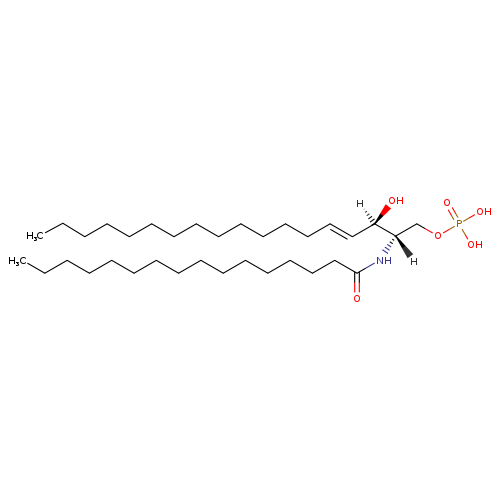
| Description | CerP(d18:1/16:0), also known as N-hexadecanoyl-sphing-4-enine-1-phosphate, is a ceramide phosphate (CerP). Ceramide phosphates are members of the class of compounds known as sphingolipids (SPs), or glycosylceramides. SPs are lipids containing a backbone of sphingoid bases (e.g. sphingosine or sphinganine) that are often covalently bound to a fatty acid derivative through N-acylation. SPs are found in cell membranes, particularly in peripheral nerve cells and the cells found in the central nervous system (including the brain and spinal cord). Sphingolipids are extremely versatile molecules that have functions controlling fundamental cellular processes such as cell division, differentiation, and cell death. Impairments associated with sphingolipid metabolism are associated with many common human diseases such as diabetes, various cancers, microbial infections, diseases of the cardiovascular and respiratory systems, Alzheimer’s disease and other neurological syndromes. The biosynthesis and catabolism of sphingolipids involves a large number of intermediate metabolites where many different enzymes are involved. Simple sphingolipids, which include the sphingoid bases and ceramides, make up the early products of the sphingolipid synthetic pathways, while complex sphingolipids may be formed by the addition of head groups to the ceramide template (Wikipedia). In humans, ceramide phosphate are formed from ceramides by the action of a specific ceramide kinase (CerK) and can be dephosphorylated by phosphatidate phosphatase back to the ceramide. CerPs are an important metabolite of ceramide as it acts as a mediator of the inflammatory response. CerPs are also known to have a dual regulatory capacity acting as intracellular second messengers to regulate cell survival, or as extracellular receptor ligands to stimulate chemotaxis. Moreover, CerPs have been shown to be specific and potent inducers of arachidonic acid and prostanoid synthesis in cells through the translocation and activation of cytoplasmic phospholipase A2. In terms of its appearance and structure, CerP(d18:1/16:0) is a colorless solid that consists of an unsaturated 18-carbon sphingoid base with an attached saturated hexadecanoyl fatty acid side chain. In most mammalian SPs, the 18-carbon sphingoid bases are predominant (PMID: 9759481 ). |
|---|
| Structure | |
|---|
| Synonyms | | Value | Source |
|---|
| N-Hexadecanoylsphing-4-enine-1-phosphate | ChEBI | | N-Palmitoylsphing-4-enine-1-phosphate | ChEBI | | N-Palmitoylsphingosine 1-phosphate | ChEBI | | N-Hexadecanoylsphing-4-enine-1-phosphoric acid | Generator | | N-Palmitoylsphing-4-enine-1-phosphoric acid | Generator | | N-Palmitoylsphingosine 1-phosphoric acid | Generator | | Ceramide phosphate | MetBuilder | | N-(Hexadecanoyl)-1-phosphate-sphing-4-enine | MetBuilder | | Ceramide phosphate(D18:1/16:0) | MetBuilder | | N-(Hexadecanoyl)-1-phosphate-sphingosine | MetBuilder | | N-(Hexadecanoyl)-1-phosphate-D-erythro-sphingosine | MetBuilder | | N-(Hexadecanoyl)-1-phosphate-4-sphingenine | MetBuilder | | N-(Hexadecanoyl)-1-phosphate-D-sphingosine | MetBuilder | | N-(Hexadecanoyl)-1-phosphate-sphingenine | MetBuilder | | N-(Hexadecanoyl)-1-phosphate-erythro-4-sphingenine | MetBuilder | | N-(Hexadecanoyl)-sphing-4-enine-1-phosphate | HMDB | | [(e,2S,3R)-2-(hexadecanoylamino)-3-Hydroxyoctadec-4-enyl] dihydrogen phosphate | HMDB |
|
|---|
| Chemical Formula | C34H68NO6P |
|---|
| Average Molecular Weight | 617.8806 |
|---|
| Monoisotopic Molecular Weight | 617.478425425 |
|---|
| IUPAC Name | {[(2S,3R,4E)-2-hexadecanamido-3-hydroxyoctadec-4-en-1-yl]oxy}phosphonic acid |
|---|
| Traditional Name | C16 CerP |
|---|
| CAS Registry Number | Not Available |
|---|
| SMILES | CCCCCCCCCCCCCCCC(=O)N[C@@]([H])(COP(=O)(O)O)[C@]([H])(O)\C=C\CCCCCCCCCCCCC |
|---|
| InChI Identifier | InChI=1S/C34H68NO6P/c1-3-5-7-9-11-13-15-17-19-21-23-25-27-29-33(36)32(31-41-42(38,39)40)35-34(37)30-28-26-24-22-20-18-16-14-12-10-8-6-4-2/h27,29,32-33,36H,3-26,28,30-31H2,1-2H3,(H,35,37)(H2,38,39,40)/b29-27+/t32-,33+/m0/s1 |
|---|
| InChI Key | UNRULDRRONAKLU-TURZORIXSA-N |
|---|
| Chemical Taxonomy |
|---|
| Description | belongs to the class of organic compounds known as phosphosphingolipids. These are sphingolipids with a structure based on a sphingoid base that is attached to a phosphate head group. They differ from phosphonospingolipids which have a phosphonate head group. |
|---|
| Kingdom | Organic compounds |
|---|
| Super Class | Lipids and lipid-like molecules |
|---|
| Class | Sphingolipids |
|---|
| Sub Class | Phosphosphingolipids |
|---|
| Direct Parent | Phosphosphingolipids |
|---|
| Alternative Parents | |
|---|
| Substituents | - Sphingoid-1-phosphate or derivatives
- Phosphoethanolamine
- Monoalkyl phosphate
- Fatty amide
- N-acyl-amine
- Organic phosphoric acid derivative
- Phosphoric acid ester
- Alkyl phosphate
- Fatty acyl
- Secondary carboxylic acid amide
- Secondary alcohol
- Carboxamide group
- Carboxylic acid derivative
- Organic nitrogen compound
- Organooxygen compound
- Organonitrogen compound
- Carbonyl group
- Organic oxygen compound
- Alcohol
- Organopnictogen compound
- Hydrocarbon derivative
- Organic oxide
- Aliphatic acyclic compound
|
|---|
| Molecular Framework | Aliphatic acyclic compounds |
|---|
| External Descriptors | |
|---|
| Ontology |
|---|
| Status | Expected but not Quantified |
|---|
| Origin | |
|---|
| Biofunction | Not Available |
|---|
| Application | Not Available |
|---|
| Cellular locations | - Cell membrane
- Endosome
- Membrane
|
|---|
| Physical Properties |
|---|
| State | Solid |
|---|
| Experimental Properties | | Property | Value | Reference |
|---|
| Melting Point | Not Available | Not Available | | Boiling Point | Not Available | Not Available | | Water Solubility | Not Available | Not Available | | LogP | Not Available | Not Available |
|
|---|
| Predicted Properties | |
|---|
| Spectra |
|---|
| Spectra | | Spectrum Type | Description | Splash Key | |
|---|
| Predicted GC-MS | Predicted GC-MS Spectrum - GC-MS (1 TMS) - 70eV, Positive | splash10-022a-9114256000-70029283243742b63ffc | View in MoNA |
|---|
| Predicted GC-MS | Predicted GC-MS Spectrum - GC-MS (TMS_1_2) - 70eV, Positive | Not Available | View in JSpectraViewer |
|---|
| Predicted GC-MS | Predicted GC-MS Spectrum - GC-MS (TMS_1_3) - 70eV, Positive | Not Available | View in JSpectraViewer |
|---|
| Predicted GC-MS | Predicted GC-MS Spectrum - GC-MS (TBDMS_1_1) - 70eV, Positive | Not Available | View in JSpectraViewer |
|---|
| Predicted GC-MS | Predicted GC-MS Spectrum - GC-MS (TBDMS_1_2) - 70eV, Positive | Not Available | View in JSpectraViewer |
|---|
| Predicted GC-MS | Predicted GC-MS Spectrum - GC-MS (TBDMS_1_3) - 70eV, Positive | Not Available | View in JSpectraViewer |
|---|
| Predicted GC-MS | Predicted GC-MS Spectrum - GC-MS ("CerP(d18:1/16:0),1TMS,#1" TMS) - 70eV, Positive | Not Available | View in JSpectraViewer |
|---|
| Predicted LC-MS/MS | Predicted LC-MS/MS Spectrum - 10V, Negative | splash10-014i-2000009000-9b49d4a6a5e50d9a0bfa | View in MoNA |
|---|
| Predicted LC-MS/MS | Predicted LC-MS/MS Spectrum - 20V, Negative | splash10-016r-9000007000-da48a526484a4a6e0f26 | View in MoNA |
|---|
| Predicted LC-MS/MS | Predicted LC-MS/MS Spectrum - 40V, Negative | splash10-004i-9000000000-a5e502a2627af2048a1f | View in MoNA |
|---|
| Predicted LC-MS/MS | Predicted LC-MS/MS Spectrum - 10V, Positive | splash10-00xr-0000197000-ca8198b56f63cdf30089 | View in MoNA |
|---|
| Predicted LC-MS/MS | Predicted LC-MS/MS Spectrum - 20V, Positive | splash10-0uk9-0010092000-ee5db710d22114fccbec | View in MoNA |
|---|
| Predicted LC-MS/MS | Predicted LC-MS/MS Spectrum - 40V, Positive | splash10-014i-4590000000-a35ff7a144ee7bc18e02 | View in MoNA |
|---|
|
|---|