| Record Information |
|---|
| Version | 1.0 |
|---|
| Creation Date | 2016-09-30 23:27:31 UTC |
|---|
| Update Date | 2020-04-22 15:19:03 UTC |
|---|
| BMDB ID | BMDB0006903 |
|---|
| Secondary Accession Numbers | |
|---|
| Metabolite Identification |
|---|
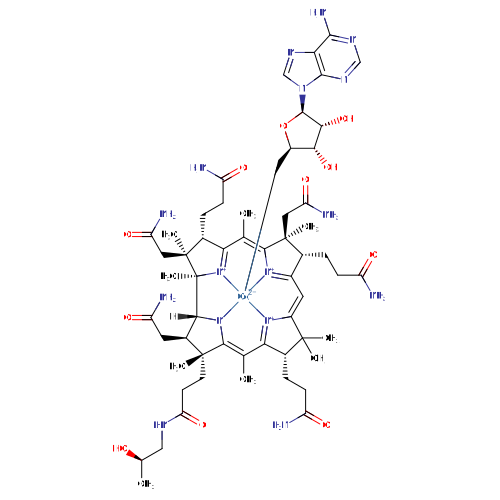
| Common Name | Adenosyl cobinamide |
|---|
| Description | Adenosyl cobinamide belongs to the class of organic compounds known as phenylpyruvic acid derivatives. Phenylpyruvic acid derivatives are compounds containing a phenylpyruvic acid moiety, which consists of a phenyl group substituted at the second position by an pyruvic acid. Adenosyl cobinamide exists in all living organisms, ranging from bacteria to humans. Based on a literature review very few articles have been published on Adenosyl cobinamide. |
|---|
| Structure | |
|---|
| Synonyms | | Value | Source |
|---|
| 5'-Deoxy-5'-adenosylcobinamide | ChEBI | | Adenosylcob(III)inamide | ChEBI |
|
|---|
| Chemical Formula | C58H84CoN16O11 |
|---|
| Average Molecular Weight | 1240.3214 |
|---|
| Monoisotopic Molecular Weight | 1239.583747804 |
|---|
| IUPAC Name | (3R,4S,5S,9S,10S,15S,19R,20R,21R)-1-{[(2S,3S,4R,5R)-5-(6-amino-9H-purin-9-yl)-3,4-dihydroxyoxolan-2-yl]methyl}-5,10,15-tris(2-carbamoylethyl)-4,9,20-tris(carbamoylmethyl)-19-(2-{[(2R)-2-hydroxypropyl]carbamoyl}ethyl)-3,4,7,9,14,14,17,19-octamethyl-2lambda5,22,23lambda5,24lambda5-tetraaza-1-cobaltaoctacyclo[11.9.1.1^{1,8}.0^{2,6}.0^{3,21}.0^{16,23}.0^{18,22}.0^{11,24}]tetracosa-2(6),7,11(24),12,16(23),17-hexaene-2,23,24-tris(ylium)-1,1-diuide |
|---|
| Traditional Name | (3R,4S,5S,9S,10S,15S,19R,20R,21R)-1-{[(2S,3S,4R,5R)-5-(6-aminopurin-9-yl)-3,4-dihydroxyoxolan-2-yl]methyl}-5,10,15-tris(2-carbamoylethyl)-4,9,20-tris(carbamoylmethyl)-19-(2-{[(2R)-2-hydroxypropyl]carbamoyl}ethyl)-3,4,7,9,14,14,17,19-octamethyl-2lambda5,22,23lambda5,24lambda5-tetraaza-1-cobaltaoctacyclo[11.9.1.1^{1,8}.0^{2,6}.0^{3,21}.0^{16,23}.0^{18,22}.0^{11,24}]tetracosa-2(6),7,11(24),12,16(23),17-hexaene-2,23,24-tris(ylium)-1,1-diuide |
|---|
| CAS Registry Number | Not Available |
|---|
| SMILES | [H][C@@]12[C@H](CC(N)=O)[C@@](C)(CCC(=O)NC[C@@H](C)O)C3=C(C)C4=[N+]5C(=CC6=[N+]7C(=C(C)C8=[N+]([C@]1(C)[C@@](C)(CC(N)=O)[C@@H]8CCC(N)=O)[Co--]57(C[C@H]1O[C@H]([C@H](O)[C@@H]1O)N1C=NC5=C1N=CN=C5N)N23)[C@@](C)(CC(N)=O)[C@@H]6CCC(N)=O)C(C)(C)[C@@H]4CCC(N)=O |
|---|
| InChI Identifier | InChI=1S/C48H73N11O8.C10H12N5O3.Co/c1-23(60)22-55-38(67)16-17-45(6)29(18-35(52)64)43-48(9)47(8,21-37(54)66)28(12-15-34(51)63)40(59-48)25(3)42-46(7,20-36(53)65)26(10-13-32(49)61)30(56-42)19-31-44(4,5)27(11-14-33(50)62)39(57-31)24(2)41(45)58-43;1-4-6(16)7(17)10(18-4)15-3-14-5-8(11)12-2-13-9(5)15;/h19,23,26-29,43,60H,10-18,20-22H2,1-9H3,(H14,49,50,51,52,53,54,55,56,57,58,59,61,62,63,64,65,66,67);2-4,6-7,10,16-17H,1H2,(H2,11,12,13);/q;;+2/p-1/t23-,26-,27-,28-,29+,43-,45-,46+,47+,48+;4-,6-,7-,10-;/m11./s1 |
|---|
| InChI Key | KQXSPGAEBZWHMC-QMUWONGRSA-M |
|---|
| Chemical Taxonomy |
|---|
| Description | belongs to the class of organic compounds known as phenylpyruvic acid derivatives. Phenylpyruvic acid derivatives are compounds containing a phenylpyruvic acid moiety, which consists of a phenyl group substituted at the second position by an pyruvic acid. |
|---|
| Kingdom | Organic compounds |
|---|
| Super Class | Benzenoids |
|---|
| Class | Benzene and substituted derivatives |
|---|
| Sub Class | Phenylpyruvic acid derivatives |
|---|
| Direct Parent | Phenylpyruvic acid derivatives |
|---|
| Alternative Parents | |
|---|
| Substituents | - Cinnamic acid
- Cinnamic acid or derivatives
- Coumaric acid
- Coumaric acid or derivatives
- Hydroxycinnamic acid
- Hydroxycinnamic acid or derivatives
- Enol-phenylpyruvate
- Phenol
- 1-hydroxy-2-unsubstituted benzenoid
- Monocarboxylic acid or derivatives
- Enol
- Carboxylic acid
- Carboxylic acid derivative
- Carbonyl group
- Organooxygen compound
- Hydrocarbon derivative
- Organic oxide
- Organic oxygen compound
- Aromatic homomonocyclic compound
|
|---|
| Molecular Framework | Aromatic homomonocyclic compounds |
|---|
| External Descriptors | |
|---|
| Ontology |
|---|
| Status | Expected but not Quantified |
|---|
| Origin | |
|---|
| Biofunction | Not Available |
|---|
| Application | Not Available |
|---|
| Cellular locations | - Cell membrane
- Cytoplasm
- Membrane
- Mitochondria
|
|---|
| Physical Properties |
|---|
| State | Solid |
|---|
| Experimental Properties | | Property | Value | Reference |
|---|
| Melting Point | Not Available | Not Available | | Boiling Point | Not Available | Not Available | | Water Solubility | Not Available | Not Available | | LogP | Not Available | Not Available |
|
|---|
| Predicted Properties | |
|---|
| Spectra |
|---|
| Spectra | |
|---|