| Record Information |
|---|
| Version | 1.0 |
|---|
| Creation Date | 2016-09-30 23:04:53 UTC |
|---|
| Update Date | 2020-04-22 15:12:22 UTC |
|---|
| BMDB ID | BMDB0003474 |
|---|
| Secondary Accession Numbers | |
|---|
| Metabolite Identification |
|---|
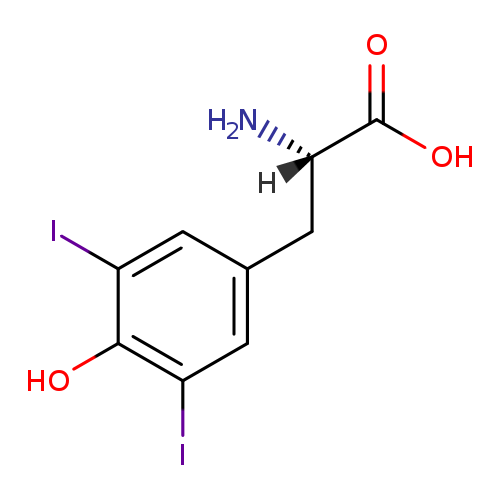
| Common Name | 3,5-Diiodo-L-tyrosine |
|---|
| Description | 3,5-Diiodo-L-tyrosine, also known as 3,5-diiodo-l-tyrosine or DIT, belongs to the class of organic compounds known as tyrosine and derivatives. Tyrosine and derivatives are compounds containing tyrosine or a derivative thereof resulting from reaction of tyrosine at the amino group or the carboxy group, or from the replacement of any hydrogen of glycine by a heteroatom. 3,5-Diiodo-L-tyrosine is possibly soluble (in water) and a very strong basic compound (based on its pKa). 3,5-Diiodo-L-tyrosine exists in all living organisms, ranging from bacteria to humans. In cattle, 3,5-diiodo-L-tyrosine is involved in the metabolic pathway called thyroid hormone synthesis pathway. |
|---|
| Structure | |
|---|
| Synonyms | | Value | Source |
|---|
| (2S)-2-Amino-3-(4-hydroxy-3,5-diiodophenyl)propanoic acid | ChEBI | | 3,5-Diiodotyrosine | ChEBI | | Diiodotyrosine | ChEBI | | DiIY | ChEBI | | DIT | ChEBI | | L-3,5-Diiodotyrosine | ChEBI | | L-Diiodotyrosine | ChEBI | | (2S)-2-Amino-3-(4-hydroxy-3,5-diiodophenyl)propanoate | Generator | | 3,5-Diiodotyrocine | HMDB | | 3,5-Iodo-L-tyrosine | HMDB | | 3,5-L-Diiodotyrosine | HMDB | | 4-Hydroxy-3,5-diiodophenylalanine | HMDB | | Iodogorgoic acid | HMDB | | Acid, iodogorgoic | HMDB |
|
|---|
| Chemical Formula | C9H9I2NO3 |
|---|
| Average Molecular Weight | 432.9816 |
|---|
| Monoisotopic Molecular Weight | 432.867179999 |
|---|
| IUPAC Name | (2S)-2-amino-3-(4-hydroxy-3,5-diiodophenyl)propanoic acid |
|---|
| Traditional Name | 3,5-diiodotyrosine |
|---|
| CAS Registry Number | 300-39-0 |
|---|
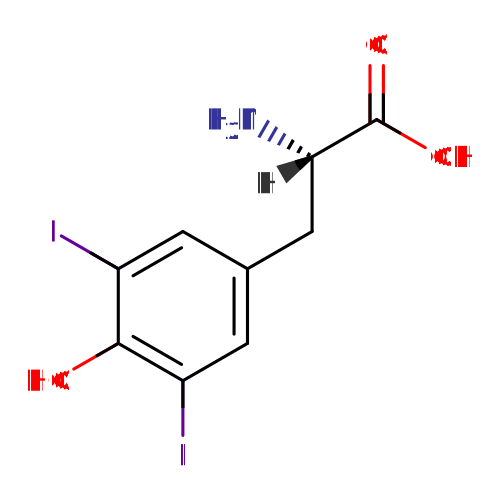
| SMILES | [H][C@](N)(CC1=CC(I)=C(O)C(I)=C1)C(O)=O |
|---|
| InChI Identifier | InChI=1S/C9H9I2NO3/c10-5-1-4(2-6(11)8(5)13)3-7(12)9(14)15/h1-2,7,13H,3,12H2,(H,14,15)/t7-/m0/s1 |
|---|
| InChI Key | NYPYHUZRZVSYKL-ZETCQYMHSA-N |
|---|
| Chemical Taxonomy |
|---|
| Description | belongs to the class of organic compounds known as tyrosine and derivatives. Tyrosine and derivatives are compounds containing tyrosine or a derivative thereof resulting from reaction of tyrosine at the amino group or the carboxy group, or from the replacement of any hydrogen of glycine by a heteroatom. |
|---|
| Kingdom | Organic compounds |
|---|
| Super Class | Organic acids and derivatives |
|---|
| Class | Carboxylic acids and derivatives |
|---|
| Sub Class | Amino acids, peptides, and analogues |
|---|
| Direct Parent | Tyrosine and derivatives |
|---|
| Alternative Parents | |
|---|
| Substituents | - Tyrosine or derivatives
- Phenylalanine or derivatives
- 3-phenylpropanoic-acid
- Amphetamine or derivatives
- Alpha-amino acid
- L-alpha-amino acid
- 2-iodophenol
- 2-halophenol
- Aralkylamine
- Halobenzene
- Phenol
- Iodobenzene
- Aryl iodide
- Monocyclic benzene moiety
- Benzenoid
- Aryl halide
- Amino acid
- Carboxylic acid
- Monocarboxylic acid or derivatives
- Amine
- Primary aliphatic amine
- Organonitrogen compound
- Organooxygen compound
- Primary amine
- Organic nitrogen compound
- Carbonyl group
- Hydrocarbon derivative
- Organic oxide
- Organopnictogen compound
- Organic oxygen compound
- Organoiodide
- Organohalogen compound
- Aromatic homomonocyclic compound
|
|---|
| Molecular Framework | Aromatic homomonocyclic compounds |
|---|
| External Descriptors | |
|---|
| Ontology |
|---|
| Status | Expected but not Quantified |
|---|
| Origin | |
|---|
| Biofunction | Not Available |
|---|
| Application | Not Available |
|---|
| Cellular locations | |
|---|
| Physical Properties |
|---|
| State | Solid |
|---|
| Experimental Properties | | Property | Value | Reference |
|---|
| Melting Point | Not Available | Not Available | | Boiling Point | Not Available | Not Available | | Water Solubility | 0.617 mg/mL at 25 °C | Not Available | | LogP | Not Available | Not Available |
|
|---|
| Predicted Properties | |
|---|
| Spectra |
|---|
| Spectra | |
|---|