| Record Information |
|---|
| Version | 1.0 |
|---|
| Creation Date | 2016-09-30 22:51:26 UTC |
|---|
| Update Date | 2020-05-11 20:23:08 UTC |
|---|
| BMDB ID | BMDB0002123 |
|---|
| Secondary Accession Numbers | |
|---|
| Metabolite Identification |
|---|
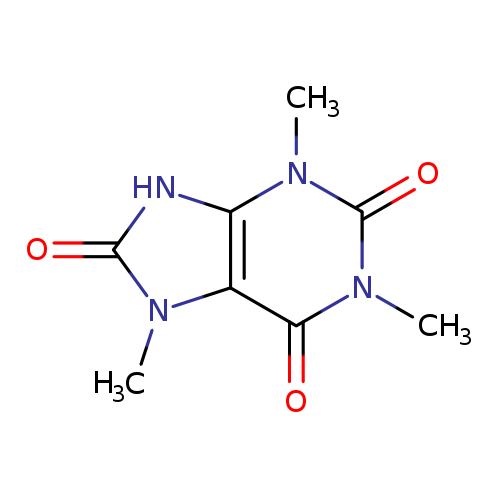
| Common Name | 1,3,7-Trimethyluric acid |
|---|
| Description | 1,3,7-Trimethyluric acid, also known as 1,3,7-trimethyluric acid or 1,3,7-trimethyluric acid, belongs to the class of organic compounds known as xanthines. These are purine derivatives with a ketone group conjugated at carbons 2 and 6 of the purine moiety. 1,3,7-Trimethyluric acid is possibly soluble (in water) and an extremely weak basic (essentially neutral) compound (based on its pKa). 1,3,7-Trimethyluric acid exists in all living organisms, ranging from bacteria to humans. 1,3,7-Trimethyluric acid can be biosynthesized from caffeine; which is catalyzed by the enzymes cytochrome P450 1A2, cytochrome P450 3A4, cytochrome P450 2C8, cytochrome P450 2C9, and cytochrome P450 2E1. In cattle, 1,3,7-trimethyluric acid is involved in the metabolic pathway called the caffeine metabolism pathway. |
|---|
| Structure | |
|---|
| Synonyms | | Value | Source |
|---|
| 1,3,7-Trimethyl-2,3,6,7,8,9-hexahydro-1H-purine-2,6,8-trione | ChEBI | | 1,3,7-Trimethylurate | ChEBI | | 7,9-Dihydro-1,3,7-trimethyl-1H-purine-2,6,8(3H)-trione | ChEBI | | 8-Oxocaffeine | ChEBI | | 8-Oxy-caffeine | ChEBI | | 1,3,7-Trimethylate | Generator | | 1,3,7-Trimethylic acid | Generator | | 1,3, 7-Trimethyluric acid | HMDB | | 1,3,7-Trimethyl-7,9-dihydro-1H-purine-2,6,8(3H)-trione | HMDB | | 2,6,8-Trihydroxy-1,3,7-trimethylpurine | HMDB | | 8-Hydroxy-1,3,7-trimethyl-3,7-dihydro-1H-purine-2,6-dione | HMDB | | Trimethyl uric acid | HMDB |
|
|---|
| Chemical Formula | C8H10N4O3 |
|---|
| Average Molecular Weight | 210.19 |
|---|
| Monoisotopic Molecular Weight | 210.075290206 |
|---|
| IUPAC Name | 1,3,7-trimethyl-2,3,6,7,8,9-hexahydro-1H-purine-2,6,8-trione |
|---|
| Traditional Name | 1,3,7-trimethyluric acid |
|---|
| CAS Registry Number | 5415-44-1 |
|---|
| SMILES | CN1C(=O)NC2=C1C(=O)N(C)C(=O)N2C |
|---|
| InChI Identifier | InChI=1S/C8H10N4O3/c1-10-4-5(9-7(10)14)11(2)8(15)12(3)6(4)13/h1-3H3,(H,9,14) |
|---|
| InChI Key | BYXCFUMGEBZDDI-UHFFFAOYSA-N |
|---|
| Chemical Taxonomy |
|---|
| Description | belongs to the class of organic compounds known as xanthines. These are purine derivatives with a ketone group conjugated at carbons 2 and 6 of the purine moiety. |
|---|
| Kingdom | Organic compounds |
|---|
| Super Class | Organoheterocyclic compounds |
|---|
| Class | Imidazopyrimidines |
|---|
| Sub Class | Purines and purine derivatives |
|---|
| Direct Parent | Xanthines |
|---|
| Alternative Parents | |
|---|
| Substituents | - Xanthine
- 6-oxopurine
- Purinone
- Alkaloid or derivatives
- Pyrimidone
- N-substituted imidazole
- Pyrimidine
- Azole
- Imidazole
- Heteroaromatic compound
- Vinylogous amide
- Lactam
- Urea
- Azacycle
- Hydrocarbon derivative
- Organic oxide
- Organopnictogen compound
- Organooxygen compound
- Organonitrogen compound
- Organic oxygen compound
- Organic nitrogen compound
- Aromatic heteropolycyclic compound
|
|---|
| Molecular Framework | Aromatic heteropolycyclic compounds |
|---|
| External Descriptors | |
|---|
| Ontology |
|---|
| Status | Expected but not Quantified |
|---|
| Origin | |
|---|
| Biofunction | Not Available |
|---|
| Application | Not Available |
|---|
| Cellular locations | |
|---|
| Physical Properties |
|---|
| State | Solid |
|---|
| Experimental Properties | | Property | Value | Reference |
|---|
| Melting Point | Not Available | Not Available | | Boiling Point | Not Available | Not Available | | Water Solubility | 5.5 mg/mL at 15 °C | Not Available | | LogP | -0.37 | GASPARI,F & BONATI,M (1987) |
|
|---|
| Predicted Properties | |
|---|
| Spectra |
|---|
| Spectra | |
|---|