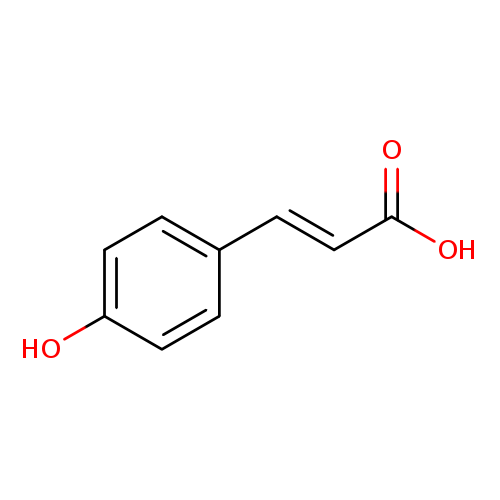
trans-4-Coumaric acid, also known as 4-hydroxycinnamic acid or trans-p-hydroxycinnamate, belongs to the class of organic compounds known as hydroxycinnamic acids. Hydroxycinnamic acids are compounds containing an cinnamic acid where the benzene ring is hydroxylated. trans-4-Coumaric acid exists as a solid, possibly soluble (in water), and an extremely weak basic (essentially neutral) compound (based on its pKa) molecule. trans-4-Coumaric acid exists in all living species, ranging from bacteria to humans.
belongs to the class of organic compounds known as hydroxycinnamic acids. Hydroxycinnamic acids are compounds containing an cinnamic acid where the benzene ring is hydroxylated.
For example, these phytochemicals (caffeic acid, p-coumaric acid, luteolin, quercetin, and gallic acid) in both herbs can be transferred from herbs to milk via blood, increasing milk TAC levels, which supports previous research [20,58].
Written in the paper as “p-coumaric acid” and “milk”
The concentration-time curves of hydroxycinnamic acids such as coumaric acid, ferulic acid, and caffeic acid in Hanwoo steer in vitro rumen fluid during incubation periods are presented in Table 2.
Written in the paper as “coumaric acid” and “rumen fluid”
Van Schaik et al. [14] investigated other COGs involved in the metabolism of carbon sources from plants including COG4677, which is predicted to be involved in the metabolism of pectin, and COG3479, which is involved in the breakdown of coumaric acid and other components of lignocellulose.
Written in the paper as “coumaric acid” and “breakdown of coumaric acid”
The FA and pCA are the most abundant hydroxycinnamic acids in plant cell walls, and they are highly involved in the lignification process during plant cell wall development [11,32].
Written in the paper as “p-coumaric acid” and “lignification process”
Involved in
plant-type cell wall organization or biogenesis GO:0071669
A process that results in the biosynthesis of constituent macromolecules, assembly, arrangement of constituent parts, or disassembly of a cellulose- and pectin-containing cell wall.
The FA and pCA are the most abundant hydroxycinnamic acids in plant cell walls, and they are highly involved in the lignification process during plant cell wall development [11,32].
Written in the paper as “p-coumaric acid” and “plant cell wall development”
A cellular process that results in the biosynthesis of constituent macromolecules, assembly, and arrangement of constituent parts of inextensible cellulose- and pectin-containing cell walls that are formed between the plasma membrane and primary cell wall after cell expansion is complete. An example of this is found in Arabidopsis thaliana.
During the second cell wall development, the pCA was incorporated into the lignin polymer through ether bounds [41], and this could explain the high correlation coefficient between pCAeth and the ED of rumen degradation in the present study.
Written in the paper as “p-coumaric acid” and “second cell wall development”
As a result, the effective degradability of dry matter, neutral detergent fibre, and acid detergent fibre were negatively related to the ether-linked FA and pCA, and their ratio in corn silages, suggesting that not only the content and but also the composition of phenolic acids significantly affected the degradation characteristics of corn silages.
Written in the paper as “p-coumaric acid” and “dry matter digestibility”
Fourteen compounds (benzoic acid, hydroxycinnamic acid, azelaic acid, phenylacetic acid, d-arabitol, fumaric acid, salicylic acid, adipic acid, 4-hydroxybenzoic acid, 2-methylglutaric acid, pimelic acid, 3-phosphoglycerate, xanthine, and adenosine) were upregulated and two compounds (threonine and glutamic acid) were downregulated in the rumen fluids of cattle fed fermented rice straw compared with those fed fresh corn Stover.
Written in the paper as “hydroxycinnamic acid” and “fermented rice straw”
For example, these phytochemicals (caffeic acid, p-coumaric acid, luteolin, quercetin, and gallic acid) in both herbs can be transferred from herbs to milk via blood, increasing milk TAC levels, which supports previous research [20,58].
Written in the paper as “p-coumaric acid” and “herbs”
Ferulic acid (FA) and p-coumaric acid (pCA) affecting fibre digestibility were the most abundant phenolic acids in plant cell wall, which can account for up to 80 of the total phenolic acids [7].
Written in the paper as “p-coumaric acid” and “plant cell walls”
A heatmap analysis shows the CON TMR demonstrated elevated levels (P < 0.05) of 18 specific compounds, including p-coumaric acid, 3,4-dihydroxybenzoic acid, and vanillic acid 4-b-D-glucopyranoside (Figure 3).
Written in the paper as “p-coumaric acid” and “total mixed ration”
Ben-Bassat, Arie; Sariaslani, Fateme Sima; Huang, Lisa L.; Patnaik, Ranjan; Lowe, David J. Fermentative preparation of para-hydroxycinnamic acid and cinnamic acid at alkaline ph. U.S. Pat. Appl. Publ. (2005), 23 pp.
Material Safety Data Sheet (MSDS)
Not Available
General References
GARTON GA: THE COMPOSITION AND BIOSYNTHESIS OF MILK LIPIDS. J Lipid Res. 1963 Jul;4:237-54. [PubMed:14168161 ]