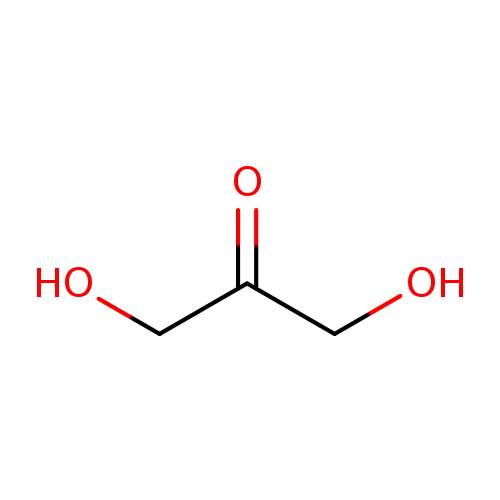
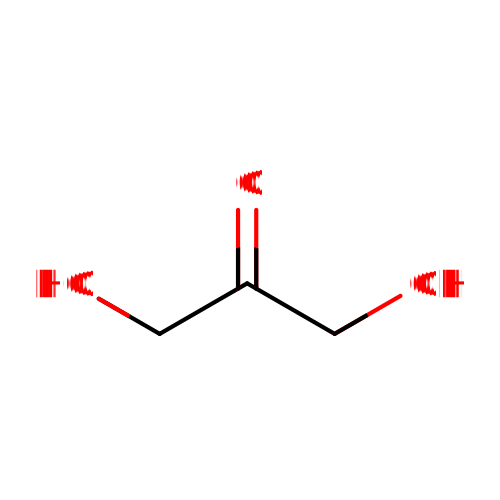
Dihydroxyacetone, also known as chromelin or DHA, belongs to the class of organic compounds known as monosaccharides. Monosaccharides are compounds containing one carbohydrate unit not glycosidically linked to another such unit, and no set of two or more glycosidically linked carbohydrate units. Monosaccharides have the general formula CnH2nOn. Dihydroxyacetone exists as a solid, possibly soluble (in water), and an extremely weak basic (essentially neutral) compound (based on its pKa) molecule. Dihydroxyacetone exists in all living species, ranging from bacteria to humans. In cattle, dihydroxyacetone is involved in the metabolic pathway called the mitochondrial electron transport chain pathway.
belongs to the class of organic compounds known as monosaccharides. Monosaccharides are compounds containing one carbohydrate unit not glycosidically linked to another such unit, and no set of two or more glycosidically linked carbohydrate units. Monosaccharides have the general formula CnH2nOn.
For instance, we identified many secondary metabolites in this study, including dihydroxyacetone, 2-hydroxyphenylacetic acid, and 5-hydroxyhexanoic acid.
Written in the paper as “dihydroxyacetone” and “plasma”
For instance, we identified many secondary metabolites in this study, including dihydroxyacetone, 2-hydroxyphenylacetic acid, and 5-hydroxyhexanoic acid.
Written in the paper as “dihydroxyacetone” and “rumen fluid”
Our results include all metabolites associated with acidosis that were identified in previous studies, except for ethanolamine, phenylacetylglycine, tyramine, and putrescine.
Written in the paper as “1,3-dihydroxyacetone” and “acidosis”
Urine concentrations of hexose (i.e., aldohexoses such as D-glucose and D-mannose; and ketohexoses such as D-fructose), 1,3-dihydroxyacetone (DHA), and L-lactic acid were greater, whereas D-galactose was lower in cows with ketosis during the disease week.
Written in the paper as “1,3-dihydroxyacetone” and “ketosis”
According to Dervishi et al [19], using urine from lactating dairy cattle, the candidate group of metabolites for the diagnosis of metritis consists of increased concentrations of 1,3-dihydroxyacetone, 3-aminoisobutyrate, acetylsalicylate, ascorbate, betaine, cysteine, galactose, glutamine, glycolate, guanidoacetate, hypoxanthine, lysine, N-acetylaspartate, O-phosphocholine, threonine, xylose, trans-aconitate, and p-methylhistidine metabolite and, decreased concentrations of uracil and urea metabolites.
Written in the paper as “1,3-dihydroxyacetone” and “Metritis”
For fat content 11 different metabolites were found to be important, e.g., 1-3-dihydroxyaceton, aspartic acid and galactitol, six of which were found in each inner cross-validation run.
Written in the paper as “1-3-dihydroxyaceton” and “fat content”
In addition, some studies found 1,3-dihydroxyacetone in association with fat, lactose and somatic cell score [18], but lysine and succinate in association with growth trait and feed efficiency traits [7,9,10] (Table 1).
Written in the paper as “1,3-dihydroxyacetone” and “somatic cell score”
Hochuli, Erich; Taylor, Keith E.; Dutler, Hans. Dihydroxyacetone reductase from Mucor javanicus. 2. Identification of the physiological substrate and reactivity towards related compounds. European Journal of Biochemistry (1977), 75(2), 433-9.
Material Safety Data Sheet (MSDS)
Not Available
General References
Jensen RG: The composition of bovine milk lipids: January 1995 to December 2000. J Dairy Sci. 2002 Feb;85(2):295-350. doi: 10.3168/jds.S0022-0302(02)74079-4. [PubMed:11913692 ]