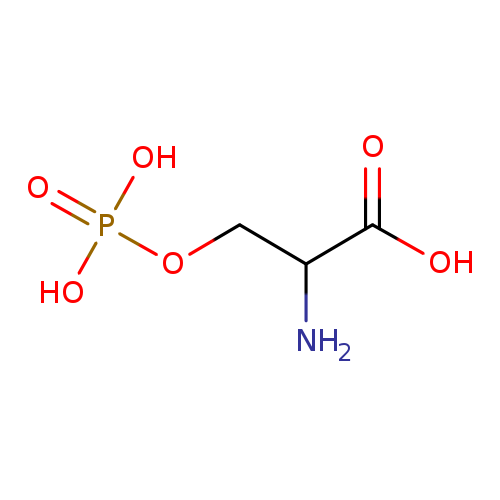
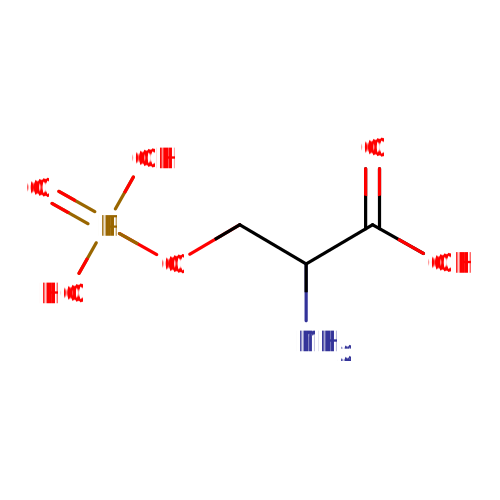
DL-O-Phosphoserine, also known as DL-O-phosphorylserine or DL-O-serine phosphate, belongs to the class of organic compounds known as alpha amino acids. These are amino acids in which the amino group is attached to the carbon atom immediately adjacent to the carboxylate group (alpha carbon). DL-O-Phosphoserine is a very strong basic compound (based on its pKa). DL-O-Phosphoserine exists in all living species, ranging from bacteria to humans.
belongs to the class of organic compounds known as alpha amino acids. These are amino acids in which the amino group is attached to the carbon atom immediately adjacent to the carboxylate group (alpha carbon).
On the contrary, in the recent past less attention has been addressed to the identification of phosphorous containing small molecules, although the pioneering 31P NMR studies on raw milk and milk fractions of various mammalians allowed to identify, along with inorganic phosphate (Pi) and serylphosphate residues of casein (Ser-P), a number of water soluble phosphorylated metabolites [23,24].
Written in the paper as “serylphosphate” and “milk”
Lacombe J M; Andriamanampisoa F; Pavia A A Solid-phase synthesis of peptides containing phosphoserine using phosphate tert.-butyl protecting group. International journal of peptide and protein research (1990), 36(3), 275-80.
Adapter protein implicated in the regulation of a large spectrum of both general and specialized signaling pathways. Binds to a large number of partners, usually by recognition of a phosphoserine or phosphothreonine motif. Binding generally results in the modulation of the activity of the binding partner. Activates the ADP-ribosyltransferase (exoS) activity of bacterial origin. Induces ARHGEF7 activity on RAC1 as well as lamellipodia and membrane ruffle formation (By similarity). In neurons, regulates spine maturation through the modulation of ARHGEF7 activity (By similarity).
Adapter protein implicated in the regulation of a large spectrum of both general and specialized signaling pathways. Binds to a large number of partners, usually by recognition of a phosphoserine or phosphothreonine motif. Binding generally results in the modulation of the activity of the binding partner. Negatively regulates the kinase activity of PDPK1 (By similarity).
Involved in insulin-like growth factor receptor binding
Specific function:
Adapter protein implicated in the regulation of a large spectrum of both general and specialized signaling pathways. Binds to a large number of partners, usually by recognition of a phosphoserine or phosphothreonine motif. Binding generally results in the modulation of the activity of the binding partner.
Adapter protein implicated in the regulation of a large spectrum of both general and specialized signaling pathways. Binds to a large number of partners, usually by recognition of a phosphoserine or phosphothreonine motif. Binding generally results in the modulation of the activity of the binding partner. Negative regulator of osteogenesis. Blocks the nuclear translocation of the phosphorylated form (by AKT1) of SRPK2 and antagonizes its stimulatory effect on cyclin D1 expression resulting in blockage of neuronal apoptosis elicited by SRPK2. Negative regulator of signaling cascades that mediate activation of MAP kinases via AKAP13.
Adapter protein implicated in the regulation of a large spectrum of both general and specialized signaling pathways. Binds to a large number of partners, usually by recognition of a phosphoserine or phosphothreonine motif. Binding generally results in the modulation of the activity of the binding partner. Negatively regulates the kinase activity of PDPK1 (By similarity).
Adapter protein implicated in the regulation of a large spectrum of both general and specialized signaling pathways (PubMed:7931346). Binds to a large number of partners, usually by recognition of a phosphoserine or phosphothreonine motif (PubMed:7931346). Binding generally results in the modulation of the activity of the binding partner (PubMed:7931346). Positively regulates phosphorylated protein HSF1 nuclear export to the cytoplasm (By similarity).
Adapter protein implicated in the regulation of a large spectrum of both general and specialized signaling pathways. Binds to a large number of partners, usually by recognition of a phosphoserine or phosphothreonine motif. Binding generally results in the modulation of the activity of the binding partner. When bound to KRT17, regulates protein synthesis and epithelial cell growth by stimulating Akt/mTOR pathway. May also regulate MDM2 autoubiquitination and degradation and thereby activate p53/TP53 (By similarity).