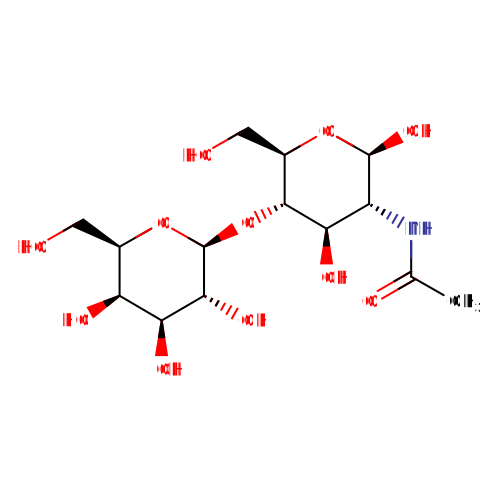
N-Acetyllactosamine, also known as galb1-4glcnacb or lacnac, belongs to the class of organic compounds known as acylaminosugars. These are organic compounds containing a sugar linked to a chain through N-acyl group. N-Acetyllactosamine is an extremely weak basic (essentially neutral) compound (based on its pKa). N-Acetyllactosamine exists in all living organisms, ranging from bacteria to humans.
belongs to the class of organic compounds known as acylaminosugars. These are organic compounds containing a sugar linked to a chain through N-acyl group.
Fucosylation, sialylation, primarily with N-acetylneuraminic acid (Neu5Ac), and a high ratio of N,N′-diacetyllactosamine (LacdiNAc)/N-acetyllactosamine (LacNAc) motifs were characteristic features of the identified N-glycans.
Written in the paper as “N-acetyllactosamine” and “colostrum”
Fucosylation, sialylation, primarily with N-acetylneuraminic acid (Neu5Ac), and a high ratio of N,N′-diacetyllactosamine (LacdiNAc)/N-acetyllactosamine (LacNAc) motifs were characteristic features of the identified N-glycans.
Written in the paper as “N-acetyllactosamine” and “milk”
At the same time, N-Acetyl-d-lactosamine can inhibit gal-3 proliferation to control disease treatment and has excellent performance in the treatment of hypoxic pulmonary hypertension and Chagas cardiomyopathy (Souza, Silva, Soares ,2017).
Written in the paper as “N-Acetyl-d-lactosamine” and “gal-3 proliferation”
A protein glycosylation process in which a carbohydrate or carbohydrate derivative unit is added to a protein via the N4 atom of an asparagine residue.
While N-glycosylation of bovine a-lactalbumin at Asn74 has never been reported, partial occupancy of Asn45 has been shown in previous studies, primarily with complex diantennary N-glycans containing LacNAc and/or N,N -diacetyllactosamine (LacdiNAc) motifs, fucosylation and Neu5Ac sialylation, with on average 10 of total a-lactalbumin occurring as a glycoprotein (Barman 1970; Hindle and Wheelock 1970; Hopper and McKenzie 1973; Chandrika 1999; Slangen and Visser 1999; Valk-Weeber et al. 2020).
Written in the paper as “LacNAc” and “N-glycosylation”
Compared with the control group, the average relative abundances of d-fructose (FDR-adjusted P = 0.0178), melibiose (FDR-adjusted P = 0.0058), N-acetyllactosamine (FDR-adjusted P = 0.0181), l-glutamate (FDR-adjusted P = 0.0163), l-tyrosine (FDR-adjusted P = 0.0236), benzoic acid (FDR-adjusted P = 0.0226), dihydroxyacetone phosphate(10:0) (DHAP[10:0]) (FDR-adjusted P = 0.0449), (+)-enterolactone (FDR-adjusted P = 0.0074), etc., were increased in the cows fed inulin.
Written in the paper as “N-acetyllactosamine” and “inulin”
N-Acetyl-d-lactosamine is an oligosaccharide fraction present in breast milk as a free disaccharide, and most oligosaccharides cannot be hydrolyzed by human glycosyl hydrolases, which suggests that these structures have evolved into natural prebiotics that help establish a healthy gut microbiota in newborns (Arnold, Whittington Bruno-Barcena,2021).
Written in the paper as “N-Acetyl-d-lactosamine” and “natural prebiotics”
The Golgi complex form catalyzes the production of lactose in the lactating mammary gland and could also be responsible for the synthesis of complex-type N-linked oligosaccharides in many glycoproteins as well as the carbohydrate moieties of glycolipids.
Involved in beta-galactoside alpha-2,6-sialyltransferas
Specific function:
Transfers sialic acid from the donor of substrate CMP-sialic acid to galactose containing acceptor substrates. Has alpha-2,6-sialyltransferase activity toward oligosaccharides that have the Gal-beta-1,4-GlcNAc sequence at the non-reducing end of their carbohydrate groups, but it has weak or no activities toward glycoproteins and glycolipids.