| Record Information |
|---|
| Version | 1.0 |
|---|
| Creation Date | 2016-09-30 22:47:03 UTC |
|---|
| Update Date | 2020-05-21 16:26:54 UTC |
|---|
| BMDB ID | BMDB0001514 |
|---|
| Secondary Accession Numbers | |
|---|
| Metabolite Identification |
|---|
| Common Name | Glucosamine |
|---|
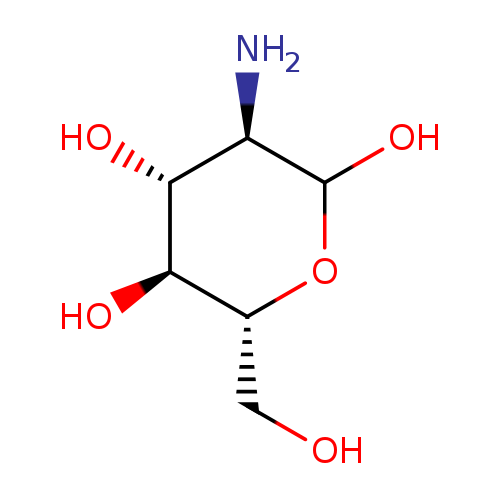
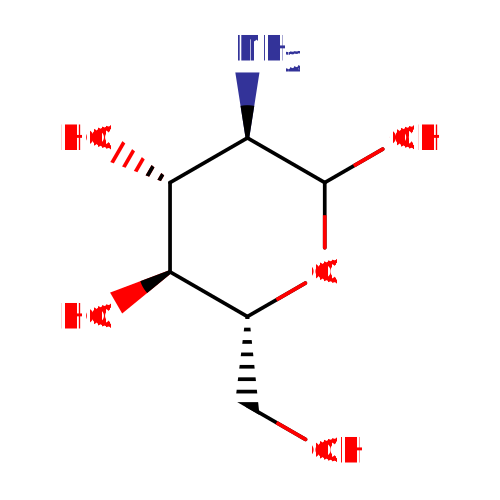
| Description | Glucosamine, also known as dona or chitosamine, belongs to the class of organic compounds known as hexoses. These are monosaccharides in which the sugar unit is a is a six-carbon containing moeity. Glucosamine exists as a solid, possibly soluble (in water), and a very strong basic compound (based on its pKa) molecule. Glucosamine exists in all living organisms, ranging from bacteria to humans. Glucosamine can be converted into glucosamine 6-phosphate; which is mediated by the enzyme hexokinase-1. In cattle, glucosamine is involved in the metabolic pathway called the amino sugar metabolism pathway. |
|---|
| Structure | |
|---|
| Synonyms | | Value | Source |
|---|
| 2-Amino-2-deoxy-D-glucose | ChEBI | | Chitosamine | ChEBI | | D-Glucosamine | ChEBI | | (+)-2-Amino-2-deoxy-D-glucopyranose | HMDB | | (3R,4R,5S,6R)-3-Amino-6-(hydroxymethyl)oxane-2,4,5-triol | HMDB | | 2-Amino-2-deoxy-D-glucopyranose | HMDB | | 2-Amino-2-deoxyglucose | HMDB | | 2-Aminoglucose | HMDB | | 2-Deoxy-2-amino-D-glucose | HMDB | | 2-Deoxy-2-aminoglucose | HMDB | | Cosamin | HMDB | | D-(+)-Glucosamine | HMDB | | Dona | HMDB | | Fides ecopharma brand OF glucosamine sulfate | HMDB | | Rottapharm brand OF glucosamine sulfate | HMDB | | Xicil | HMDB | | 2 Amino 2 deoxyglucose | HMDB | | Glucosamine sulfate | HMDB | | Sulfate, glucosamine | HMDB | | Dona S | HMDB | | Opfermann brand OF glucosamine sulfate | HMDB | | Hespercorbin | HMDB |
|
|---|
| Chemical Formula | C6H13NO5 |
|---|
| Average Molecular Weight | 179.1711 |
|---|
| Monoisotopic Molecular Weight | 179.079372531 |
|---|
| IUPAC Name | (3R,4R,5S,6R)-3-amino-6-(hydroxymethyl)oxane-2,4,5-triol |
|---|
| Traditional Name | glucosamine |
|---|
| CAS Registry Number | 3416-24-8 |
|---|
| SMILES | N[C@H]1C(O)O[C@H](CO)[C@@H](O)[C@@H]1O |
|---|
| InChI Identifier | InChI=1S/C6H13NO5/c7-3-5(10)4(9)2(1-8)12-6(3)11/h2-6,8-11H,1,7H2/t2-,3-,4-,5-,6?/m1/s1 |
|---|
| InChI Key | MSWZFWKMSRAUBD-IVMDWMLBSA-N |
|---|
| Chemical Taxonomy |
|---|
| Description | belongs to the class of organic compounds known as hexoses. These are monosaccharides in which the sugar unit is a is a six-carbon containing moeity. |
|---|
| Kingdom | Organic compounds |
|---|
| Super Class | Organic oxygen compounds |
|---|
| Class | Organooxygen compounds |
|---|
| Sub Class | Carbohydrates and carbohydrate conjugates |
|---|
| Direct Parent | Hexoses |
|---|
| Alternative Parents | |
|---|
| Substituents | - Hexose monosaccharide
- Amino saccharide
- Oxane
- 1,2-aminoalcohol
- Hemiacetal
- Secondary alcohol
- Polyol
- Organoheterocyclic compound
- Oxacycle
- Primary amine
- Primary alcohol
- Organopnictogen compound
- Organonitrogen compound
- Primary aliphatic amine
- Organic nitrogen compound
- Alcohol
- Amine
- Hydrocarbon derivative
- Aliphatic heteromonocyclic compound
|
|---|
| Molecular Framework | Aliphatic heteromonocyclic compounds |
|---|
| External Descriptors | |
|---|
| Ontology |
|---|
| Status | Detected but not Quantified |
|---|
| Origin | |
|---|
| Biofunction | Not Available |
|---|
| Application | Not Available |
|---|
| Cellular locations | - Cell membrane
- Cytoplasm
- Membrane
|
|---|
| Physical Properties |
|---|
| State | Solid |
|---|
| Experimental Properties | | Property | Value | Reference |
|---|
| Melting Point | Not Available | Not Available | | Boiling Point | Not Available | Not Available | | Water Solubility | Not Available | Not Available | | LogP | Not Available | Not Available |
|
|---|
| Predicted Properties | |
|---|
| Spectra |
|---|
| Spectra | |
|---|
| Biological Properties |
|---|
| Cellular Locations | - Cell membrane
- Cytoplasm
- Membrane
|
|---|
| Biospecimen Locations | - Cartilage
- Epidermis
- Fibroblasts
- Intestine
- Liver
- Milk
- Platelet
|
|---|
| Pathways | |
|---|
| Normal Concentrations |
|---|
| |
| Cartilage | Expected but not Quantified | Not Quantified | Not Specified | Not Specified | Normal | | details | | Epidermis | Expected but not Quantified | Not Quantified | Not Specified | Not Specified | Normal | | details | | Fibroblasts | Expected but not Quantified | Not Quantified | Not Specified | Not Specified | Normal | | details | | Intestine | Expected but not Quantified | Not Quantified | Not Specified | Not Specified | Normal | | details | | Liver | Detected but not Quantified | Not Quantified | Not Specified | Not Specified | Normal | | details | | Milk | Detected but not Quantified | Not Quantified | Not Specified | Not Specified | Normal | | details | | Milk | Detected but not Quantified | Not Quantified | Not Specified | Not Specified | Normal | | details | | Platelet | Expected but not Quantified | Not Quantified | Not Specified | Not Specified | Normal | | details |
|
|---|
| Abnormal Concentrations |
|---|
| Not Available |
|---|
| External Links |
|---|
| HMDB ID | HMDB0001514 |
|---|
| DrugBank ID | DB01296 |
|---|
| Phenol Explorer Compound ID | Not Available |
|---|
| FooDB ID | FDB022668 |
|---|
| KNApSAcK ID | Not Available |
|---|
| Chemspider ID | 388352 |
|---|
| KEGG Compound ID | C00329 |
|---|
| BioCyc ID | Not Available |
|---|
| BiGG ID | 34633 |
|---|
| Wikipedia Link | Glucosamine |
|---|
| METLIN ID | 266 |
|---|
| PubChem Compound | 439213 |
|---|
| PDB ID | Not Available |
|---|
| ChEBI ID | 47977 |
|---|
| References |
|---|
| Synthesis Reference | Li, Nan; Li, Jiheng. Preparation of D-glucosamine hydrochloride. Zhongguo Yaoke Daxue Xuebao (1997), 28(1), 56-58. |
|---|
| Material Safety Data Sheet (MSDS) | Not Available |
|---|
| General References | - Melzer N, Wittenburg D, Hartwig S, Jakubowski S, Kesting U, Willmitzer L, Lisec J, Reinsch N, Repsilber D: Investigating associations between milk metabolite profiles and milk traits of Holstein cows. J Dairy Sci. 2013 Mar;96(3):1521-34. doi: 10.3168/jds.2012-5743. [PubMed:23438684 ]
- Qian L, Zhao A, Zhang Y, Chen T, Zeisel SH, Jia W, Cai W: Metabolomic Approaches to Explore Chemical Diversity of Human Breast-Milk, Formula Milk and Bovine Milk. Int J Mol Sci. 2016 Dec 17;17(12). pii: ijms17122128. doi: 10.3390/ijms17122128. [PubMed:27999311 ]
|
|---|