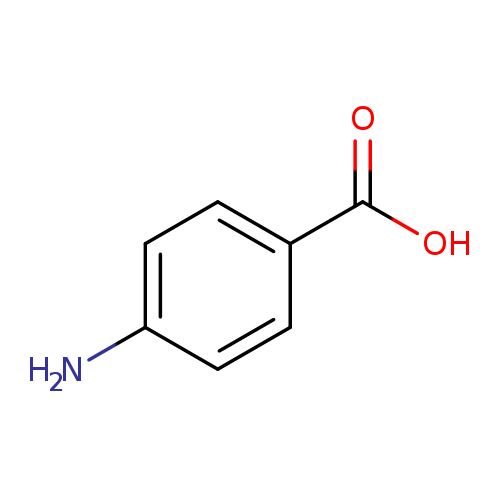
Record Information Version 1.0 Creation Date 2016-09-30 22:45:19 UTC Update Date 2026-11-27 16:53:45 UTC BMDB ID BMDB0001392 Secondary Accession Numbers Metabolite Identification Common Name p-Aminobenzoic acid Description 4-Aminobenzoic acid, also known as paba or p-aminobenzoate, belongs to the class of organic compounds known as aminobenzoic acids. These are benzoic acids containing an amine group attached to the benzene moiety. 4-Aminobenzoic acid exists as a solid, possibly soluble (in water), and a moderately basic compound (based on its pKa) molecule. 4-Aminobenzoic acid exists in all living species, ranging from bacteria to humans.
Structure Synonyms Value Source 1-Amino-4-carboxybenzene ChEBI 4-Amino-benzoic acid ChEBI 4-Aminobenzoesaeure ChEBI 4-Carboxyaniline ChEBI 4-Carboxyphenylamine ChEBI ABEE ChEBI gamma-Aminobenzoic acid ChEBI p-Aminobenzoesaeure ChEBI p-Carboxyaniline ChEBI p-Carboxyphenylamine ChEBI PABA ChEBI Para-aminobenzoic acid ChEBI 4-Aminobenzoic acid Kegg p-Aminobenzoate Kegg RVPaba lipstick Kegg 4-Amino-benzoate Generator g-Aminobenzoate Generator g-Aminobenzoic acid Generator gamma-Aminobenzoate Generator Γ-aminobenzoate Generator Γ-aminobenzoic acid Generator Para-aminobenzoate Generator 4-Aminobenzoate Generator acido P-Aminobenzoico HMDB Acidum paraminobenzoicum HMDB Actipol HMDB Amben HMDB Aminobenzoate HMDB Aminobenzoic acid HMDB, MeSH Aniline-4-carboxylate HMDB Aniline-4-carboxylic acid HMDB Anti-chromotrichia factor HMDB Anticanitic vitamin HMDB Anticantic vitamin HMDB Antichromotrichia factor HMDB Bacterial vitamin H1 HMDB Chromotrichia factor HMDB Hachemina HMDB, MeSH Kyselina P-aminobenzoova HMDB P-amino-Benzoate HMDB P-amino-Benzoic acid HMDB PAB HMDB Pabacyd HMDB Pabafilm HMDB Pabagel HMDB Pabamine HMDB Pabanol HMDB Papacidum HMDB Paraminol HMDB, MeSH Paranate HMDB Potaba HMDB, MeSH Romavit HMDB Rvpaba HMDB Sunbrella HMDB Super shade by coppertone HMDB Trichochromogenic factor HMDB Trochromogenic factor HMDB Vitamin BX HMDB Vitamin h' HMDB 4 Aminobenzoic acid MeSH, HMDB 4 Aminobenzoic acid, potassium salt MeSH, HMDB Epitelplast MeSH, HMDB Jumer brand OF aminobenzoic acid MeSH, HMDB Medea brand OF aminobenzoic acid MeSH, HMDB Paraminan MeSH, HMDB 4-Aminobenzoate, potassium MeSH, HMDB Epit vit MeSH, HMDB Llorens brand OF aminobenzoic acid MeSH, HMDB Pabasan MeSH, HMDB Potassium aminobenzoate MeSH, HMDB 4-Aminobenzoic acid, potassium salt MeSH, HMDB Aminobenzoate, potassium MeSH, HMDB Glenwood brand OF potassium aminobezoate MeSH, HMDB Llorens brand OF aminobenzoic acid sodium salt MeSH, HMDB Magnesium para-aminobenzoate MeSH, HMDB Potassium 4 aminobenzoate MeSH, HMDB Potassium 4-aminobenzoate MeSH, HMDB P Aminobenzoic acid MeSH, HMDB Para aminobenzoic acid MeSH, HMDB Para-aminobenzoate, magnesium MeSH, HMDB p-Aminobenzoic acid ChEBI
Chemical Formula C7 H7 NO2 Average Molecular Weight 137.136 Monoisotopic Molecular Weight 137.047678473 IUPAC Name 4-aminobenzoic acid Traditional Name sunbrella CAS Registry Number 150-13-0 SMILES NC1=CC=C(C=C1)C(O)=O
InChI Identifier InChI=1S/C7H7NO2/c8-6-3-1-5(2-4-6)7(9)10/h1-4H,8H2,(H,9,10)
InChI Key ALYNCZNDIQEVRV-UHFFFAOYSA-N Chemical Taxonomy Description belongs to the class of organic compounds known as aminobenzoic acids. These are benzoic acids containing an amine group attached to the benzene moiety. Kingdom Organic compounds Super Class Benzenoids Class Benzene and substituted derivatives Sub Class Benzoic acids and derivatives Direct Parent Aminobenzoic acids Alternative Parents Substituents Aminobenzoic acid
Benzoic acid
Benzoyl
Aniline or substituted anilines
Amino acid or derivatives
Amino acid
Carboxylic acid derivative
Carboxylic acid
Monocarboxylic acid or derivatives
Amine
Organonitrogen compound
Organooxygen compound
Primary amine
Hydrocarbon derivative
Organic oxide
Organopnictogen compound
Organic oxygen compound
Organic nitrogen compound
Aromatic homomonocyclic compound Molecular Framework Aromatic homomonocyclic compounds External Descriptors Ontology Status Detected but not Quantified Origin Biofunction Not Available
Application Not Available
Cellular locations Not Available
Physical Properties State Solid Experimental Properties Property Value Reference Melting Point 188.5 °C Not Available Boiling Point Not Available Not Available Water Solubility 6.11 mg/mL Not Available LogP 0.83 HANSCH,C ET AL. (1995)
Predicted Properties Spectra Spectra
Biological Properties Cellular Locations Not Available
Biospecimen Locations Epidermis
Fibroblasts
Intestine
Liver
Milk
Placenta
Prostate Tissue Body Locations
Udder: Milk
Skin: Epidermis, Fibroblasts
Liver: Liver
Intestines: Intestine
Reproductive organs: Placenta, Prostate Tissue, Prostate
Reproductive organs
Placenta
Organ in the uterus that connects the calf to the cow during pregnancy, exchanging nutrients, oxygen and waste.
Concentration references
Prostate Tissue
Gland of the male reproductive tract that adds fluid to semen.
Concentration references
Prostate
Gland of the male reproductive tract that adds fluid to semen.
Curated tissue location; no reference linked.
Skin
Epidermis
Outermost layer of the skin, which forms a protective barrier.
Concentration references
Fibroblasts
Cells that make collagen and other connective-tissue fibres; important in wound healing.
Concentration references
Intestines
Intestine
Long tube after the stomach where feed is digested and nutrients and water are absorbed.
Concentration references
Liver
Liver
Large organ that processes nutrients, makes glucose and proteins, breaks down toxins and makes bile. Central to energy metabolism in dairy cows.
Concentration references
Udder
Milk
Fluid secreted by the mammary gland to feed the calf; contains fat, protein, lactose, minerals and vitamins.
Concentration references
Environmental Sources Definition Detected in Jeevamrit No definition available details1 paper
These included organic acids such as organic acids such as benzoic acid, 2-methylbutanoic acid, crotonic acid, butanoic acid, propanoic acid, pentaonic acid, formic acid, 4-aminobenzoic acid, and dihydroxymalonic acid. Written in the paper as “4-aminobenzoic acid” and “Jeevamrit”
Pathways Concentrations Epidermis Expected but not Quantified Not Quantified Not Specified Not Specified Normal detailsFibroblasts Expected but not Quantified Not Quantified Not Specified Not Specified Normal detailsIntestine Expected but not Quantified Not Quantified Not Specified Not Specified Normal detailsLiver Expected but not Quantified Not Quantified Not Specified Not Specified Normal detailsMilk Detected but not Quantified Not Quantified Not Specified Not Specified Normal detailsPlacenta Expected but not Quantified Not Quantified Not Specified Not Specified Normal detailsProstate Tissue Expected but not Quantified Not Quantified Not Specified Not Specified Normal details
No abnormal concentrations recorded
External Links HMDB ID HMDB0001392 DrugBank ID DB02362 Phenol Explorer Compound ID Not Available FooDB ID FDB001037 KNApSAcK ID C00001401 Chemspider ID 953 KEGG Compound ID C00568 BioCyc ID P-AMINO-BENZOATE BiGG ID Not Available Wikipedia Link 4-Aminobenzoic_acid METLIN ID 3261 PubChem Compound 978 PDB ID Not Available ChEBI ID 30753 References Synthesis Reference Sato, Ryu; Kimura, Koichi; Takahashi, Akira. Preparation of p-aminobenzoic acid from styrene polymers. Jpn. Kokai Tokkyo Koho (2007), 13pp. Material Safety Data Sheet (MSDS) Not Available General References Mung D, Li L: Applying quantitative metabolomics based on chemical isotope labeling LC-MS for detecting potential milk adulterant in human milk. Anal Chim Acta. 2018 Feb 25;1001:78-85. doi: 10.1016/j.aca.2017.11.019. Epub 2017 Nov 14. [PubMed:29291809 ]