| Record Information |
|---|
| Version | 1.0 |
|---|
| Creation Date | 2016-09-30 22:45:15 UTC |
|---|
| Update Date | 2020-06-04 18:59:03 UTC |
|---|
| BMDB ID | BMDB0001389 |
|---|
| Secondary Accession Numbers | |
|---|
| Metabolite Identification |
|---|
| Common Name | Melatonin |
|---|
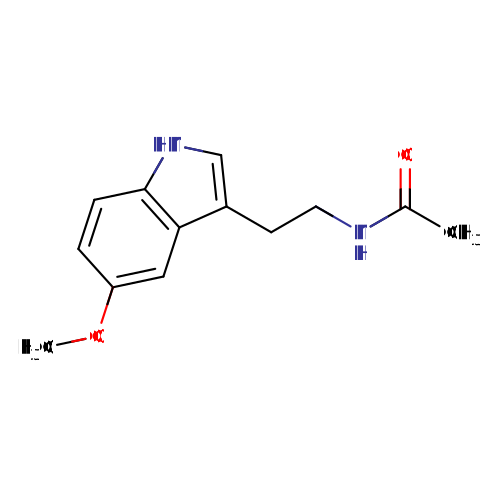
| Description | Melatonin, also known as circadin or melatol, belongs to the class of organic compounds known as 3-alkylindoles. 3-alkylindoles are compounds containing an indole moiety that carries an alkyl chain at the 3-position. Melatonin is a drug which is used orally for jet lag, insomnia, shift-work disorder, circadian rhythm disorders in the blind (evidence for efficacy), and benzodiazepine and nicotine withdrawal. evidence indicates that melatonin is likely effective for treating circadian rhythm sleep disorders in blind children and adults. it has received fda orphan drug status as an oral medication for this use. a number of studies have shown that melatonin may be effective for treating sleep-wake cycle disturbances in children and adolescents with mental retardation, autism, and other central nervous system disorders. it appears to decrease the time to fall asleep in children with developmental disabilities, such as cerebral palsy, autism, and mental retardation. it may also improve secondary insomnia associated with various sleep-wake cycle disturbances. other possible uses for which there is some evidence for include: benzodiazepine withdrawal, cluster headache, delayed sleep phase syndrome (dsps), primary insomnia, jet lag, nicotine withdrawal, preoperative anxiety and sedation, prostate cancer, solid tumors (when combined with il-2 therapy in certain cancers), sunburn prevention (topical use), tardive dyskinesia, thrombocytopenia associated with cancer, chemotherapy and other disorders. . Melatonin exists as a solid, possibly soluble (in water), and an extremely weak basic (essentially neutral) compound (based on its pKa) molecule. Melatonin exists in all living organisms, ranging from bacteria to humans. Melatonin participates in a number of enzymatic reactions, within cattle. In particular, Melatonin and S-adenosylhomocysteine can be biosynthesized from N-acetylserotonin and S-adenosylmethionine through the action of the enzyme acetylserotonin O-methyltransferase. In addition, Melatonin can be converted into 6-hydroxymelatonin; which is mediated by the enzyme cytochrome P450 1A1. In cattle, melatonin is involved in the metabolic pathway called the tryptophan metabolism pathway. Melatonin is a potentially toxic compound. |
|---|
| Structure | |
|---|
| Synonyms | | Value | Source |
|---|
| 5-Methoxy-N-acetyltryptamine | ChEBI | | Melatonine | ChEBI | | N-[2-(5-Methoxyindol-3-yl)ethyl]acetamide | ChEBI | | N-Acetyl-5-methoxytryptamine | ChEBI | | Melatonina | Kegg | | Circadin | HMDB | | Melatol | HMDB | | Melatonin (synth.) standard-grade | HMDB | | Melatonin (synth.) ultra-pure | HMDB | | Melovine | HMDB | | MT6 | HMDB | | N-(2-(5-Methoxy-1H-indol-3-yl)ethyl)acetamide | HMDB | | N-(2-(5-Methoxyindol-3-yl)ethyl)-acetamide | HMDB | | N-(2-(5-Methoxyindol-3-yl)ethyl)acetamide | HMDB | | N-Acetyl-5-methoxy-tryptamine | HMDB | | N-Acetyl-5-methoxy-tryptamine melatonine | HMDB | | N-[2-(5-Methoxy-1H-indol-3-yl)ethyl)acetamide | HMDB | | N-[2-(5-Methoxy-1H-indol-3-yl)ethyl]-acetamide | HMDB | | N-[2-(5-Methoxy-1H-indol-3-yl)ethyl]acetamide | HMDB | | N-[2-(5-Methoxyindol-3-yl)ethyl]-acetamide | HMDB | | Regulin | HMDB | | {N-[2-(5-methoxy-1H-indol-3-yl)ethyl]-} acetamide | HMDB | | {N-[2-(5-methoxyindol-3-yl)ethyl]-} acetamide | HMDB | | 3-(2-Acetamidoethyl)-5-methoxyindole | HMDB | | Melatonin | HMDB |
|
|---|
| Chemical Formula | C13H16N2O2 |
|---|
| Average Molecular Weight | 232.2783 |
|---|
| Monoisotopic Molecular Weight | 232.121177766 |
|---|
| IUPAC Name | N-[2-(5-methoxy-1H-indol-3-yl)ethyl]acetamide |
|---|
| Traditional Name | melatonin |
|---|
| CAS Registry Number | 73-31-4 |
|---|
| SMILES | COC1=CC2=C(NC=C2CCNC(C)=O)C=C1 |
|---|
| InChI Identifier | InChI=1S/C13H16N2O2/c1-9(16)14-6-5-10-8-15-13-4-3-11(17-2)7-12(10)13/h3-4,7-8,15H,5-6H2,1-2H3,(H,14,16) |
|---|
| InChI Key | DRLFMBDRBRZALE-UHFFFAOYSA-N |
|---|
| Chemical Taxonomy |
|---|
| Description | belongs to the class of organic compounds known as 3-alkylindoles. 3-alkylindoles are compounds containing an indole moiety that carries an alkyl chain at the 3-position. |
|---|
| Kingdom | Organic compounds |
|---|
| Super Class | Organoheterocyclic compounds |
|---|
| Class | Indoles and derivatives |
|---|
| Sub Class | Indoles |
|---|
| Direct Parent | 3-alkylindoles |
|---|
| Alternative Parents | |
|---|
| Substituents | - 3-alkylindole
- Anisole
- Alkyl aryl ether
- Substituted pyrrole
- Benzenoid
- Pyrrole
- Heteroaromatic compound
- Propargyl-type 1,3-dipolar organic compound
- Ether
- Carboximidic acid derivative
- Carboximidic acid
- Organic 1,3-dipolar compound
- Azacycle
- Organic oxygen compound
- Hydrocarbon derivative
- Organopnictogen compound
- Organic nitrogen compound
- Organooxygen compound
- Organonitrogen compound
- Aromatic heteropolycyclic compound
|
|---|
| Molecular Framework | Aromatic heteropolycyclic compounds |
|---|
| External Descriptors | |
|---|
| Ontology |
|---|
| Status | Detected and Quantified |
|---|
| Origin | |
|---|
| Biofunction | Not Available |
|---|
| Application | Not Available |
|---|
| Cellular locations | |
|---|
| Physical Properties |
|---|
| State | Solid |
|---|
| Experimental Properties | | Property | Value | Reference |
|---|
| Melting Point | Not Available | Not Available | | Boiling Point | Not Available | Not Available | | Water Solubility | Not Available | Not Available | | LogP | Not Available | Not Available |
|
|---|
| Predicted Properties | |
|---|
| Spectra |
|---|
| Spectra | |
|---|