| Record Information |
|---|
| Version | 1.0 |
|---|
| Creation Date | 2016-09-30 22:44:10 UTC |
|---|
| Update Date | 2020-05-21 16:28:30 UTC |
|---|
| BMDB ID | BMDB0001325 |
|---|
| Secondary Accession Numbers | |
|---|
| Metabolite Identification |
|---|
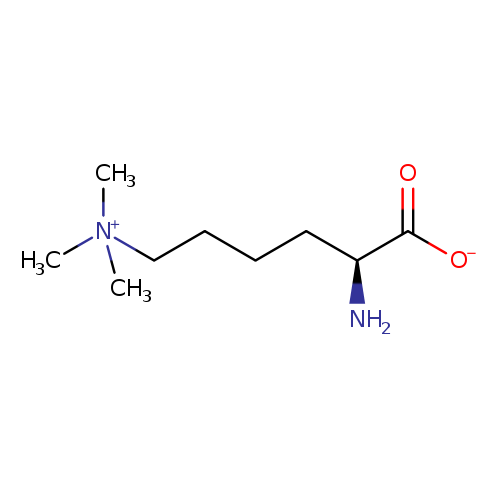
| Common Name | N6,N6,N6-Trimethyl-L-lysine |
|---|
| Description | N6,N6,N6-Trimethyl-L-lysine, also known as epsilon-N-trimethyl-L-lysine or n6,n6,n6-trimethyl-l-lysine, belongs to the class of organic compounds known as l-alpha-amino acids. These are alpha amino acids which have the L-configuration of the alpha-carbon atom. N6,N6,N6-Trimethyl-L-lysine is possibly soluble (in water) and a very strong basic compound (based on its pKa). N6,N6,N6-Trimethyl-L-lysine exists in all living organisms, ranging from bacteria to humans. N6,N6,N6-Trimethyl-L-lysine participates in a number of enzymatic reactions, within cattle. In particular, N6,N6,N6-Trimethyl-L-lysine and S-adenosylhomocysteine can be biosynthesized from L-lysine and S-adenosylmethionine; which is catalyzed by the enzyme histone-lysine N-methyltransferase SETD7. In addition, N6,N6,N6-Trimethyl-L-lysine and oxoglutaric acid can be converted into 3-hydroxy-N6,N6,N6-trimethyl-L-lysine and succinic acid; which is mediated by the enzyme n6,n6,n6-trimethyl-l-lysine dioxygenase, mitochondrial. In cattle, N6,N6,N6-trimethyl-L-lysine is involved in the metabolic pathway called carnitine synthesis pathway. |
|---|
| Structure | |
|---|
| Synonyms | | Value | Source |
|---|
| (S)-2-Amino-6-(trimethylammonio)hexanoate | HMDB | | (S)-2-Amino-6-(trimethylammonio)hexanoic acid | HMDB | | delta-Trimethyllysine | HMDB | | epsilon-N-Trimethyl-L-lysine | HMDB | | epsilon-Trimethyl-L-lysine | HMDB | | N(6),N(6),N(6)-Trimethyl-L-lysine | HMDB | | S)-5-Amino-5-carboxy-N,N,N-trimethyl-1-pentanaminium | HMDB | | Trimethyllysine | HMDB | | 6-N-L-Trimethyl-L-lysine | HMDB | | epsilon-N-Trimethyl-lysine | HMDB | | TRIMETHYLLLYSINE | HMDB | | Trimethyllysine hydroxide, inner salt, (S)-isomer | HMDB | | Trimethyllysine, (+-)-isomer | HMDB | | Trimethyllysine hydroxide,inner salt, (+-)-isomer | HMDB | | Trimethyllysine chloride, (S)-isomer | HMDB | | (2S)-2-Amino-6-(trimethylazaniumyl)hexanoic acid | HMDB |
|
|---|
| Chemical Formula | C9H20N2O2 |
|---|
| Average Molecular Weight | 188.2673 |
|---|
| Monoisotopic Molecular Weight | 188.152477894 |
|---|
| IUPAC Name | (2S)-2-amino-6-(trimethylazaniumyl)hexanoate |
|---|
| Traditional Name | n-trimethyllysine |
|---|
| CAS Registry Number | 19253-88-4 |
|---|
| SMILES | C[N+](C)(C)CCCC[C@H](N)C([O-])=O |
|---|
| InChI Identifier | InChI=1S/C9H20N2O2/c1-11(2,3)7-5-4-6-8(10)9(12)13/h8H,4-7,10H2,1-3H3/t8-/m0/s1 |
|---|
| InChI Key | MXNRLFUSFKVQSK-QMMMGPOBSA-N |
|---|
| Chemical Taxonomy |
|---|
| Description | belongs to the class of organic compounds known as l-alpha-amino acids. These are alpha amino acids which have the L-configuration of the alpha-carbon atom. |
|---|
| Kingdom | Organic compounds |
|---|
| Super Class | Organic acids and derivatives |
|---|
| Class | Carboxylic acids and derivatives |
|---|
| Sub Class | Amino acids, peptides, and analogues |
|---|
| Direct Parent | L-alpha-amino acids |
|---|
| Alternative Parents | |
|---|
| Substituents | - L-alpha-amino acid
- Medium-chain fatty acid
- Amino fatty acid
- Fatty acyl
- Fatty acid
- Tetraalkylammonium salt
- Quaternary ammonium salt
- Carboxylic acid salt
- Amino acid
- Carboxylic acid
- Monocarboxylic acid or derivatives
- Amine
- Organic zwitterion
- Organic salt
- Hydrocarbon derivative
- Primary amine
- Organooxygen compound
- Organonitrogen compound
- Organic oxide
- Primary aliphatic amine
- Organopnictogen compound
- Organic oxygen compound
- Carbonyl group
- Organic nitrogen compound
- Aliphatic acyclic compound
|
|---|
| Molecular Framework | Aliphatic acyclic compounds |
|---|
| External Descriptors | Not Available |
|---|
| Ontology |
|---|
| Status | Expected but not Quantified |
|---|
| Origin | |
|---|
| Biofunction | Not Available |
|---|
| Application | Not Available |
|---|
| Cellular locations | - Cytoplasm
- Endoplasmic reticulum
|
|---|
| Physical Properties |
|---|
| State | Solid |
|---|
| Experimental Properties | | Property | Value | Reference |
|---|
| Melting Point | Not Available | Not Available | | Boiling Point | Not Available | Not Available | | Water Solubility | Not Available | Not Available | | LogP | Not Available | Not Available |
|
|---|
| Predicted Properties | |
|---|
| Spectra |
|---|
| Spectra | |
|---|