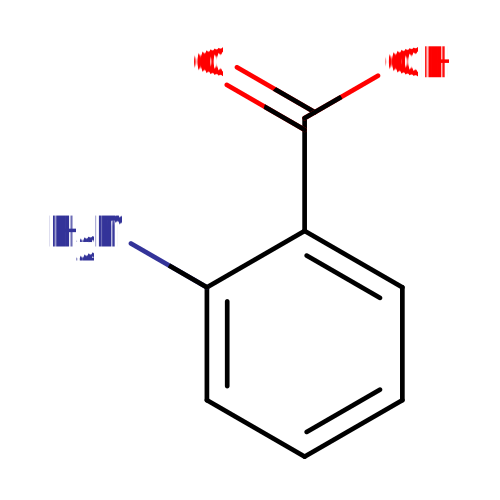
2-Aminobenzoic acid, also known as 2-aminobenzoic acid or 2-aminobenzoic acid, belongs to the class of organic compounds known as aminobenzoic acids. These are benzoic acids containing an amine group attached to the benzene moiety. 2-Aminobenzoic acid exists as a solid, possibly soluble (in water), and a moderately basic compound (based on its pKa) molecule. 2-Aminobenzoic acid exists in all living species, ranging from bacteria to humans. 2-Aminobenzoic acid participates in a number of enzymatic reactions, within cattle. In particular, 2-Aminobenzoic acid and formic acid can be biosynthesized from formyl2-aminobenzoic acid; which is mediated by the enzyme kynurenine formamidase. In addition, 2-Aminobenzoic acid and L-alanine can be biosynthesized from L-kynurenine through the action of the enzyme kynureninase. In cattle, 2-aminobenzoic acid is involved in the metabolic pathway called the tryptophan metabolism pathway. 2-Aminobenzoic acid is a potentially toxic compound.
belongs to the class of organic compounds known as aminobenzoic acids. These are benzoic acids containing an amine group attached to the benzene moiety.
Pus is a bodily fluid consisting of a whitish-yellow or yellow substance produced during inflammatory responses of the body that can be found in regions of pyogenic bacterial infections. Pus is produced from the dead and living cells which travel into the intercellular spaces around the affected cells.
Among the 15 amino acid metabolites in the top 50 biochemicals, four were tryptophan metabolites, indoleacrylate, indolepropionate, tryptamine, and anthranilate.
Written in the paper as “anthranilate” and “Abscess purulent materials”
A localized, circumscribed collection of purulent material (pus) within the liver parenchyma, typically resulting from a bacterial, parasitic, or fungal infection. Unlike hepatitis, which is often diffuse, an abscess is a focal lesion.
Among the 15 amino acid metabolites in the top 50 biochemicals, four were tryptophan metabolites, indoleacrylate, indolepropionate, tryptamine, and anthranilate.
Written in the paper as “anthranilate” and “liver abscesses”
Biological Processes
Relation
Term
Definition
Sources
Involved in
'de novo' NAD+ biosynthetic process from L-tryptophan GO:0034354
The chemical reactions and pathways resulting in the formation of nicotinamide adenine dinucleotide (NAD+), beginning with the catabolism of L-tryptophan into the precursor quinolinate. NAD+ is a coenzyme that interconverts with its reduced form, NADH, in many redox and catabolic reactions.
AA, 3-HAA and quinolinic acid have been known as an electron donor or precursor with properties of primary or secondary antioxidants [39, 40, 41] in the tryptophan kynurenine pathway, a route for cellular energy generation [42].
Written in the paper as “Anthranilic acid” and “tryptophan kynurenine pathway”
Anthranilate metabolism is a central node in P. aeruginosa physiology, linking aromatic amino acid biosynthesis, quorum sensing, and production of secondary metabolites [90].
Written in the paper as “anthranilate” and “anthranilate metabolism”
Involved in
aromatic amino acid biosynthetic process GO:0009073
The chemical reactions and pathways resulting in the formation of an amino acid whose structure includes an aromatic ring.
In all positive genomes, the prophage integrated between anthranilate synthase component I and anthranilate phosphoribosyltransferase, genes involved in aromatic amino acid biosynthesis.
Written in the paper as “anthranilate” and “aromatic amino acid biosynthesis”
The cell-cell signaling process in which single-celled organisms carry out coordinated responses by monitoring their own population density, and often also that of other microbes, by producing small, diffusible, signal molecules, detecting the concentration of these molecules, and triggering a signal transduction pathway when a certain threshold is reached. Quorum sensing can occur amongst microbial communities in the environment or within host organisms.
Anthranilate metabolism is a central node in P. aeruginosa physiology, linking aromatic amino acid biosynthesis, quorum sensing, and production of secondary metabolites [90].
Written in the paper as “anthranilate” and “quorum sensing”
Involved in
secondary metabolite biosynthetic process GO:0044550
The chemical reactions and pathways resulting in the formation of secondary metabolites, the compounds that are not necessarily required for growth and maintenance of cells, and are often unique to a taxon.
Anthranilate metabolism is a central node in P. aeruginosa physiology, linking aromatic amino acid biosynthesis, quorum sensing, and production of secondary metabolites [90].
Written in the paper as “anthranilate” and “production of secondary metabolites”
AA, 3-HAA and quinolinic acid have been known as an electron donor or precursor with properties of primary or secondary antioxidants [39, 40, 41] in the tryptophan kynurenine pathway, a route for cellular energy generation [42].
Written in the paper as “Anthranilic acid” and “primary or secondary antioxidants”
AA, 3-HAA and quinolinic acid have been known as an electron donor or precursor with properties of primary or secondary antioxidants [39, 40, 41] in the tryptophan kynurenine pathway, a route for cellular energy generation [42].
Written in the paper as “Anthranilic acid” and “electron donor”
AA, 3-HAA and quinolinic acid have been known as an electron donor or precursor with properties of primary or secondary antioxidants [39, 40, 41] in the tryptophan kynurenine pathway, a route for cellular energy generation [42].
Written in the paper as “Anthranilic acid” and “precursor”
Catalyzes the cleavage of L-kynurenine (L-Kyn) and L-3-hydroxykynurenine (L-3OHKyn) into anthranilic acid (AA) and 3-hydroxyanthranilic acid (3-OHAA), respectively. Has a preference for the L-3-hydroxy form. Also has cysteine-conjugate-beta-lyase activity.
Catalyzes the hydrolysis of N-formyl-L-kynurenine to L-kynurenine, the second step in the kynurenine pathway of tryptophan degradation. Kynurenine may be further oxidized to nicotinic acid, NAD(H) and NADP(H). Required for elimination of toxic metabolites.