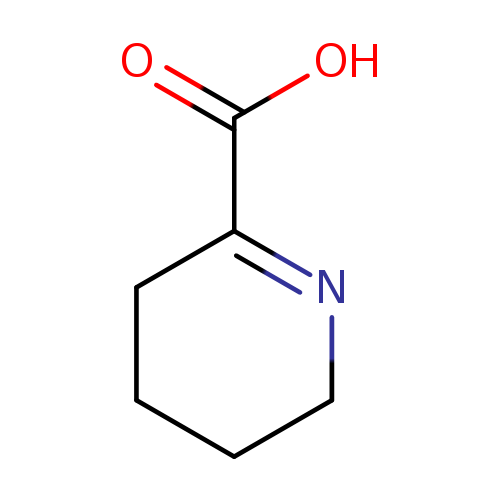
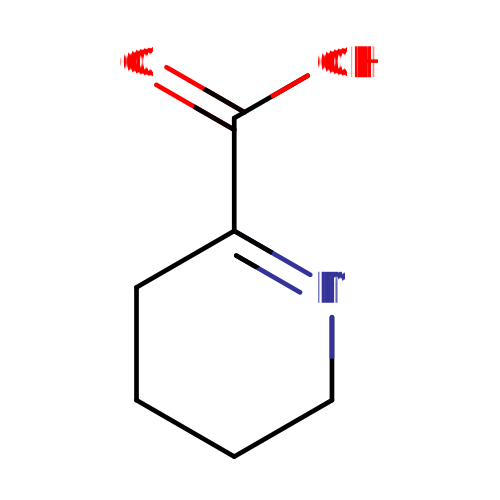
Record Information Version 1.0 Creation Date 2016-09-30 22:40:52 UTC Update Date 2026-11-27 18:48:37 UTC BMDB ID BMDB0001084 Secondary Accession Numbers Metabolite Identification Common Name D-1-Piperideine-2-carboxylic acid Description 1-Piperideine-2-carboxylic acid, also known as delta(1)-piperidine-2-carboxylate or 1,2-didehydropiperidine-2-carboxylate, belongs to the class of organic compounds known as tetrahydropyridines. These are derivatives of pyridine in which two double bonds in the pyridine moiety are reduced by adding four hydrogen atoms. 1-Piperideine-2-carboxylic acid is a moderately basic compound (based on its pKa).
Structure Synonyms Value Source 1,2-Didehydropiperidine-2-carboxylate ChEBI Delta(1)-Piperidine-2-carboxylic acid ChEBI 1-Piperideine-2-carboxylate Kegg 1,2-Didehydropiperidine-2-carboxylic acid Generator delta(1)-Piperidine-2-carboxylate Generator Δ(1)-piperidine-2-carboxylate Generator Δ(1)-piperidine-2-carboxylic acid Generator D-1-Piperideine-2-carboxylate HMDB delta(1)-Piperideine-2-carboxylate HMDB Delta1-Piperideine-2-carboxylate HMDB 1-p-2-CA HMDB delta 1-Piperideine-2-carboxylate HMDB delta1-Piperideine-2-carboxylic acid HMDB Δ1-piperideine-2-carboxylate HMDB Δ1-piperideine-2-carboxylic acid HMDB 3,4,5,6-Tetrahydro-2-pyridinecarboxylate HMDB 3,4,5,6-Tetrahydro-2-pyridinecarboxylic acid HMDB D-1-Piperideine-2-carboxylic acid HMDB delta1-Pipecolic acid HMDB delta1-Piperidine-2-carboxylate HMDB delta1-Piperidine-2-carboxylic acid HMDB Δ1-pipecolic acid HMDB Δ1-piperidine-2-carboxylate HMDB Δ1-piperidine-2-carboxylic acid HMDB P2C HMDB 1-Piperideine-2-carboxylic acid Generator
Chemical Formula C6 H9 NO2 Average Molecular Weight 127.1412 Monoisotopic Molecular Weight 127.063328537 IUPAC Name 3,4,5,6-tetrahydropyridine-2-carboxylic acid Traditional Name 1-piperideine-2-carboxylate CAS Registry Number 2756-89-0 SMILES OC(=O)C1=NCCCC1
InChI Identifier InChI=1S/C6H9NO2/c8-6(9)5-3-1-2-4-7-5/h1-4H2,(H,8,9)
InChI Key GEJXSVNGWOSZPC-UHFFFAOYSA-N Chemical Taxonomy Description belongs to the class of organic compounds known as tetrahydropyridines. These are derivatives of pyridine in which two double bonds in the pyridine moiety are reduced by adding four hydrogen atoms. Kingdom Organic compounds Super Class Organoheterocyclic compounds Class Pyridines and derivatives Sub Class Hydropyridines Direct Parent Tetrahydropyridines Alternative Parents Substituents Tetrahydropyridine
Ketimine
Carboxylic acid derivative
Carboxylic acid
Monocarboxylic acid or derivatives
Azacycle
Organic 1,3-dipolar compound
Propargyl-type 1,3-dipolar organic compound
Carbonyl group
Hydrocarbon derivative
Organooxygen compound
Organonitrogen compound
Organic oxide
Organopnictogen compound
Imine
Organic oxygen compound
Organic nitrogen compound
Aliphatic heteromonocyclic compound Molecular Framework Aliphatic heteromonocyclic compounds External Descriptors Ontology Status Expected but not Quantified Origin Not Available Biofunction Not Available
Application Not Available
Cellular locations Physical Properties State Solid Experimental Properties Property Value Reference Melting Point Not Available Not Available Boiling Point Not Available Not Available Water Solubility Not Available Not Available LogP Not Available Not Available
Predicted Properties Spectra Spectra
Biological Properties Cellular Locations Biospecimen Locations Body Locations
Brain: Brain
Brain
Brain
Main organ of the nervous system, inside the skull. Controls the body and processes senses.
Concentration references
Health Effects Definition Elevated in Lameness No definition available details1 paper
In addition, we observed an increase in 1-piperideine-2-carboxylic acid, which is a metabolite in the pipecolic acid pathway of lysine degradation.58 Written in the paper as “1-piperideine-2-carboxylic acid” and “lameness”
Biological Processes Definition Involved in amino acid catabolic process GO:0009063 The chemical reactions and pathways resulting in the breakdown of amino acids, organic acids containing one or more amino substituents. details1 paper
Meanwhile, the reduction of D-1-Piperideine-2-carboxylic acid, a lysine degradation intermediate, suggests perturbations in amino acid catabolic pathways. Written in the paper as “D-1-Piperideine-2-carboxylic acid” and “amino acid catabolic pathways”
Involved in pipecolic acid pathway of lysine degradation No definition available details1 paper
In addition, we observed an increase in 1-piperideine-2-carboxylic acid, which is a metabolite in the pipecolic acid pathway of lysine degradation.58 Written in the paper as “1-piperideine-2-carboxylic acid” and “pipecolic acid pathway of lysine degradation”
Pathways Concentrations Brain Expected but not Quantified Not Quantified Not Specified Not Specified Normal details
No abnormal concentrations recorded
External Links HMDB ID HMDB0001084 DrugBank ID Not Available Phenol Explorer Compound ID Not Available FooDB ID FDB022415 KNApSAcK ID Not Available Chemspider ID 1157 KEGG Compound ID C04092 BioCyc ID Not Available BiGG ID 35015 Wikipedia Link Not Available METLIN ID 5992 PubChem Compound 1194 PDB ID Not Available ChEBI ID 30912 References Synthesis Reference Noguchi, Yuichi; Kanda, Kiyoo; Hosoda, Taku; Akiyama, Katsumi. D1-Piperidine-2-carboxylic acid isolation from fermentatin broth. Jpn. Tokkyo Koho (1971), 5 pp. Material Safety Data Sheet (MSDS) Not Available General References Not Available