| Record Information |
|---|
| Version | 1.0 |
|---|
| Creation Date | 2016-09-30 22:38:32 UTC |
|---|
| Update Date | 2020-05-11 20:38:17 UTC |
|---|
| BMDB ID | BMDB0000912 |
|---|
| Secondary Accession Numbers | |
|---|
| Metabolite Identification |
|---|
| Common Name | Succinyladenosine |
|---|
| Description | Succinyladenosine belongs to the class of organic compounds known as purine nucleosides. Purine nucleosides are compounds comprising a purine base attached to a ribosyl or deoxyribosyl moiety. In cattle, succinyladenosine is involved in the metabolic pathway called the aspartate metabolism pathway. Succinyladenosine, with regard to humans, has been found to be associated with the diseases such as autism; succinyladenosine has also been linked to several inborn metabolic disorders including adenylosuccinate lyase deficiency and fumarase deficiency. Based on a literature review a significant number of articles have been published on Succinyladenosine. |
|---|
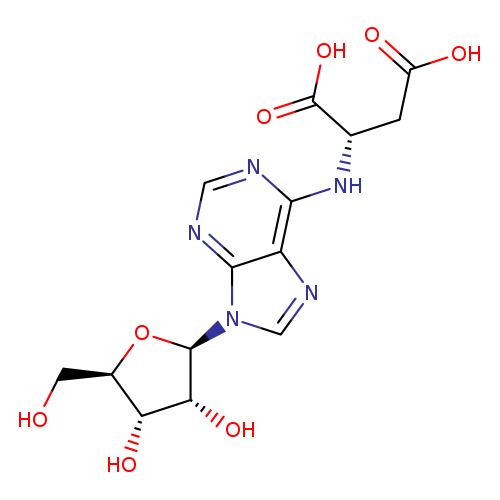
| Structure | |
|---|
| Synonyms | | Value | Source |
|---|
| (S)-N-(1,2-Dicarboxyethyl)-adenosine | ChEBI | | 6-(1,2-Dicarboxyethylamino)-9-beta-D-ribofuranosylpurine | ChEBI | | N-(9-beta-D-Ribofuranosyl-9H-purin-6-yl)-L-aspartic acid | ChEBI | | N-9-Ribofuranosyl-9H-purin-6-yl-aspartic acid | ChEBI | | Succinoadenosine | ChEBI | | 6-(1,2-Dicarboxyethylamino)-9-b-D-ribofuranosylpurine | Generator | | 6-(1,2-Dicarboxyethylamino)-9-β-D-ribofuranosylpurine | Generator | | N-(9-b-D-Ribofuranosyl-9H-purin-6-yl)-L-aspartate | Generator | | N-(9-b-D-Ribofuranosyl-9H-purin-6-yl)-L-aspartic acid | Generator | | N-(9-beta-D-Ribofuranosyl-9H-purin-6-yl)-L-aspartate | Generator | | N-(9-Β-D-ribofuranosyl-9H-purin-6-yl)-L-aspartate | Generator | | N-(9-Β-D-ribofuranosyl-9H-purin-6-yl)-L-aspartic acid | Generator | | N-9-Ribofuranosyl-9H-purin-6-yl-aspartate | Generator | | 6-(1,2-Dicarboxyethylamino)-9-beta-delta-ribofuranosylpurine | HMDB | | N-(9-beta-delta-Ribofuranosyl-9H-purin-6-yl)-L-aspartate | HMDB | | N-(9-beta-delta-Ribofuranosyl-9H-purin-6-yl)-L-aspartic acid | HMDB |
|
|---|
| Chemical Formula | C14H17N5O8 |
|---|
| Average Molecular Weight | 383.3135 |
|---|
| Monoisotopic Molecular Weight | 383.107712545 |
|---|
| IUPAC Name | (2S)-2-({9-[(2R,3R,4S,5R)-3,4-dihydroxy-5-(hydroxymethyl)oxolan-2-yl]-9H-purin-6-yl}amino)butanedioic acid |
|---|
| Traditional Name | atp - adenosine triphosphate |
|---|
| CAS Registry Number | 4542-23-8 |
|---|
| SMILES | OC[C@H]1O[C@H]([C@H](O)[C@@H]1O)N1C=NC2=C(N[C@@H](CC(O)=O)C(O)=O)N=CN=C12 |
|---|
| InChI Identifier | InChI=1S/C14H17N5O8/c20-2-6-9(23)10(24)13(27-6)19-4-17-8-11(15-3-16-12(8)19)18-5(14(25)26)1-7(21)22/h3-6,9-10,13,20,23-24H,1-2H2,(H,21,22)(H,25,26)(H,15,16,18)/t5-,6+,9+,10+,13+/m0/s1 |
|---|
| InChI Key | VKGZCEJTCKHMRL-VWJPMABRSA-N |
|---|
| Chemical Taxonomy |
|---|
| Description | belongs to the class of organic compounds known as purine nucleosides. Purine nucleosides are compounds comprising a purine base attached to a ribosyl or deoxyribosyl moiety. |
|---|
| Kingdom | Organic compounds |
|---|
| Super Class | Nucleosides, nucleotides, and analogues |
|---|
| Class | Purine nucleosides |
|---|
| Sub Class | Not Available |
|---|
| Direct Parent | Purine nucleosides |
|---|
| Alternative Parents | |
|---|
| Substituents | - Purine nucleoside
- Aspartic acid or derivatives
- Glycosyl compound
- N-glycosyl compound
- 6-alkylaminopurine
- 6-aminopurine
- Alpha-amino acid or derivatives
- Pentose monosaccharide
- L-alpha-amino acid
- Imidazopyrimidine
- Purine
- Aminopyrimidine
- Secondary aliphatic/aromatic amine
- N-substituted imidazole
- Monosaccharide
- Pyrimidine
- Dicarboxylic acid or derivatives
- Imidolactam
- Heteroaromatic compound
- Imidazole
- Tetrahydrofuran
- Azole
- Amino acid or derivatives
- Secondary alcohol
- Amino acid
- Carboxylic acid derivative
- Carboxylic acid
- Oxacycle
- Azacycle
- Organoheterocyclic compound
- Secondary amine
- Organic oxygen compound
- Alcohol
- Organic nitrogen compound
- Carbonyl group
- Hydrocarbon derivative
- Amine
- Organopnictogen compound
- Organic oxide
- Primary alcohol
- Organooxygen compound
- Organonitrogen compound
- Aromatic heteropolycyclic compound
|
|---|
| Molecular Framework | Aromatic heteropolycyclic compounds |
|---|
| External Descriptors | |
|---|
| Ontology |
|---|
| Status | Expected but not Quantified |
|---|
| Origin | |
|---|
| Biofunction | Not Available |
|---|
| Application | Not Available |
|---|
| Cellular locations | |
|---|
| Physical Properties |
|---|
| State | Solid |
|---|
| Experimental Properties | | Property | Value | Reference |
|---|
| Melting Point | 233 - 238 °C | Not Available | | Boiling Point | Not Available | Not Available | | Water Solubility | Not Available | Not Available | | LogP | Not Available | Not Available |
|
|---|
| Predicted Properties | |
|---|
| Spectra |
|---|
| Spectra | |
|---|