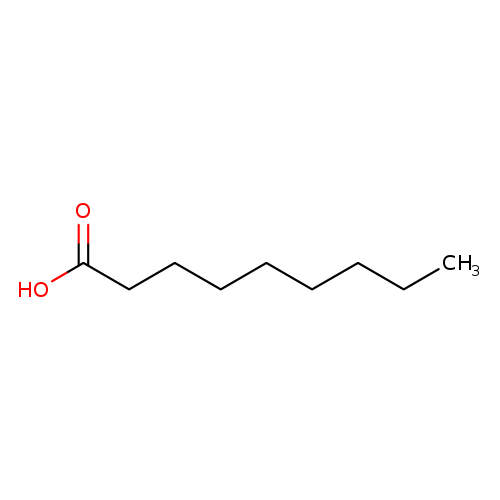
Record Information Version 1.0 Creation Date 2016-09-30 22:37:27 UTC Update Date 2026-11-27 18:26:17 UTC BMDB ID BMDB0000847 Secondary Accession Numbers Metabolite Identification Common Name Pelargonic acid Description Nonanoic acid, also known as pelargon or nonanoate, belongs to the class of organic compounds known as medium-chain fatty acids. These are fatty acids with an aliphatic tail that contains between 4 and 12 carbon atoms. Nonanoic acid exists as a liquid, very hydrophobic, practically insoluble (in water), and relatively neutral molecule. Nonanoic acid exists in all living species, ranging from bacteria to humans. Nonanoic acid is a potentially toxic compound.
Structure Synonyms Value Source 1-Nonanoic acid ChEBI 1-Octanecarboxylic acid ChEBI CH3-[CH2]7-COOH ChEBI N-Nonanoic acid ChEBI Nonanoate ChEBI Nonansaeure ChEBI Nonoic acid ChEBI Nonylic acid ChEBI Pelargic acid ChEBI Pelargon ChEBI Pelargonsaeure ChEBI Pergonic acid ChEBI 1-Nonanoate Generator 1-Octanecarboxylate Generator N-Nonanoate Generator Nonanoic acid Generator Nonoate Generator Nonylate Generator Pelargate Generator Pergonate Generator Pelargonate Generator Cirrasol 185a HMDB Emery 1202 HMDB Emery'S L-114 HMDB Emfac 1202 HMDB Hexacid C-9 HMDB N-Nonoate HMDB N-Nonoic acid HMDB N-Nonylate HMDB N-Nonylic acid HMDB N-Pelargonate HMDB N-Pelargonic acid HMDB Pelargonic acid, calcium salt HMDB Potassium nonanoate HMDB Pelargonic acid, cadmium salt HMDB Pelargonic acid, sodium salt HMDB Pelargonic acid, zinc salt HMDB Pelargonic acid, aluminum salt HMDB Pelargonic acid, potassium salt HMDB FA(9:0) HMDB Pelargonic acid ChEBI
Chemical Formula C9 H18 O2 Average Molecular Weight 158.238 Monoisotopic Molecular Weight 158.13067982 IUPAC Name nonanoic acid Traditional Name nonanoic acid CAS Registry Number 112-05-0 SMILES CCCCCCCCC(O)=O
InChI Identifier InChI=1S/C9H18O2/c1-2-3-4-5-6-7-8-9(10)11/h2-8H2,1H3,(H,10,11)
InChI Key FBUKVWPVBMHYJY-UHFFFAOYSA-N Chemical Taxonomy Description belongs to the class of organic compounds known as medium-chain fatty acids. These are fatty acids with an aliphatic tail that contains between 4 and 12 carbon atoms. Kingdom Organic compounds Super Class Lipids and lipid-like molecules Class Fatty Acyls Sub Class Fatty acids and conjugates Direct Parent Medium-chain fatty acids Alternative Parents Substituents Medium-chain fatty acid
Straight chain fatty acid
Monocarboxylic acid or derivatives
Carboxylic acid
Carboxylic acid derivative
Organic oxygen compound
Organic oxide
Hydrocarbon derivative
Organooxygen compound
Carbonyl group
Aliphatic acyclic compound Molecular Framework Aliphatic acyclic compounds External Descriptors Ontology Status Detected and Quantified Origin Biofunction Not Available
Application Not Available
Cellular locations Adiposome
Cell membrane
Cytoplasm
Membrane Physical Properties State Liquid Experimental Properties Property Value Reference Melting Point 12.3 °C Not Available Boiling Point Not Available Not Available Water Solubility 0.284 mg/mL Not Available LogP 3.42 SANGSTER (1993)
Predicted Properties Spectra Spectra
Biological Properties Cellular Locations Adiposome
Cell membrane
Cytoplasm
Membrane Biospecimen Locations Epidermis
Liver
Mammary Gland
Milk
Semen Body Locations
Udder: Milk, Mammary Gland
Bone: Synovial Fluid
Skin: Epidermis
Liver: Liver
Reproductive organs: Semen, Spermatozoa
Udder
Milk
Fluid secreted by the mammary gland to feed the calf; contains fat, protein, lactose, minerals and vitamins.
Concentration references
Mammary Gland
The udder, the gland that makes milk.
Concentration references
Liver
Liver
Large organ that processes nutrients, makes glucose and proteins, breaks down toxins and makes bile. Central to energy metabolism in dairy cows.
Concentration references
Reproductive organs
Semen
Fluid ejaculated by a bull, containing sperm and fluid from the accessory glands.
Concentration references
Spermatozoa
Male reproductive cells that fertilise the egg.
Papers
Skin
Epidermis
Outermost layer of the skin, which forms a protective barrier.
Concentration references
Location Evidence Definition Detected in Spermatozoa Male reproductive cells that fertilise the egg. details1 paper
Our analytical methods allowed the detection of considerable amounts of nonanoic acid and azelaic acid in bull spermatozoa. Written in the paper as “nonanoic acid” and “spermatozoa”
Detected in Synovial Fluid UBERON:0001090 Joint fluid is a transudate of plasma that is actively secreted by synovial cells. details1 paper
Six fatty acids were detected, including myristic acid, stearic acid, palmitic acid, heptadecanoic acid, pelargonic acid and oleic acid (Fig. 2B). Written in the paper as “pelargonic acid” and “synovial fluid”
Biological Processes Definition Activates phosphorylation of various protein kinases No definition available details1 paper
In addition, OR51E1, a known receptor of nonanoic acid, was detected in the acrosomal cap of human spermatozoa [88, 89], and activation of OR51E1 with nonanoic acid led to the phosphorylation of various protein kinases [90]. Written in the paper as “nonanoic acid” and “phosphorylation of various protein kinases”
Production Traits Definition Is biomarker of milk protein yield CMO:0000796 The total amount of milk protein produced over a specific period of time. details2 papers
Hippuric acid, nicotinamide, and pelargonic acid are milk protein biomarkers (Wu et al. 2018). Written in the paper as “pelargonic acid” and “milk protein yield”
Hippuric acid, nicotinamide and pelargonic acid out of 36 significant metabolites were identified to play the key roles in MPY metabolism [8], whereas a-ketoglutarate and succinic acid were found in the network of feed efficiency [9]. Written in the paper as “pelargonic acid” and “milk protein yield”
Pathways Concentrations Epidermis Expected but not Quantified Not Quantified Not Specified Not Specified Normal detailsLiver Detected but not Quantified Not Quantified Not Specified Not Specified Normal detailsLiver Detected but not Quantified Not Quantified Not Specified Not Specified Normal detailsLiver Detected but not Quantified Not Quantified Not Specified Not Specified Normal detailsMammary Gland Detected but not Quantified Not Quantified Not Specified Not Specified Normal detailsMammary Gland Detected but not Quantified Not Quantified Not Specified Not Specified Normal detailsMilk Detected and Quantified 0.251 +/- 0.001 uM Not Specified Not Specified Normal detailsMilk Detected and Quantified 0.468 +/- 0.012 uM Not Specified Not Specified Normal detailsMilk Detected and Quantified 0.568 +/- 0.014 uM Not Specified Not Specified Normal detailsMilk Detected and Quantified 0.64 +/- 0.02 uM Not Specified Not Specified Normal detailsMilk Detected but not Quantified Not Quantified Not Specified Not Specified Normal detailsSemen Detected but not Quantified Not Quantified Not Specified Not Specified Normal details
No abnormal concentrations recorded
External Links HMDB ID HMDB0000847 DrugBank ID Not Available Phenol Explorer Compound ID Not Available FooDB ID FDB003306 KNApSAcK ID C00030829 Chemspider ID 7866 KEGG Compound ID C01601 BioCyc ID CPD-8505 BiGG ID Not Available Wikipedia Link Nonanoic_acid METLIN ID 5810 PubChem Compound 8158 PDB ID Not Available ChEBI ID 29019 References Synthesis Reference Yu, Zhongjiang; Wang, Jinglin; Shi, Zhiming. Industrial process for producing azelaic acid and nonanoic acid. Faming Zhuanli Shenqing Gongkai Shuomingshu (2007), 8pp. Material Safety Data Sheet (MSDS) Not Available General References Jensen RG: The composition of bovine milk lipids: January 1995 to December 2000. J Dairy Sci. 2002 Feb;85(2):295-350. doi: 10.3168/jds.S0022-0302(02)74079-4. [PubMed:11913692 ]