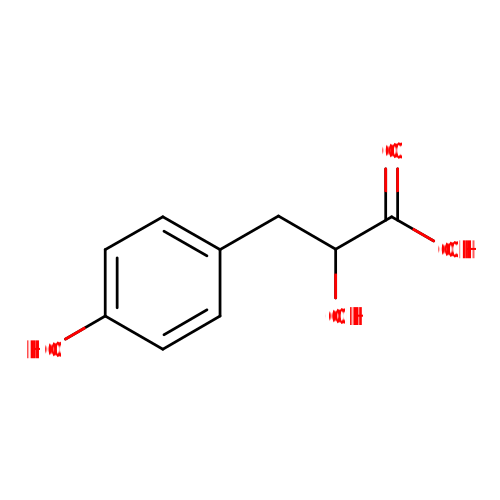
3-(4-Hydroxyphenyl)lactic acid, also known as 4-hydroxyphenyllactate or hpla, belongs to the class of organic compounds known as phenylpropanoic acids. Phenylpropanoic acids are compounds with a structure containing a benzene ring conjugated to a propanoic acid. 3-(4-Hydroxyphenyl)lactic acid is possibly soluble (in water) and an extremely weak basic (essentially neutral) compound (based on its pKa). 3-(4-Hydroxyphenyl)lactic acid exists in all eukaryotes, ranging from yeast to humans. 3-(4-Hydroxyphenyl)lactic acid is a potentially toxic compound. 3-(4-Hydroxyphenyl)lactic acid has been found to be associated with several diseases known as eosinophilic esophagitis, colorectal cancer, and supradiaphragmatic malignancy; also 3-(4-hydroxyphenyl)lactic acid has been linked to the inborn metabolic disorders including phenylketonuria.
belongs to the class of organic compounds known as phenylpropanoic acids. Phenylpropanoic acids are compounds with a structure containing a benzene ring conjugated to a propanoic acid.
As for Tyr metabolism, 4-hydroxyphenylpyruvic acid can produce 4-hydroxyphenyllactic acid under the action of (R)-4-hydroxyphenyllactic dehydrogenase; the levels of 4-hydroxyphenylpyruvate and 4-hydroxyphenyllactic acid were reduced in the CM group compared to the healthy group, and that of 4-hydroxyphenyllactic acid was also significantly reduced in the CM group compared to the SCM group [75].
Written in the paper as “4-hydroxyphenyllactic acid” and “mastitis”
Milk metabolomics using liquid chromatography-quadrupole time-of-flight mass spectrometry (LC-Q-TOF-MS) in healthy cows (n = 20), SCM (n = 20), and CM cows (n = 20) revealed that milk from CM cows had lower levels of glucose, D-glycerol-1-phosphate, 4-hydroxyphenyllactate, L-carnitine, sn-glycero-3-phosphocholine, citrate, and hippurate compared to milk from healthy cows (Xi et al., 2017).
Written in the paper as “4-hydroxyphenyllactate” and “mastitis”
Xi et al. found that less concentrations of d-glycerol-1-phosphate, sn-glycero-3-phosphocholine, glucose, citrate, 4-hydroxyphenyllactate, hippurate and carnitine were found in the clinical mastitic milk samples [11].
Written in the paper as “4-hydroxyphenyllactate” and “mastitis”
In milk from cows with clinical mastitis, concentrations of glucose, D-glycerol-1-phosphate, l-carnitine, 4-hydroxyphenyllactate, citrate, and hippurate were reduced, whereas oligopeptides, such as Leu-Ala, Phe-Pro-Ile, Asn-Arg-Ala-Ile, and Val-Phe-Val-Tyr, were elevated (Xi et al., 2017).
Written in the paper as “4-hydroxyphenyllactate” and “clinical mastitis”
As for Tyr metabolism, 4-hydroxyphenylpyruvic acid can produce 4-hydroxyphenyllactic acid under the action of (R)-4-hydroxyphenyllactic dehydrogenase; the levels of 4-hydroxyphenylpyruvate and 4-hydroxyphenyllactic acid were reduced in the CM group compared to the healthy group, and that of 4-hydroxyphenyllactic acid was also significantly reduced in the CM group compared to the SCM group [75].
Written in the paper as “4-hydroxyphenyllactic acid” and “tyrosine metabolism”
Food material which can be used to meet nutritional requirements of animals, particularly livestock such as cattle, goats, sheep, horses, chickens and pigs.
In the present study, the levels of nine identified metabolites associated with feed materials differed significantly between contaminated and control herds, including adonitol, threitol, cinnamate, hydroxyphenyllactate, glycolic acid, indol-3-acetic acid, deoxytetronic acid, threonic acid, and gluconic acid.
Written in the paper as “hydroxyphenyllactate” and “feed materials”
Mung D, Li L: Development of Chemical Isotope Labeling LC-MS for Milk Metabolomics: Comprehensive and Quantitative Profiling of the Amine/Phenol Submetabolome. Anal Chem. 2017 Apr 18;89(8):4435-4443. doi: 10.1021/acs.analchem.6b03737. Epub 2017 Mar 28. [PubMed:28306241 ]
Xi X, Kwok LY, Wang Y, Ma C, Mi Z, Zhang H: Ultra-performance liquid chromatography-quadrupole-time of flight mass spectrometry MS(E)-based untargeted milk metabolomics in dairy cows with subclinical or clinical mastitis. J Dairy Sci. 2017 Jun;100(6):4884-4896. doi: 10.3168/jds.2016-11939. Epub 2017 Mar 23. [PubMed:28342601 ]
Mung D, Li L: Applying quantitative metabolomics based on chemical isotope labeling LC-MS for detecting potential milk adulterant in human milk. Anal Chim Acta. 2018 Feb 25;1001:78-85. doi: 10.1016/j.aca.2017.11.019. Epub 2017 Nov 14. [PubMed:29291809 ]