| Record Information |
|---|
| Version | 1.0 |
|---|
| Creation Date | 2016-09-30 22:34:57 UTC |
|---|
| Update Date | 2020-06-04 20:13:58 UTC |
|---|
| BMDB ID | BMDB0000691 |
|---|
| Secondary Accession Numbers | |
|---|
| Metabolite Identification |
|---|
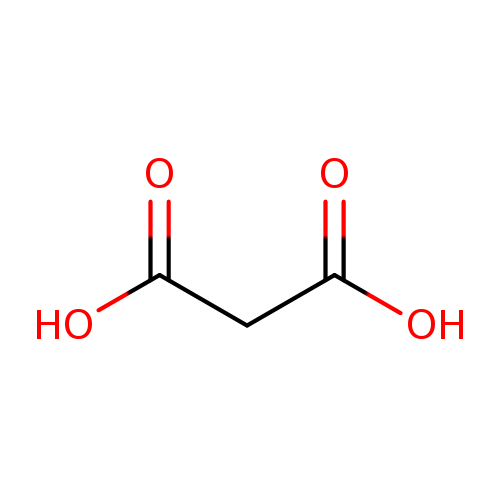
| Common Name | Malonic acid |
|---|
| Description | Malonate, also known as H2MALO or HOOC-CH2-COOH, belongs to the class of organic compounds known as dicarboxylic acids and derivatives. These are organic compounds containing exactly two carboxylic acid groups. Malonate exists as a solid, very hydrophobic, practically insoluble (in water), and relatively neutral molecule. Malonate exists in all living species, ranging from bacteria to humans. In cattle, malonate is involved in the metabolic pathway called fatty acid biosynthesis pathway. Malonate has been found to be associated with several diseases known as combined malonic and methylmalonic aciduria, eosinophilic esophagitis, early preeclampsia, and colorectal cancer; also malonate has been linked to the inborn metabolic disorders including malonyl-coa decarboxylase deficiency. |
|---|
| Structure | |
|---|
| Synonyms | | Value | Source |
|---|
| H2Malo | ChEBI | | HOOC-CH2-COOH | ChEBI | | Propanedioic acid | ChEBI | | Propanedioate | Generator | | Malonate | Generator | | alpha,Omega-dicarboxylic acid | HMDB | | Carboxyacetic acid | HMDB | | Dicarboxylate | HMDB | | Dicarboxylic acid | HMDB | | Dicarboxymethane | HMDB | | Kyselina malonova | HMDB | | Malonate dicarboxylic acid | HMDB | | Metahnedicarboxylic acid | HMDB | | Methanedicarbonic acid | HMDB | | Methanedicarboxylic acid | HMDB | | Propanedioic acid dithallium salt | HMDB | | Propanediolic acid | HMDB | | Thallium malonate | HMDB | | Malonic acid, 2-(14)C-labeled | HMDB | | Malonic acid, monocalcium salt | HMDB | | Malonic acid, 1,3-(14)C2-labeled | HMDB | | Malonic acid, diammonium salt | HMDB | | Malonic acid, disodium salt | HMDB | | Malonic acid, dithallium salt | HMDB | | Malonic acid, dipotassium salt | HMDB | | Malonic acid, disodium salt, 1-(14)C-labeled | HMDB | | Malonic acid, monosodium salt | HMDB | | Malonic acid, potassium salt | HMDB | | Malonic acid, sodium salt | HMDB | | Thallous malonate | HMDB | | Dithallium malonate | HMDB | | Monosodium malonate | HMDB | | Malonic acid | Generator |
|
|---|
| Chemical Formula | C3H4O4 |
|---|
| Average Molecular Weight | 104.0615 |
|---|
| Monoisotopic Molecular Weight | 104.010958616 |
|---|
| IUPAC Name | propanedioic acid |
|---|
| Traditional Name | malonic acid |
|---|
| CAS Registry Number | 141-82-2 |
|---|
| SMILES | OC(=O)CC(O)=O |
|---|
| InChI Identifier | InChI=1S/C3H4O4/c4-2(5)1-3(6)7/h1H2,(H,4,5)(H,6,7) |
|---|
| InChI Key | OFOBLEOULBTSOW-UHFFFAOYSA-N |
|---|
| Chemical Taxonomy |
|---|
| Description | belongs to the class of organic compounds known as dicarboxylic acids and derivatives. These are organic compounds containing exactly two carboxylic acid groups. |
|---|
| Kingdom | Organic compounds |
|---|
| Super Class | Organic acids and derivatives |
|---|
| Class | Carboxylic acids and derivatives |
|---|
| Sub Class | Dicarboxylic acids and derivatives |
|---|
| Direct Parent | Dicarboxylic acids and derivatives |
|---|
| Alternative Parents | |
|---|
| Substituents | - 1,3-dicarbonyl compound
- Dicarboxylic acid or derivatives
- Carboxylic acid
- Organic oxygen compound
- Organic oxide
- Hydrocarbon derivative
- Organooxygen compound
- Carbonyl group
- Aliphatic acyclic compound
|
|---|
| Molecular Framework | Aliphatic acyclic compounds |
|---|
| External Descriptors | |
|---|
| Ontology |
|---|
| Status | Detected but not Quantified |
|---|
| Origin | |
|---|
| Biofunction | Not Available |
|---|
| Application | Not Available |
|---|
| Cellular locations | |
|---|
| Physical Properties |
|---|
| State | Solid |
|---|
| Experimental Properties | | Property | Value | Reference |
|---|
| Melting Point | 135 °C | Not Available | | Boiling Point | Not Available | Not Available | | Water Solubility | 763.0 mg/mL | Not Available | | LogP | -0.81 | HANSCH,C ET AL. (1995) |
|
|---|
| Predicted Properties | |
|---|
| Spectra |
|---|
| Spectra | |
|---|
| Biological Properties |
|---|
| Cellular Locations | |
|---|
| Biospecimen Locations | - Blood
- Colostrum
- Kidney
- Liver
- Mammary Gland
- Milk
- Muscle
- Ruminal Fluid
- Urine
|
|---|
| Pathways | |
|---|
| Normal Concentrations |
|---|
| |
| Blood | Detected but not Quantified | Not Quantified | Not Specified | Not Specified | Normal | | details | | Kidney | Expected but not Quantified | Not Quantified | Not Specified | Not Specified | Normal | | details | | Liver | Detected but not Quantified | Not Quantified | Not Specified | Not Specified | Normal | | details | | Liver | Detected but not Quantified | Not Quantified | Not Specified | Not Specified | Normal | | details | | Mammary Gland | Detected but not Quantified | Not Quantified | Not Specified | Not Specified | Normal | | details | | Mammary Gland | Detected but not Quantified | Not Quantified | Not Specified | Not Specified | Normal | | details | | Milk | Detected but not Quantified | Not Quantified | Not Specified | Not Specified | Normal | | details | | Milk | Detected but not Quantified | Not Quantified | Not Specified | Not Specified | Normal | | details | | Ruminal Fluid | Detected but not Quantified | Not Quantified | Not Specified | Not Specified | Normal | | details | | Urine | Detected but not Quantified | Not Quantified | Not Specified | Not Specified | Normal | | details |
|
|---|
| Abnormal Concentrations |
|---|
| |
| Colostrum | Detected but not Quantified | Not Quantified | Not Specified | Not Specified | Fed pasture vs barley-based concentrate | | details | | Muscle | Detected but not Quantified | Not Quantified | Not Specified | Not Specified | Fed pasture vs barley-based concentrate | | details |
|
|---|
| External Links |
|---|
| HMDB ID | HMDB0000691 |
|---|
| DrugBank ID | DB02175 |
|---|
| Phenol Explorer Compound ID | Not Available |
|---|
| FooDB ID | FDB008117 |
|---|
| KNApSAcK ID | C00001193 |
|---|
| Chemspider ID | 844 |
|---|
| KEGG Compound ID | C04025 |
|---|
| BioCyc ID | MALONATE |
|---|
| BiGG ID | Not Available |
|---|
| Wikipedia Link | Malonic_acid |
|---|
| METLIN ID | 3237 |
|---|
| PubChem Compound | 867 |
|---|
| PDB ID | Not Available |
|---|
| ChEBI ID | 30794 |
|---|
| References |
|---|
| Synthesis Reference | Behr, Arno; Botulinski, Andreas; Carduck, Franz Josef; Schneider, Michael. Process for preparation of malonic acid. Ger. Offen. (1992), 4 pp. |
|---|
| Material Safety Data Sheet (MSDS) | Not Available |
|---|
| General References | - Sundekilde UK, Gustavsson F, Poulsen NA, Glantz M, Paulsson M, Larsen LB, Bertram HC: Association between the bovine milk metabolome and rennet-induced coagulation properties of milk. J Dairy Sci. 2014 Oct;97(10):6076-84. doi: 10.3168/jds.2014-8304. Epub 2014 Jul 30. [PubMed:25087032 ]
- Buitenhuis AJ, Sundekilde UK, Poulsen NA, Bertram HC, Larsen LB, Sorensen P: Estimation of genetic parameters and detection of quantitative trait loci for metabolites in Danish Holstein milk. J Dairy Sci. 2013 May;96(5):3285-95. doi: 10.3168/jds.2012-5914. Epub 2013 Mar 15. [PubMed:23497994 ]
- Antunes-Fernandes EC, van Gastelen S, Dijkstra J, Hettinga KA, Vervoort J: Milk metabolome relates enteric methane emission to milk synthesis and energy metabolism pathways. J Dairy Sci. 2016 Aug;99(8):6251-6262. doi: 10.3168/jds.2015-10248. Epub 2016 May 26. [PubMed:27236769 ]
|
|---|