| Record Information |
|---|
| Version | 1.0 |
|---|
| Creation Date | 2016-09-30 22:32:57 UTC |
|---|
| Update Date | 2020-05-11 20:50:32 UTC |
|---|
| BMDB ID | BMDB0000569 |
|---|
| Secondary Accession Numbers | |
|---|
| Metabolite Identification |
|---|
| Common Name | Deoxypyridinoline |
|---|
| Description | Deoxypyridinoline belongs to the class of organic compounds known as l-alpha-amino acids. These are alpha amino acids which have the L-configuration of the alpha-carbon atom. Deoxypyridinoline, with regard to humans, has been found to be associated with several diseases such as congestive heart failure, multiple myeloma, and cirrhosis; deoxypyridinoline has also been linked to the inborn metabolic disorder growth hormone deficiency. Based on a literature review a significant number of articles have been published on Deoxypyridinoline. |
|---|
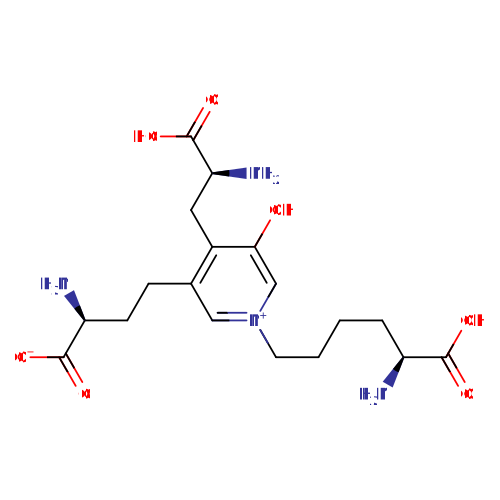
| Structure | |
|---|
| Synonyms | | Value | Source |
|---|
| 4-(2-Amino-2-carboxyethyl)-1-(5-amino-5-carboxypentyl)-3-(3-amino-3-carboxypropyl)-5-hydroxy-pyridinium inner salt stereoisomer | HMDB | | Deoxipyridinoline | HMDB | | Deoxy-pyridinoline | HMDB | | Deoxypiridinoline | HMDB | | Deoxypirydynoline | HMDB | | Deoxypyridinolone | HMDB | | Deoxypyridoline | HMDB | | Desoxypyridinoline | HMDB | | Lysylpyridinoline | HMDB | | N-(5-Amino-5-carboxypentyl)-3-hydroxy-4-(2-amino-2-carboxyethyl)-5-(3-amino-3-carboxypropyl)pyridine | HMDB |
|
|---|
| Chemical Formula | C18H28N4O7 |
|---|
| Average Molecular Weight | 412.4375 |
|---|
| Monoisotopic Molecular Weight | 412.19579927 |
|---|
| IUPAC Name | 4-[(2S)-2-amino-2-carboxyethyl]-3-[(3S)-3-amino-3-carboxypropyl]-1-[(5S)-5-amino-5-carboxypentyl]-5-hydroxypyridin-1-ium |
|---|
| Traditional Name | 4-[(2S)-2-amino-2-carboxyethyl]-3-[(3S)-3-amino-3-carboxypropyl]-1-[(5S)-5-amino-5-carboxypentyl]-5-hydroxypyridin-1-ium |
|---|
| CAS Registry Number | 83462-55-9 |
|---|
| SMILES | N[C@@H](CCCC[N+]1=CC(CC[C@H](N)C([O-])=O)=C(C[C@H](N)C(O)=O)C(O)=C1)C(O)=O |
|---|
| InChI Identifier | InChI=1S/C18H28N4O7/c19-12(16(24)25)3-1-2-6-22-8-10(4-5-13(20)17(26)27)11(15(23)9-22)7-14(21)18(28)29/h8-9,12-14H,1-7,19-21H2,(H3-,23,24,25,26,27,28,29)/t12-,13-,14-/m0/s1 |
|---|
| InChI Key | ZAHDXEIQWWLQQL-IHRRRGAJSA-N |
|---|
| Chemical Taxonomy |
|---|
| Description | belongs to the class of organic compounds known as l-alpha-amino acids. These are alpha amino acids which have the L-configuration of the alpha-carbon atom. |
|---|
| Kingdom | Organic compounds |
|---|
| Super Class | Organic acids and derivatives |
|---|
| Class | Carboxylic acids and derivatives |
|---|
| Sub Class | Amino acids, peptides, and analogues |
|---|
| Direct Parent | L-alpha-amino acids |
|---|
| Alternative Parents | |
|---|
| Substituents | - L-alpha-amino acid
- Tricarboxylic acid or derivatives
- Pyridinolate
- Aralkylamine
- Pyridine
- Pyridinium
- Heteroaromatic compound
- Amino acid
- Carboxylic acid
- Organoheterocyclic compound
- Azacycle
- Organic zwitterion
- Organopnictogen compound
- Organic oxygen compound
- Organic nitrogen compound
- Primary amine
- Organooxygen compound
- Organonitrogen compound
- Primary aliphatic amine
- Amine
- Organic oxide
- Carbonyl group
- Hydrocarbon derivative
- Aromatic heteromonocyclic compound
|
|---|
| Molecular Framework | Aromatic heteromonocyclic compounds |
|---|
| External Descriptors | Not Available |
|---|
| Ontology |
|---|
| Status | Expected but not Quantified |
|---|
| Origin | |
|---|
| Biofunction | Not Available |
|---|
| Application | Not Available |
|---|
| Cellular locations | |
|---|
| Physical Properties |
|---|
| State | Solid |
|---|
| Experimental Properties | | Property | Value | Reference |
|---|
| Melting Point | Not Available | Not Available | | Boiling Point | Not Available | Not Available | | Water Solubility | Not Available | Not Available | | LogP | Not Available | Not Available |
|
|---|
| Predicted Properties | |
|---|
| Spectra |
|---|
| Spectra | |
|---|