| Record Information |
|---|
| Version | 1.0 |
|---|
| Creation Date | 2016-09-30 22:31:39 UTC |
|---|
| Update Date | 2020-04-22 15:03:51 UTC |
|---|
| BMDB ID | BMDB0000497 |
|---|
| Secondary Accession Numbers | |
|---|
| Metabolite Identification |
|---|
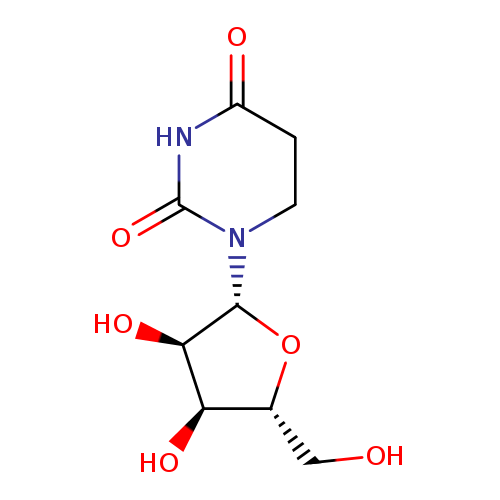
| Common Name | 5,6-Dihydrouridine |
|---|
| Description | 5,6-Dihydrouridine belongs to the class of organic compounds known as glycosylamines. Glycosylamines are compounds consisting of an amine with a beta-N-glycosidic bond to a carbohydrate, thus forming a cyclic hemiaminal ether bond (alpha-amino ether). Based on a literature review a significant number of articles have been published on 5,6-Dihydrouridine. |
|---|
| Structure | |
|---|
| Synonyms | | Value | Source |
|---|
| 1-beta-D-Ribofuranosylhydrouracil | ChEBI | | 3,4-Dihydrouridine | ChEBI | | D | ChEBI | | 1-b-D-Ribofuranosylhydrouracil | Generator | | 1-Β-D-ribofuranosylhydrouracil | Generator | | Dihydro-1-b-D-ribofuranosyl-2,4(1H,3H)-pyrimidinedione | HMDB | | Dihydro-1-beta-delta-ribofuranosyl-2,4(1H,3H)-pyrimidinedione | HMDB | | Dihydrouridine | HMDB | | 5,6-Dihydrouridine | MeSH |
|
|---|
| Chemical Formula | C9H14N2O6 |
|---|
| Average Molecular Weight | 246.2173 |
|---|
| Monoisotopic Molecular Weight | 246.08518619 |
|---|
| IUPAC Name | 1-[(2R,3R,4S,5R)-3,4-dihydroxy-5-(hydroxymethyl)oxolan-2-yl]-1,3-diazinane-2,4-dione |
|---|
| Traditional Name | dihydrouridine |
|---|
| CAS Registry Number | 5627-05-4 |
|---|
| SMILES | OC[C@H]1O[C@H]([C@H](O)[C@@H]1O)N1CCC(=O)NC1=O |
|---|
| InChI Identifier | InChI=1S/C9H14N2O6/c12-3-4-6(14)7(15)8(17-4)11-2-1-5(13)10-9(11)16/h4,6-8,12,14-15H,1-3H2,(H,10,13,16)/t4-,6-,7-,8-/m1/s1 |
|---|
| InChI Key | ZPTBLXKRQACLCR-XVFCMESISA-N |
|---|
| Chemical Taxonomy |
|---|
| Description | belongs to the class of organic compounds known as glycosylamines. Glycosylamines are compounds consisting of an amine with a beta-N-glycosidic bond to a carbohydrate, thus forming a cyclic hemiaminal ether bond (alpha-amino ether). |
|---|
| Kingdom | Organic compounds |
|---|
| Super Class | Organic oxygen compounds |
|---|
| Class | Organooxygen compounds |
|---|
| Sub Class | Carbohydrates and carbohydrate conjugates |
|---|
| Direct Parent | Glycosylamines |
|---|
| Alternative Parents | |
|---|
| Substituents | - N-glycosyl compound
- Pentose monosaccharide
- Pyrimidone
- Hydropyrimidine
- 1,2,5,6-tetrahydropyrimidine
- Monosaccharide
- Pyrimidine
- Tetrahydrofuran
- Secondary alcohol
- Carbonic acid derivative
- Organic 1,3-dipolar compound
- Propargyl-type 1,3-dipolar organic compound
- Oxacycle
- Azacycle
- Organoheterocyclic compound
- Hydrocarbon derivative
- Organonitrogen compound
- Organopnictogen compound
- Carbonyl group
- Alcohol
- Primary alcohol
- Organic nitrogen compound
- Organic oxide
- Aliphatic heteromonocyclic compound
|
|---|
| Molecular Framework | Aliphatic heteromonocyclic compounds |
|---|
| External Descriptors | |
|---|
| Ontology |
|---|
| Status | Expected but not Quantified |
|---|
| Origin | |
|---|
| Biofunction | Not Available |
|---|
| Application | Not Available |
|---|
| Cellular locations | |
|---|
| Physical Properties |
|---|
| State | Solid |
|---|
| Experimental Properties | | Property | Value | Reference |
|---|
| Melting Point | Not Available | Not Available | | Boiling Point | Not Available | Not Available | | Water Solubility | Not Available | Not Available | | LogP | Not Available | Not Available |
|
|---|
| Predicted Properties | |
|---|
| Spectra |
|---|
| Spectra | |
|---|
| Synthesis Reference | Cerutti, Peter; Kondo, Yoshikazu; Landis, W. R.; Witkop, Bernhard. Photoreduction of uridine and reduction of dihydrouridine with sodium borohydride. Journal of the American Chemical Society (1968), 90(3), 771-5. |
|---|