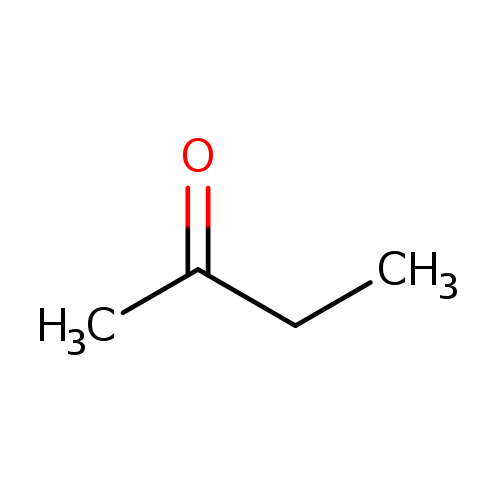
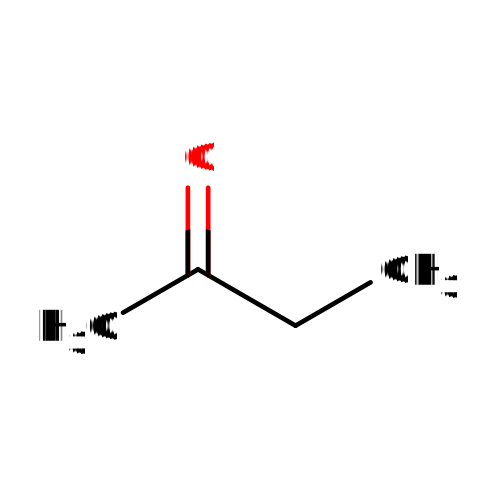
Butanone, also known as aethylmethylketon or methyl acetone, belongs to the class of organic compounds known as ketones. These are organic compounds in which a carbonyl group is bonded to two carbon atoms R2C=O (neither R may be a hydrogen atom). Ketones that have one or more alpha-hydrogen atoms undergo keto-enol tautomerization, the tautomer being an enol. Thus, butanone is considered to be an oxygenated hydrocarbon lipid molecule. Butanone exists as a solid, very hydrophobic, practically insoluble (in water), and relatively neutral molecule. Butanone is a potentially toxic compound.
belongs to the class of organic compounds known as ketones. These are organic compounds in which a carbonyl group is bonded to two carbon atoms R2C=O (neither R may be a hydrogen atom). Ketones that have one or more alpha-hydrogen atoms undergo keto-enol tautomerization, the tautomer being an enol.
The compounds selected to determine the detection limits were the most widely known volatile markers associated with the presence of pathogenic microorganisms in milk [62,63,64,65,66,67].
A total of 128 metabolites was identified in the fecal sample; just 19 metabolites (Azelate, butanone, ethylene glycol, galactitol, glutamate, glutathione, etc.) of them were identified in the fecal sample (Fig 1 and S2 Table).
Written in the paper as “butanone” and “fecal sample”
Using gas chromatography-mass spectrometry, Hettinga et al. (16) reported that healthy cows' milk contained lower concentrations of volatile metabolites such as acetaldehyde, 2-butanone, butyric acid, 2-methylbutanal, and ethyl acetate compared with mastitic cows caused by coagulase negative staphylococci, Escherichia coli, Staphylococcus aureus, Streptococcus dysgalactiae, and Streptococcus uberis.
Written in the paper as “2-butanone” and “Mastitis”
Further, 2-Butanone (buttery, sour milk, ethereal) derived from carbohydrate metabolism, was only detected in TMR milk samples, and has previously been reported to originate from the diet of cows and from carbohydrate metabolism [19].
Written in the paper as “2-Butanone” and “carbohydrate metabolism”
Further, 2-Butanone (buttery, sour milk, ethereal) derived from carbohydrate metabolism, was only detected in TMR milk samples, and has previously been reported to originate from the diet of cows and from carbohydrate metabolism [19].
For timothy silage, levels of acetone, 2-butanone, and a-pinene were the highest compared to the other two milks in agreement with the results reported by O Callaghan, et al. [81].
Written in the paper as “2-butanone” and “timothy silage”
Reportedly, 2-Butanone originates from the cows feeding system [19], specifically from carbohydrate metabolism which could explain why levels of this compound were highest in pTMR samples.
Written in the paper as “2-Butanone” and “total mixed ration”
Vergnaud, Paul. The manufacture of butanediol and butanone. (1950),
Material Safety Data Sheet (MSDS)
Not Available
General References
Toso B, Procida G, Stefanon B: Determination of volatile compounds in cows' milk using headspace GC-MS. J Dairy Res. 2002 Nov;69(4):569-77. [PubMed:12463694 ]
Antunes-Fernandes EC, van Gastelen S, Dijkstra J, Hettinga KA, Vervoort J: Milk metabolome relates enteric methane emission to milk synthesis and energy metabolism pathways. J Dairy Sci. 2016 Aug;99(8):6251-6262. doi: 10.3168/jds.2015-10248. Epub 2016 May 26. [PubMed:27236769 ]
Brigitta Gaspardo, Giuseppe Procida, Saša Volarič, Sandy Sgorlon & Bruno Stefanon (2009). Brigitta Gaspardo et al. Determination of volatile fractions in raw milk and ripened cheese by means of GC-MS. Results of a survey performed in the marginal area between Italy and Slovenia. Italian Jounal of Animal Science Vol 8, 377-390, 2009. Italian Journal of Animal Science .