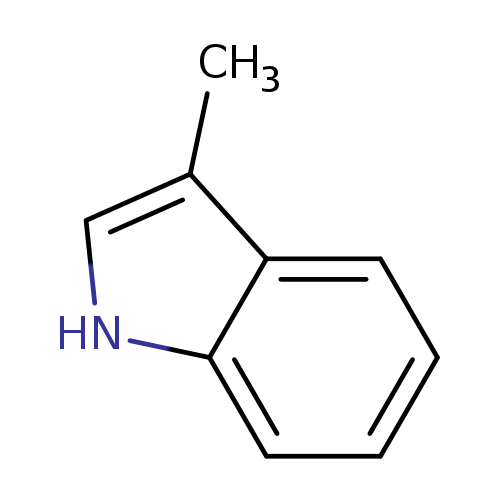
3-Methylindole, also known as skatol or 3-MI, belongs to the class of organic compounds known as 3-methylindoles. These are aromatic heterocyclic compounds that contain an indole moiety substituted at the 3-position with a methyl group. Based on a literature review a significant number of articles have been published on 3-Methylindole.
belongs to the class of organic compounds known as 3-methylindoles. These are aromatic heterocyclic compounds that contain an indole moiety substituted at the 3-position with a methyl group.
These compounds, including skatole and indolepropionic acid, are synthesized by rumen bacteria such as Clostridium aminophilum, Peptostreptococcus, and Fusobacterium necrophorum.
The plasma half-life of 3-MI was short (14.4 min) and, since absorption of 3-MI from the rumen is known to be slow, the extent of formation of 3-MI from L-tryptophan in the rumen would have to be substantial if 3-MI is to be considered the causative agent of 'fog fever', an acute respiratory distress syndrome seen in cattle.
Written in the paper as “3-methylindole” and “rumen”
Other potentially flavor-active compounds in milk from grass-based farming systems are indole and skatole (presenting flowery of fecal odor, depending on the concentration): they also can originate from protein degradation in the rumen, and then are transferred to milk.
Fresh isolates from sheep and dairy cows produced indole, indole propionic acid, tryptophol and skatole from the fermentation of tryptophan and indoleacetic acid [53].
The plasma half-life of 3-MI was short (14.4 min) and, since absorption of 3-MI from the rumen is known to be slow, the extent of formation of 3-MI from L-tryptophan in the rumen would have to be substantial if 3-MI is to be considered the causative agent of 'fog fever', an acute respiratory distress syndrome seen in cattle.
Written in the paper as “3-methylindole” and “plasma”
Metabolism of 3MI in bronchiolar Clara cells and type I pneumocytes results in highly activated intermediates that cause pneumocyte necrosis and exfoliation setting in motion the pathologic processes resulting in interstitial pneumonia.
Written in the paper as “3-methylindole” and “bronchiolar Clara cells”
A specific subset of metabolites was of interest, given the nature of the animal system and feed additive, namely, p-cresol, skatole, indole-3-lactate, indole-3-acetate, putrescine, spermine, and spermidine were measured.
Other potentially flavor-active compounds in milk from grass-based farming systems are indole and skatole (presenting flowery of fecal odor, depending on the concentration): they also can originate from protein degradation in the rumen, and then are transferred to milk.
Written in the paper as “skatole” and “milk”
Taken up by
Type I Pneumocytes
A squamous pulmonary alveolar epithelial cell that is flattened and branched. A pulmonary alveolar type 1 cell covers more than 98% of the alveolar surface. This large cell has thin (50-100 nm) cytoplasmic extensions to form the air-blood barrier essential for normal gas exchange.
Metabolism of 3MI in bronchiolar Clara cells and type I pneumocytes results in highly activated intermediates that cause pneumocyte necrosis and exfoliation setting in motion the pathologic processes resulting in interstitial pneumonia.
Written in the paper as “3-methylindole” and “type I pneumocytes”
A idiopathic interstitial pneumonia which develops suddenly and is severe. Initially, the lung shows edema, hyaline membranes, and interstitial acute inflammation. Later, it develops loose organizing fibrosis, mostly within alveolar septa and type II pneumocyte hyperplasia. Fever, cough, and difficulty breathing develop over 1 to 2 weeks, typically progressing to acute respiratory failure.
In one feedlot study, however, blood levels of a 3MI metabolite were significantly higher in AIP than in control cattle suggesting a potential pathogenic role for 3MI.54
Written in the paper as “3-methylindole” and “acute interstitial pneumonia”
There are many established causes of interstitial pneumonia, which include, but are not limited to, various chemical compounds, such as 3-methylindole (3MI); viruses, such as BRSV; migrating parasite larvae; immune mechanisms; toxic gases; and perhaps environmental conditions.3, 51, 52
Written in the paper as “3-methylindole” and “interstitial pneumonia”
A bacterium that is capable of decarboxylating indoleacetic acid to skatole (3-methylindole) has been isolated from an L-tryptophan enrichment of bovine rumen fluid.
Written in the paper as “skatole” and “decarboxylating indoleacetic acid to skatole”
Antibiotics reduced the degradation of L-tryptophan to skatole and indole, with kanamycin and neomycin particularly effective in reducing the decarboxylation of IAA to skatole.
Written in the paper as “skatole” and “decarboxylation of indoleacetate to skatole”
Fresh isolates from sheep and dairy cows produced indole, indole propionic acid, tryptophol and skatole from the fermentation of tryptophan and indoleacetic acid [53].
Written in the paper as “skatole” and “fermentation of tryptophan and indoleacetic acid”
This is the first report of indoleacetic acid decarboxylation to skatole in pure culture and the demonstration of skatole production by a Lactobacillus species.
Written in the paper as “skatole” and “indoleacetic acid decarboxylation to skatole”
Metabolism of 3MI in bronchiolar Clara cells and type I pneumocytes results in highly activated intermediates that cause pneumocyte necrosis and exfoliation setting in motion the pathologic processes resulting in interstitial pneumonia.
Written in the paper as “3-methylindole” and “pneumocyte necrosis and exfoliation”
The chemical reactions and pathways resulting in the breakdown of a protein by the destruction of the native, active configuration, with or without the hydrolysis of peptide bonds.
Other potentially flavor-active compounds in milk from grass-based farming systems are indole and skatole (presenting flowery of fecal odor, depending on the concentration): they also can originate from protein degradation in the rumen, and then are transferred to milk.
Written in the paper as “skatole” and “protein degradation in the rumen”
This is the first report of indoleacetic acid decarboxylation to skatole in pure culture and the demonstration of skatole production by a Lactobacillus species.
Written in the paper as “skatole” and “skatole production”