| Record Information |
|---|
| Version | 1.0 |
|---|
| Creation Date | 2016-09-30 22:29:20 UTC |
|---|
| Update Date | 2020-06-04 20:39:42 UTC |
|---|
| BMDB ID | BMDB0000363 |
|---|
| Secondary Accession Numbers | |
|---|
| Metabolite Identification |
|---|
| Common Name | 17a-Hydroxypregnenolone |
|---|
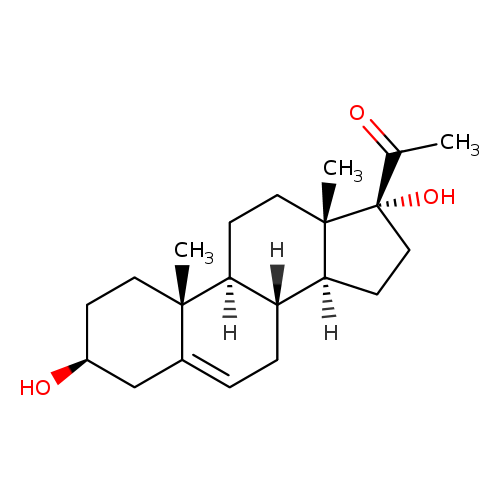
| Description | 17a-17a-17a-hydroxypregnenolone belongs to the class of organic compounds known as gluco/mineralocorticoids, progestogins and derivatives. These are steroids with a structure based on a hydroxylated prostane moiety. Thus, 17a-17a-hydroxypregnenolone is considered to be a steroid lipid molecule. 17a-17a-17a-hydroxypregnenolone exists as a solid, very hydrophobic, practically insoluble (in water), and relatively neutral molecule. 17a-17a-17a-hydroxypregnenolone participates in a number of enzymatic reactions, within cattle. In particular, 17a-17a-17a-hydroxypregnenolone can be converted into 17-hydroxyprogesterone; which is mediated by the enzyme 3-beta-HSD 1. In addition, 17a-17a-17a-hydroxypregnenolone can be biosynthesized from pregnenolone through the action of the enzyme steroid 17-alpha-hydroxylase/17,20 lyase. In cattle, 17a-17a-hydroxypregnenolone is involved in the metabolic pathway called the steroidogenesis pathway. 17a-17a-17a-hydroxypregnenolone is a potentially toxic compound. |
|---|
| Structure | |
|---|
| Synonyms | | Value | Source |
|---|
| (3beta)-3,17-Dihydroxypregn-5-en-20-one | ChEBI | | 17-Hydroxypregnenolone | ChEBI | | 5-Pregnen-3beta,17alpha-diol-20-one | ChEBI | | (3b)-3,17-Dihydroxypregn-5-en-20-one | Generator | | (3Β)-3,17-dihydroxypregn-5-en-20-one | Generator | | 5-Pregnen-3b,17a-diol-20-one | Generator | | 5-Pregnen-3β,17α-diol-20-one | Generator | | 17-Hydroxy-D5-pregnenolone | HMDB | | 17-OH-Pregnenolone | HMDB | | 17a-Hydroxypregnolone | HMDB | | 17alpha-Hydroxypregnanolone | HMDB | | 17alpha-Hydroxypregnenolone | HMDB | | 3b,17-Dihydroxy-5-pregnen-20-one | HMDB | | 3b,17-Dihydroxy-pregn-5-en-20-one | HMDB | | 3b,17a-Dihydroxypregn-5-en-20-one | HMDB | | 17alpha Hydroxypregnenolone | HMDB | | Hydroxypregnenolone | HMDB | | 17 Hydroxypregnenolone | HMDB | | 17 alpha Hydroxypregnenolone | HMDB | | 17-Hydroxypregnenolone, (3alpha)-isomer | HMDB | | 17-Hydroxypregnenolone, (3beta,13alpha)-isomer | HMDB | | 17-alpha-Hydroxypregnenolone | HMDB | | 17 alpha-Hydroxypregnenolone | HMDB | | 17-Hydroxypregnenolone, (3beta,13alpha,17alpha)-isomer | HMDB | | 17-Hydroxypregnenolone, (3beta,17alpha)-isomer | HMDB |
|
|---|
| Chemical Formula | C21H32O3 |
|---|
| Average Molecular Weight | 332.477 |
|---|
| Monoisotopic Molecular Weight | 332.23514489 |
|---|
| IUPAC Name | 1-[(1S,2R,5S,10R,11S,14R,15S)-5,14-dihydroxy-2,15-dimethyltetracyclo[8.7.0.0^{2,7}.0^{11,15}]heptadec-7-en-14-yl]ethan-1-one |
|---|
| Traditional Name | 1-[(1S,2R,5S,10R,11S,14R,15S)-5,14-dihydroxy-2,15-dimethyltetracyclo[8.7.0.0^{2,7}.0^{11,15}]heptadec-7-en-14-yl]ethanone |
|---|
| CAS Registry Number | 387-79-1 |
|---|
| SMILES | [H][C@@]12CC[C@](O)(C(C)=O)[C@@]1(C)CC[C@@]1([H])[C@@]2([H])CC=C2C[C@@H](O)CC[C@]12C |
|---|
| InChI Identifier | InChI=1S/C21H32O3/c1-13(22)21(24)11-8-18-16-5-4-14-12-15(23)6-9-19(14,2)17(16)7-10-20(18,21)3/h4,15-18,23-24H,5-12H2,1-3H3/t15-,16+,17-,18-,19-,20-,21-/m0/s1 |
|---|
| InChI Key | JERGUCIJOXJXHF-TVWVXWENSA-N |
|---|
| Chemical Taxonomy |
|---|
| Description | belongs to the class of organic compounds known as gluco/mineralocorticoids, progestogins and derivatives. These are steroids with a structure based on a hydroxylated prostane moiety. |
|---|
| Kingdom | Organic compounds |
|---|
| Super Class | Lipids and lipid-like molecules |
|---|
| Class | Steroids and steroid derivatives |
|---|
| Sub Class | Pregnane steroids |
|---|
| Direct Parent | Gluco/mineralocorticoids, progestogins and derivatives |
|---|
| Alternative Parents | |
|---|
| Substituents | - Progestogin-skeleton
- 20-oxosteroid
- 3-hydroxy-delta-5-steroid
- 3-hydroxysteroid
- 17-hydroxysteroid
- 3-beta-hydroxysteroid
- 3-beta-hydroxy-delta-5-steroid
- Oxosteroid
- Hydroxysteroid
- Delta-5-steroid
- Alpha-hydroxy ketone
- Tertiary alcohol
- Cyclic alcohol
- Secondary alcohol
- Ketone
- Organic oxygen compound
- Organooxygen compound
- Carbonyl group
- Hydrocarbon derivative
- Alcohol
- Organic oxide
- Aliphatic homopolycyclic compound
|
|---|
| Molecular Framework | Aliphatic homopolycyclic compounds |
|---|
| External Descriptors | |
|---|
| Ontology |
|---|
| Status | Detected and Quantified |
|---|
| Origin | |
|---|
| Biofunction | Not Available |
|---|
| Application | Not Available |
|---|
| Cellular locations | - Cell membrane
- Cytoplasm
- Endoplasmic reticulum
- Membrane
|
|---|
| Physical Properties |
|---|
| State | Solid |
|---|
| Experimental Properties | | Property | Value | Reference |
|---|
| Melting Point | 266 - 271 °C | Not Available | | Boiling Point | Not Available | Not Available | | Water Solubility | Not Available | Not Available | | LogP | Not Available | Not Available |
|
|---|
| Predicted Properties | |
|---|
| Spectra |
|---|
| Spectra | |
|---|