| Record Information |
|---|
| Version | 1.0 |
|---|
| Creation Date | 2016-09-30 22:29:12 UTC |
|---|
| Update Date | 2020-04-22 15:03:08 UTC |
|---|
| BMDB ID | BMDB0000356 |
|---|
| Secondary Accession Numbers | |
|---|
| Metabolite Identification |
|---|
| Common Name | 17-Epiestriol |
|---|
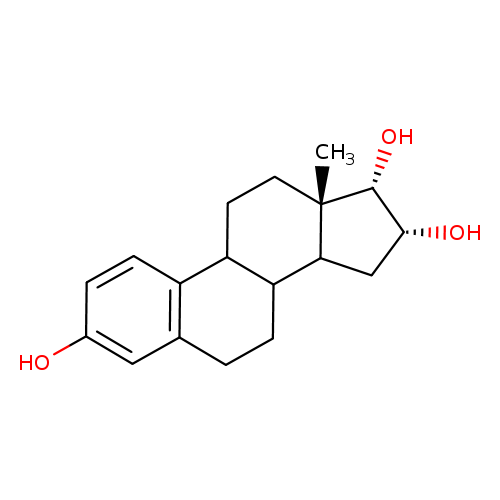
| Description | 17-Epiestriol, also known as 16a,17a-estriol, belongs to the class of organic compounds known as estrogens and derivatives. These are steroids with a structure containing a 3-hydroxylated estrane. 17-Epiestriol is an extremely weak basic (essentially neutral) compound (based on its pKa). |
|---|
| Structure | |
|---|
| Synonyms | | Value | Source |
|---|
| 16a,17a-Estriol | HMDB | | 16a-Hydroxy-17a-estradiol | HMDB | | 17-Epi-estriol | HMDB | | 17a-Estriol | HMDB | | Estra-1,3,5(10)-triene-3,16a,17a-triol | HMDB |
|
|---|
| Chemical Formula | C18H24O3 |
|---|
| Average Molecular Weight | 288.3814 |
|---|
| Monoisotopic Molecular Weight | 288.172544634 |
|---|
| IUPAC Name | (13R,14S,15S)-15-methyltetracyclo[8.7.0.0^{2,7}.0^{11,15}]heptadeca-2(7),3,5-triene-5,13,14-triol |
|---|
| Traditional Name | (13R,14S,15S)-15-methyltetracyclo[8.7.0.0^{2,7}.0^{11,15}]heptadeca-2(7),3,5-triene-5,13,14-triol |
|---|
| CAS Registry Number | 1228-72-4 |
|---|
| SMILES | C[C@]12CCC3C(CCC4=C3C=CC(O)=C4)C1C[C@@H](O)[C@H]2O |
|---|
| InChI Identifier | InChI=1S/C18H24O3/c1-18-7-6-13-12-5-3-11(19)8-10(12)2-4-14(13)15(18)9-16(20)17(18)21/h3,5,8,13-17,19-21H,2,4,6-7,9H2,1H3/t13?,14?,15?,16-,17-,18+/m1/s1 |
|---|
| InChI Key | PROQIPRRNZUXQM-MAHASAQBSA-N |
|---|
| Chemical Taxonomy |
|---|
| Description | belongs to the class of organic compounds known as estrogens and derivatives. These are steroids with a structure containing a 3-hydroxylated estrane. |
|---|
| Kingdom | Organic compounds |
|---|
| Super Class | Lipids and lipid-like molecules |
|---|
| Class | Steroids and steroid derivatives |
|---|
| Sub Class | Estrane steroids |
|---|
| Direct Parent | Estrogens and derivatives |
|---|
| Alternative Parents | |
|---|
| Substituents | - Estrogen-skeleton
- 3-hydroxysteroid
- 17-hydroxysteroid
- 16-hydroxysteroid
- 16-alpha-hydroxysteroid
- Hydroxysteroid
- Phenanthrene
- Tetralin
- 1-hydroxy-2-unsubstituted benzenoid
- Benzenoid
- Cyclic alcohol
- Secondary alcohol
- 1,2-diol
- Polyol
- Organooxygen compound
- Hydrocarbon derivative
- Alcohol
- Organic oxygen compound
- Aromatic homopolycyclic compound
|
|---|
| Molecular Framework | Aromatic homopolycyclic compounds |
|---|
| External Descriptors | Not Available |
|---|
| Ontology |
|---|
| Status | Expected but not Quantified |
|---|
| Origin | |
|---|
| Biofunction | Not Available |
|---|
| Application | Not Available |
|---|
| Cellular locations | - Cell membrane
- Cytoplasm
- Membrane
|
|---|
| Physical Properties |
|---|
| State | Solid |
|---|
| Experimental Properties | | Property | Value | Reference |
|---|
| Melting Point | Not Available | Not Available | | Boiling Point | Not Available | Not Available | | Water Solubility | Not Available | Not Available | | LogP | Not Available | Not Available |
|
|---|
| Predicted Properties | |
|---|
| Spectra |
|---|
| Spectra | |
|---|