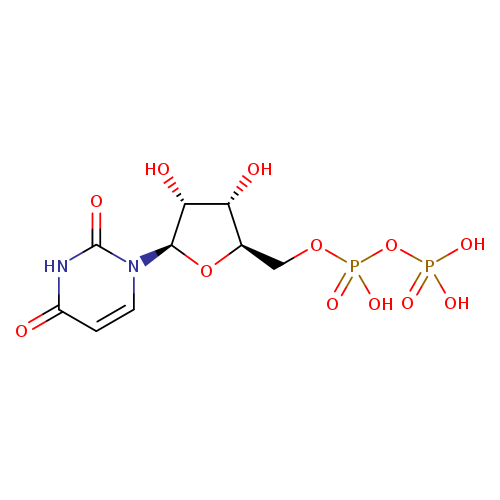
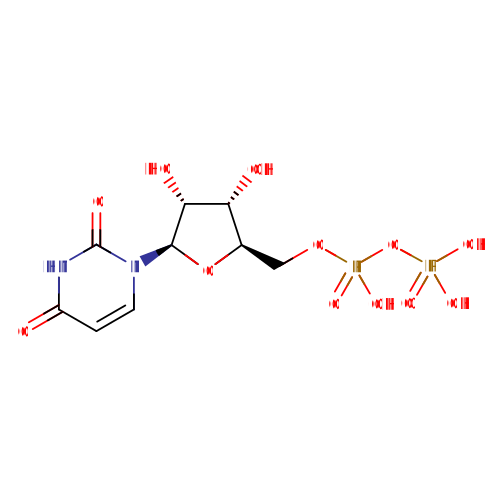
Uridine 5'-diphosphate, also known as uridine diphosphoric acid or uridine pyrophosphate, belongs to the class of organic compounds known as pyrimidine ribonucleoside diphosphates. These are pyrimidine ribonucleotides with diphosphate group linked to the ribose moiety. Uridine 5'-diphosphate exists in all living species, ranging from bacteria to plants to humans. Based on a literature review a significant number of articles have been published on Uridine 5'-diphosphate.
belongs to the class of organic compounds known as pyrimidine ribonucleoside diphosphates. These are pyrimidine ribonucleotides with diphosphate group linked to the ribose moiety.
The production of lactose occurs exclusively in the mammary gland, and it involves the transfer of a galactose molecule coupled to UDP to a glucose molecule, facilitated by a galactosyl transferase enzyme (171).
Written in the paper as “uridine diphosphate” and “production of lactose”
Lastly, expression of multiple metabolism-related genes were altered by increased milking including the increased expression of genes controlling catabolism of UDP (ENTPD4), glycoproteins (AGA) and fatty acids (CPT1A), and biosynthesis of cholesterol (SC4MOL), isoprenoids (IDI1) and prostaglandins (AKR1C1).
Written in the paper as “uridine diphosphate” and “catabolism of uridine diphosphate”
Produced by
pyrimidine ribonucleotide biosynthetic process GO:0009220
The chemical reactions and pathways resulting in the formation of a pyrimidine ribonucleotide, a compound consisting of nucleoside (a pyrimidine base linked to a ribose sugar) esterified with a phosphate group at either the 3' or 5'-hydroxyl group of the sugar.
Two KEGG modules (M00049: Adenine ribonucleotide biosynthesis, IMP = > ADP, ATP and M00052: Pyrimidine ribonucleotide biosynthesis, UMP = > UDP/UTP, CDP/CTP) and one KEGG name (Trimeric autotransporter adhesin) were enriched in the LL group, while one KEGG module (M00844: Arginine biosynthesis, ornithine = > arginine) was enriched in the LH group (LDA > 2, P < 0.05; Fig. S19A-19B).
Written in the paper as “uridine diphosphate” and “Pyrimidine ribonucleotide biosynthesis”
Major role in the synthesis of nucleoside triphosphates other than ATP. The ATP gamma phosphate is transferred to the NDP beta phosphate via a ping-pong mechanism, using a phosphorylated active-site intermediate (By similarity).
Major role in the synthesis of nucleoside triphosphates other than ATP. The ATP gamma phosphate is transferred to the NDP beta phosphate via a ping-pong mechanism, using a phosphorylated active-site intermediate (By similarity). Negatively regulates Rho activity by interacting with AKAP13/LBC. Acts as a transcriptional activator of the MYC gene; binds DNA non-specifically. Binds to both single-stranded guanine- and cytosine-rich strands within the nuclease hypersensitive element (NHE) III(1) region of the MYC gene promoter. Does not bind to duplex NHE III(1). Has G-quadruplex (G4) DNA-binding activity, which is independent of its nucleotide-binding and kinase activity. Binds both folded and unfolded G4 with similar low nanomolar affinities. Stabilizes folded G4s regardless of whether they are prefolded or not (By similarity). Exhibits histidine protein kinase activity (PubMed:12486123).
Involved in maintaining the homeostasis of cellular nucleotides by catalyzing the interconversion of nucleoside phosphates. Has GTP:AMP phosphotransferase and ITP:AMP phosphotransferase activities.
The Golgi complex form catalyzes the production of lactose in the lactating mammary gland and could also be responsible for the synthesis of complex-type N-linked oligosaccharides in many glycoproteins as well as the carbohydrate moieties of glycolipids.
UDP-glucuronosyltransferases catalyze phase II biotransformation reactions in which lipophilic substrates are conjugated with glucuronic acid to increase water solubility and enhance excretion. They are of major importance in the conjugation and subsequent elimination of potentially toxic xenobiotics and endogenous compounds (By similarity).
Catalyzes the phosphorylation of pyrimidine nucleoside monophosphates at the expense of ATP. Plays an important role in de novo pyrimidine nucleotide biosynthesis. Has preference for UMP and CMP as phosphate acceptors. Also displays broad nucleoside diphosphate kinase activity.
Regulatory subunit of lactose synthase, changes the substrate specificity of galactosyltransferase in the mammary gland making glucose a good acceptor substrate for this enzyme. This enables LS to synthesize lactose, the major carbohydrate component of milk. In other tissues, galactosyltransferase transfers galactose onto the N-acetylglucosamine of the oligosaccharide chains in glycoproteins.