| Record Information |
|---|
| Version | 1.0 |
|---|
| Creation Date | 2016-09-30 22:27:20 UTC |
|---|
| Update Date | 2020-04-22 15:02:35 UTC |
|---|
| BMDB ID | BMDB0000246 |
|---|
| Secondary Accession Numbers | |
|---|
| Metabolite Identification |
|---|
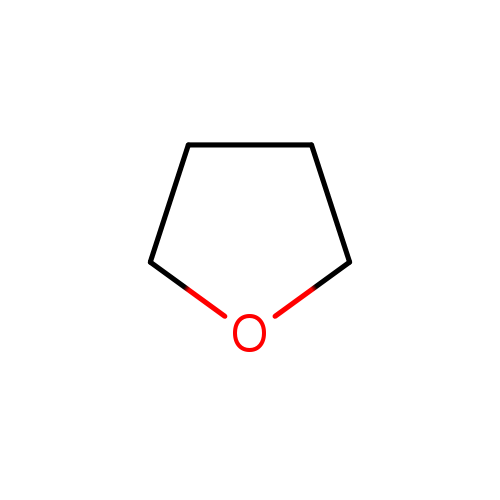
| Common Name | Tetrahydrofuran |
|---|
| Description | Tetrahydrofuran, also known as 1,4-epoxybutane or butylene oxide, belongs to the class of organic compounds known as tetrahydrofurans. These are heterocyclic compounds containing a saturated, aliphatic, five-membered ring where a carbon is replaced by an oxygen. Tetrahydrofuran exists as a solid, possibly soluble (in water), and an extremely weak basic (essentially neutral) compound (based on its pKa) molecule. |
|---|
| Structure | |
|---|
| Synonyms | | Value | Source |
|---|
| 1,4-Epoxybutane | ChEBI | | Butane alpha,delta-oxide | ChEBI | | Butylene oxide | ChEBI | | Furanidine | ChEBI | | Tetramethylene oxide | ChEBI | | THF | ChEBI | | Butane a,delta-oxide | Generator | | Butane α,δ-oxide | Generator | | Butane a,δ-oxide | HMDB | | 1,4-Epoxy-butane | HMDB | | Butane a,D-oxide | HMDB | | Cyclotetramethylene | HMDB | | Cyclotetramethylene oxide | HMDB | | Diethylene oxide | HMDB | | Hydrofuran | HMDB | | Oxacyclopentane | HMDB | | Oxolane | HMDB | | Polytetrahydrofuran | HMDB | | Tetrahydrofuraan | HMDB | | Tetrahydrofurane | HMDB | | Tetrahydrofuranne | HMDB | | Tetraidrofurano | HMDB | | Tetrahydrofuran | ChEBI |
|
|---|
| Chemical Formula | C4H8O |
|---|
| Average Molecular Weight | 72.1057 |
|---|
| Monoisotopic Molecular Weight | 72.057514878 |
|---|
| IUPAC Name | oxolane |
|---|
| Traditional Name | tetrahydrofuran |
|---|
| CAS Registry Number | 109-99-9 |
|---|
| SMILES | C1CCOC1 |
|---|
| InChI Identifier | InChI=1S/C4H8O/c1-2-4-5-3-1/h1-4H2 |
|---|
| InChI Key | WYURNTSHIVDZCO-UHFFFAOYSA-N |
|---|
| Chemical Taxonomy |
|---|
| Description | belongs to the class of organic compounds known as tetrahydrofurans. These are heterocyclic compounds containing a saturated, aliphatic, five-membered ring where a carbon is replaced by an oxygen. |
|---|
| Kingdom | Organic compounds |
|---|
| Super Class | Organoheterocyclic compounds |
|---|
| Class | Tetrahydrofurans |
|---|
| Sub Class | Not Available |
|---|
| Direct Parent | Tetrahydrofurans |
|---|
| Alternative Parents | |
|---|
| Substituents | - Tetrahydrofuran
- Oxacycle
- Ether
- Dialkyl ether
- Organic oxygen compound
- Hydrocarbon derivative
- Organooxygen compound
- Aliphatic heteromonocyclic compound
|
|---|
| Molecular Framework | Aliphatic heteromonocyclic compounds |
|---|
| External Descriptors | |
|---|
| Ontology |
|---|
| Status | Detected but not Quantified |
|---|
| Origin | |
|---|
| Biofunction | Not Available |
|---|
| Application | Not Available |
|---|
| Cellular locations | |
|---|
| Physical Properties |
|---|
| State | Liquid |
|---|
| Experimental Properties | | Property | Value | Reference |
|---|
| Melting Point | -108.3 °C | Not Available | | Boiling Point | Not Available | Not Available | | Water Solubility | 1000.0 mg/mL | Not Available | | LogP | 0.46 | HANSCH,C ET AL. (1995) |
|
|---|
| Predicted Properties | |
|---|
| Spectra |
|---|
| Spectra | |
|---|
| Biological Properties |
|---|
| Cellular Locations | |
|---|
| Biospecimen Locations | |
|---|
| Pathways | |
|---|
| Normal Concentrations |
|---|
| |
| Milk | Detected but not Quantified | Not Quantified | Not Specified | Not Specified | Normal | | details |
|
|---|
| Abnormal Concentrations |
|---|
| Not Available |
|---|
| External Links |
|---|
| HMDB ID | HMDB0000246 |
|---|
| DrugBank ID | Not Available |
|---|
| Phenol Explorer Compound ID | Not Available |
|---|
| FooDB ID | FDB021917 |
|---|
| KNApSAcK ID | C00010358 |
|---|
| Chemspider ID | 7737 |
|---|
| KEGG Compound ID | Not Available |
|---|
| BioCyc ID | Not Available |
|---|
| BiGG ID | Not Available |
|---|
| Wikipedia Link | THF |
|---|
| METLIN ID | Not Available |
|---|
| PubChem Compound | 8028 |
|---|
| PDB ID | Not Available |
|---|
| ChEBI ID | 26911 |
|---|
| References |
|---|
| Synthesis Reference | Li, Haixia; Yin, Hengbo; Jiang, Tingshun; Hu, Tongjie; Wu, Jing; Wada, Yuji. Cyclodehydration of 1,4-butanediol to tetrahydrofuran catalyzed by supported silicotungstic acid. Catalysis Communications (2006), 7(10), 778-782. |
|---|
| Material Safety Data Sheet (MSDS) | Not Available |
|---|
| General References | - Antunes-Fernandes EC, van Gastelen S, Dijkstra J, Hettinga KA, Vervoort J: Milk metabolome relates enteric methane emission to milk synthesis and energy metabolism pathways. J Dairy Sci. 2016 Aug;99(8):6251-6262. doi: 10.3168/jds.2015-10248. Epub 2016 May 26. [PubMed:27236769 ]
|
|---|