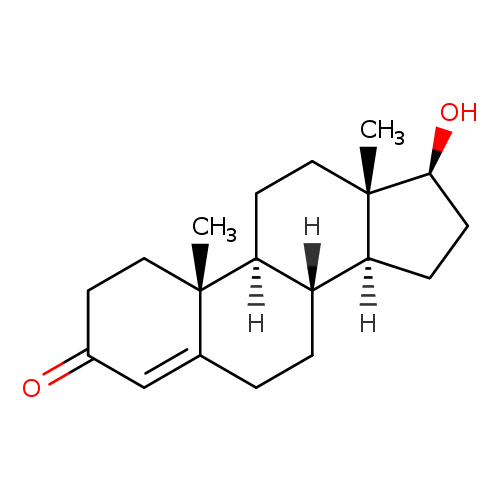
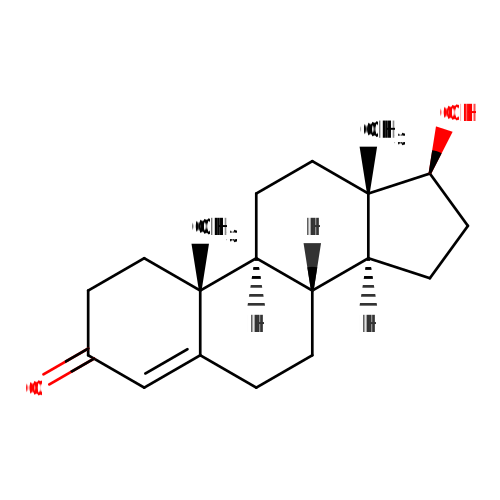
Testosterone belongs to the class of organic compounds known as androgens and derivatives. These are 3-hydroxylated C19 steroid hormones. They are known to favor the development of masculine characteristics. They also show profound effects on scalp and body hair in humans. Thus, testosterone is considered to be a steroid lipid molecule. Testosterone exists as a solid, very hydrophobic, practically insoluble (in water), and relatively neutral molecule. Testosterone exists in all living organisms, ranging from bacteria to humans. Testosterone participates in a number of enzymatic reactions, within cattle. In particular, Testosterone can be converted into 19-hydroxytestosterone; which is catalyzed by the enzyme cytochrome P450 19A1. In addition, Testosterone can be converted into androstenedione; which is catalyzed by the enzyme testosterone 17-beta-dehydrogenase 3. In cattle, testosterone is involved in the metabolic pathway called the androgen and estrogen metabolism pathway. Testosterone is a potentially toxic compound.
belongs to the class of organic compounds known as androgens and derivatives. These are 3-hydroxylated C19 steroid hormones. They are known to favor the development of masculine characteristics. They also show profound effects on scalp and body hair in humans.
Despite the fact that the main source of androgens and in particular testosterone is the testes but previous studies showed the presence of testosterone (45-150 pg/ml) and other members of androgens family including 5a-androstane-3, 17-dion (1-5 ng/ml) in cows, milk (53, 54).
Other factors such as the fluctuation of blood testosterone levels that can enter the rumen via saliva or via the rumen epithelium may also affect VFA content and rumen bacterial protein [63, 64].
Written in the paper as “testosterone” and “blood”
The principal effects of ACTH are increased production and release of cortisol and androgens (e.g., testosterone) by the cortex and medulla of the adrenal gland.
Written in the paper as “testosterone” and “medulla”
In twenty Red Danish bulls, plasma testosterone measured 3-times from 4 to 10 months of age was not associated with the rate of gain or linear growth40.
Written in the paper as “testosterone” and “plasma”
The principal effects of ACTH are increased production and release of cortisol and androgens (e.g., testosterone) by the cortex and medulla of the adrenal gland.
Written in the paper as “testosterone” and “cortex”
Produced by
Leydig Cells
A Leydig cell is a testosterone-secreting cell in the interstitial area, between the seminiferous tubules, in the testis.
Under heat stress, the concurrent decline in serum LH and FSH concentrations simultaneously compromises FSH-dependent trophic support of Sertoli cells and attenuates LH-driven testosterone biosynthesis in Leydig cells, and the synergistic perturbation of these two compartments collectively disrupts the testicular microenvironment essential for spermatogenic cell survival and differentiation.
Written in the paper as “testosterone” and “Leydig cells”
An epithelium consisting of myopethelial cells, which are contractile cells resembling smooth muscle cells that are present in glands, notably the mammary gland, and aid in secretion. This cell has long weaving dendritic processes containing myofilament[CL].
In male cattle, when the androgen hormone testosterone interacts with receptors on myoepithelial cells during embryonic development, sexual dimorphism is achieved.
Written in the paper as “testosterone” and “myoepithelial cells”
Despite the fact that the main source of androgens and in particular testosterone is the testes but previous studies showed the presence of testosterone (45-150 pg/ml) and other members of androgens family including 5a-androstane-3, 17-dion (1-5 ng/ml) in cows, milk (53, 54).
Written in the paper as “testosterone” and “testes”
Urine glucocorticoids and sex-steroids (testosterone + progesterone) tended to be significant (P = 0.10) between ADG-classification in stage-1 but were not significant in stage-2.
Written in the paper as “testosterone” and “Urine”
Dysbiosis leads to increased intestinal barrier permeability, allowing endotoxins such as lipopolysaccharide (LPS) to enter the systemic circulation via the portal vein or lymphatic system, thereby reducing serum testosterone levels and constituting an important pathological factor in hypogonadism [95].
Written in the paper as “testosterone” and “hypogonadism”
A programmed cell death process which begins when a cell receives an internal (e.g. DNA damage) or external signal (e.g. an extracellular death ligand), and proceeds through a series of biochemical events (signaling pathway phase) which trigger an execution phase. The execution phase is the last step of an apoptotic process, and is typically characterized by rounding-up of the cell, retraction of pseudopodes, reduction of cellular volume (pyknosis), chromatin condensation, nuclear fragmentation (karyorrhexis), plasma membrane blebbing and fragmentation of the cell into apoptotic bodies. When the execution phase is completed, the cell has died.
Progesterone, estradiol, and testosterone act to target tissues affecting their activity via the bloodstream to regulate a variety of reproductive events, including apoptosis, inflammation, and metabolism [22].
Written in the paper as “testosterone” and “apoptosis”
In contrast, the significantly larger eye muscle area in bulls is primarily driven by testosterone, which enhances muscle growth by stimulating protein synthesis and inhibiting protein degradation [39].
Written in the paper as “testosterone” and “muscle growth”
For instance, an association between steroid administration and fearfulness reduction to novel objects or unfamiliar surroundings due to the inhibitory functions of testosterone on adrenal function has been documented [24].
Written in the paper as “testosterone” and “adrenal function”
The cellular developmental process in which a relatively unspecialized cell, e.g. embryonic or regenerative cell, acquires specialized structural and/or functional features that characterize a specific cell. Differentiation includes the processes involved in commitment of a cell to a specific fate and its subsequent development to the mature state.
These include reproduction, cell differentiation, proliferation, programmed cell death (apoptosis), inflammation, metabolism, bodily equilibrium (homeostasis), and brain functionality (Qi et al., 2021b).
Written in the paper as “testosterone” and “cell differentiation”
Inhibits
differentiation of Intramuscular fat preadipocytes from cattle into adipocytes
Testosterone inhibited the differentiation of IMF preadipocytes from cattle into adipocytes in culture by suppressing the activity of glycerol-3-phosphate dehydrogenase (GAPDH), a lipogenesis-related enzyme [145].
Written in the paper as “testosterone” and “differentiation of Intramuscular fat preadipocytes from cattle into adipocytes”
The process in which a relatively unspecialized cell acquires specialized features of an adipocyte, an animal connective tissue cell specialized for the synthesis and storage of fat.
The process of differentiation of preadipocytes into adipocytes is also controlled by hormones and other extracellular signals such as leptin and testosterone (Figure 1), and these extracellular signals will be discussed in detail in the sections below.
Written in the paper as “testosterone” and “differentiation of preadipocytes into adipocytes”
Testosterone is also one of the two initiation products of the GnRH secretion pathway, which indirectly inhibits the activity of the kisspeptins (Kiss1) metastasis suppressor and affects the synthesis of Kiss1.
Written in the paper as “Testosterone” and “gonadotropin-releasing hormone secretion pathway”
The immediate defensive reaction (by vertebrate tissue) to infection or injury caused by chemical or physical agents. The process is characterized by local vasodilation, extravasation of plasma into intercellular spaces and accumulation of white blood cells and macrophages.
Progesterone, estradiol, and testosterone act to target tissues affecting their activity via the bloodstream to regulate a variety of reproductive events, including apoptosis, inflammation, and metabolism [22].
Written in the paper as “testosterone” and “inflammation”
The present study demonstrated that implementing the castration of calves caused a testosterone deficiency during the subsequent growth period, which predisposed the calves to deregulate lipid and glucose metabolism, leading to increased adipose content in the liver and peripheral tissues.
Written in the paper as “testosterone” and “lipid and glucose metabolism”
The accumulation and maintenance in cells or tissues of lipids, compounds soluble in organic solvents but insoluble or sparingly soluble in aqueous solvents. Lipid reserves can be accumulated during early developmental stages for mobilization and utilization at later stages of development.
Sex hormones such as estrogen and testosterone are known to influence various physiological processes, including the modulation of microbial communities [107].
Written in the paper as “testosterone” and “modulation of microbial communities”
The muscle system process that results in enlargement or overgrowth of all or part of a muscle organ due to an increase in the size of its muscle cells. Physiological hypertrophy is a normal process during development (it stops in cardiac muscle after adolescence) and can also be brought on in response to demand. In athletes cardiac and skeletal muscles undergo hypertrophy stimulated by increasing muscle activity on exercise. Smooth muscle cells in the uterus undergo hypertrophy during pregnancy.
These sex-specific variations are primarily regulated by hormonal factors, with testosterone promoting muscle hypertrophy by regulating muscle protein synthesis and breakdown, while estrogen affecting adipogenesis [8, 9].
Written in the paper as “testosterone” and “muscle hypertrophy”
These sex-specific variations are primarily regulated by hormonal factors, with testosterone promoting muscle hypertrophy by regulating muscle protein synthesis and breakdown, while estrogen affecting adipogenesis [8, 9].
Written in the paper as “testosterone” and “muscle protein synthesis”
The process in which a relatively unspecialized cell acquires specialized features of a myoblast. A myoblast is a mononucleate cell type that, by fusion with other myoblasts, gives rise to the myotubes that eventually develop into striated muscle fibers.
A few studies report cell-line specific effects: male serum, rich in testosterone, enhances the proliferation of bovine and human myogenic satellite cells, promoting myoblast formation.
Written in the paper as “testosterone” and “myoblast formation”
The multiplication or reproduction of myoblasts, resulting in the expansion of a myoblast cell population. A myoblast is a mononucleate cell type that, by fusion with other myoblasts, gives rise to the myotubes that eventually develop into skeletal muscle fibers.
A few studies report cell-line specific effects: male serum, rich in testosterone, enhances the proliferation of bovine and human myogenic satellite cells, promoting myoblast formation.
Written in the paper as “testosterone” and “proliferation of bovine and human myogenic satellite cells”
A process which begins when a cell receives an internal or external signal and activates a series of biochemical events (signaling pathway). The process ends with the death of the cell.
These include reproduction, cell differentiation, proliferation, programmed cell death (apoptosis), inflammation, metabolism, bodily equilibrium (homeostasis), and brain functionality (Qi et al., 2021b).
Written in the paper as “testosterone” and “programmed cell death”
These include reproduction, cell differentiation, proliferation, programmed cell death (apoptosis), inflammation, metabolism, bodily equilibrium (homeostasis), and brain functionality (Qi et al., 2021b).
Written in the paper as “testosterone” and “proliferation”
In contrast, the significantly larger eye muscle area in bulls is primarily driven by testosterone, which enhances muscle growth by stimulating protein synthesis and inhibiting protein degradation [39].
Written in the paper as “testosterone” and “protein synthesis”
The chemical reactions and pathways resulting in the breakdown of a protein by the destruction of the native, active configuration, with or without the hydrolysis of peptide bonds.
In contrast, the significantly larger eye muscle area in bulls is primarily driven by testosterone, which enhances muscle growth by stimulating protein synthesis and inhibiting protein degradation [39].
Written in the paper as “testosterone” and “protein degradation”
A biological process that directly contributes to the process of producing new individuals by one or two organisms. The new individuals inherit some proportion of their genetic material from the parent or parents.
These include reproduction, cell differentiation, proliferation, programmed cell death (apoptosis), inflammation, metabolism, bodily equilibrium (homeostasis), and brain functionality (Qi et al., 2021b).
Written in the paper as “testosterone” and “reproduction”
Testosterone, an important substrate for the synthesis of androgen receptor (AR), can synthesize AR not only directly but also through dihydrotestosterone, which is catalyzed by 3-oxo-5-alpha-steroid 4-dehydrogenase 2.
Written in the paper as “Testosterone” and “synthesis of androgen receptor”
The chemical reactions and pathways resulting in the formation of testosterone, an androgen having 17beta-hydroxy and 3-oxo groups, together with unsaturation at C-4 C-5.
At the endocrine level, heat stress disrupts the hypothalamic–pituitary axes, suppressing testosterone synthesis and perturbing the testicular microenvironment to compromise spermatogenesis.
Written in the paper as “testosterone” and “testosterone synthesis”
These data provide potential mechanisms by which testosterone inhibits IMF deposition, whereas estrogen and progesterone stimulate IMF deposition in cattle.
Written in the paper as “testosterone” and “Intramuscular fat”
Reproductive hormones such as testosterone, estradiol, progesterone, and related synthetics like trenbolone acetate and zeranol can be strategically utilized in both beef and dairy cattle production systems to enhance their most valuable traits, but the impact of these substances must account for the welfare of the animal as well as the health of the consumer.
Written in the paper as “testosterone” and “growth”
The findings were in agreement with the principle that testosterone deficiency contributes to the increment in lipid droplets in skeletal muscle [31] and improves adipocyte differentiation rather than that of myocytes in pluripotent mesenchymal stem cells through androgen-receptor-dependent signaling [32].
Written in the paper as “testosterone” and “intramuscular fat”
The length of a straight line from the anus to the genitalia, that is, to the base of the genital tubercle in the fetus, to the genital bud in neonatal animals, or to the base of the penis or vagina in older individuals.
Fetal exposure to maternal androgens, particularly testosterone and dihydrotestosterone, determines anogenital distance (AGD), a biomarker of androgen exposure during the reproductive programming window (Dean et al., 2012).
Written in the paper as “testosterone” and “anogenital distance”
In terms of the lower growth rate in castrated cattle relative to non castrated cattle, the results could be attributed to the absence of the anabolic effect of testosterone because this hormone can increase lean tissue deposition and further growth traits as well as feed efficiency [24,26].
Written in the paper as “testosterone” and “feed efficiency”
In terms of the lower growth rate in castrated cattle relative to non castrated cattle, the results could be attributed to the absence of the anabolic effect of testosterone because this hormone can increase lean tissue deposition and further growth traits as well as feed efficiency [24,26].
Written in the paper as “testosterone” and “growth traits”
In terms of the lower growth rate in castrated cattle relative to non castrated cattle, the results could be attributed to the absence of the anabolic effect of testosterone because this hormone can increase lean tissue deposition and further growth traits as well as feed efficiency [24,26].
Written in the paper as “testosterone” and “lean tissue deposition”
In contrast, the significantly larger eye muscle area in bulls is primarily driven by testosterone, which enhances muscle growth by stimulating protein synthesis and inhibiting protein degradation [39].
Written in the paper as “testosterone” and “eye muscle area”
These sex-specific variations are primarily regulated by hormonal factors, with testosterone promoting muscle hypertrophy by regulating muscle protein synthesis and breakdown, while estrogen affecting adipogenesis [8, 9].
Written in the paper as “testosterone” and “muscle development”
Reproductive hormones such as testosterone, estradiol, progesterone, and related synthetics like trenbolone acetate and zeranol can be strategically utilized in both beef and dairy cattle production systems to enhance their most valuable traits, but the impact of these substances must account for the welfare of the animal as well as the health of the consumer.
Written in the paper as “testosterone” and “reproduction”
Testosterone, an important substrate for the synthesis of androgen receptor (AR), can synthesize AR not only directly but also through dihydrotestosterone, which is catalyzed by 3-oxo-5-alpha-steroid 4-dehydrogenase 2.
Written in the paper as “Testosterone” and “substrate”
Ercoli, Alberto; De Ruggieri, Pietro. An improved method of preparing testosterone, dihydrotestosterone, and some of their esters. Journal of the American Chemical Society (1953), 75 650-3.
Material Safety Data Sheet (MSDS)
Not Available
General References
Courant F, Antignac JP, Laille J, Monteau F, Andre F, Le Bizec B: Exposure assessment of prepubertal children to steroid endocrine disruptors. 2. Determination of steroid hormones in milk, egg, and meat samples. J Agric Food Chem. 2008 May 14;56(9):3176-84. doi: 10.1021/jf800096f. Epub 2008 Apr 16. [PubMed:18412364 ]
NAD-dependent oxidoreductase with broad substrate specificity that shows both oxidative and reductive activity (in vitro). Has 17-beta-hydroxysteroid dehydrogenase activity towards various steroids (in vitro). Converts 5-alpha-androstan-3-alpha,17-beta-diol to androsterone and estradiol to estrone (in vitro). Has 3-alpha-hydroxysteroid dehydrogenase activity towards androsterone (in vitro). Has retinol dehydrogenase activity towards all-trans-retinol (in vitro). Can convert androsterone to epi-androsterone. Androsterone is first oxidized to 5-alpha-androstane-3,17-dione and then reduced to epi-andosterone. Can act on both C-19 and C-21 3-alpha-hydroxysteroids (By similarity).
UDP-glucuronosyltransferases catalyze phase II biotransformation reactions in which lipophilic substrates are conjugated with glucuronic acid to increase water solubility and enhance excretion. They are of major importance in the conjugation and subsequent elimination of potentially toxic xenobiotics and endogenous compounds (By similarity).