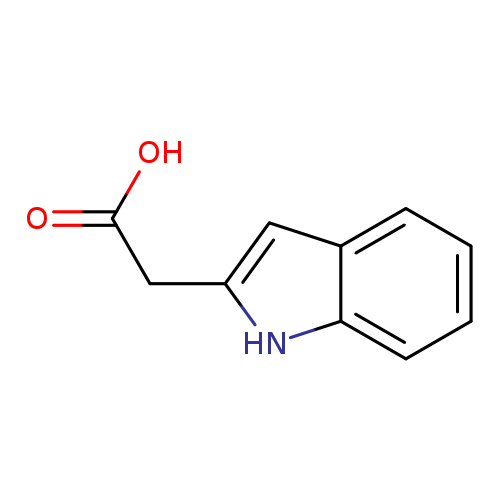
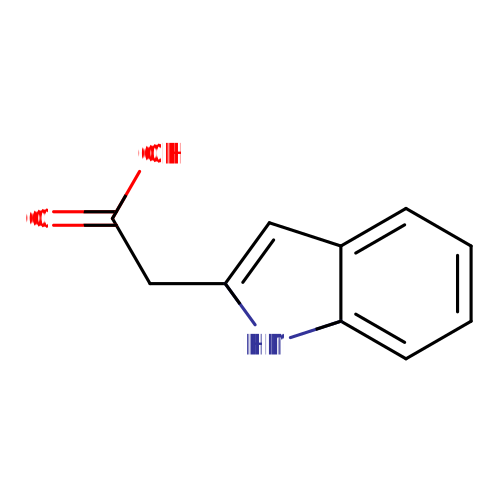
Indoleacetic acid, also known as indoleacetate, belongs to the class of organic compounds known as indolyl carboxylic acids and derivatives. Indolyl carboxylic acids and derivatives are compounds containing a carboxylic acid chain (of at least 2 carbon atoms) linked to an indole ring. Indoleacetic acid is a weakly acidic compound (based on its pKa). indoleacetic acid can be biosynthesized from indoleacetaldehyde through the action of the enzyme aldehyde dehydrogenase, mitochondrial. In cattle, indoleacetic acid is involved in the metabolic pathway called the tryptophan metabolism pathway.
belongs to the class of organic compounds known as indolyl carboxylic acids and derivatives. Indolyl carboxylic acids and derivatives are compounds containing a carboxylic acid chain (of at least 2 carbon atoms) linked to an indole ring.
To investigate links between the rumen microbiota and host metabolism, we assessed correlations between the 10 most abundant bacterial genera and the 10 most abundant fungal genera and metabolites detected in rumen fluid using Spearman s rank correlation analysis (Figures 8A,B).
Written in the paper as “N6-acetyllysine” and “rumen fluid”
Linear regression analysis was conducted with the lm function from the R stats package to evaluate the relationship between the abundance of putative IAA-producing taxa and the IAA concentration, thereby elucidating the contribution of microorganisms to metabolite dynamics.
Written in the paper as “indole-3-acetic acid” and “rumen fluid”
The compound indoleacetic acid belongs to the class of indoles and derivatives; it was previously reported by Zhang and co-authors [25] as a discriminant metabolite in the ruminal fluid of high-yield and low-yield group of dairy cows in terms of milk production.
Written in the paper as “indoleacetic acid” and “ruminal fluid”
A specific subset of metabolites was of interest, given the nature of the animal system and feed additive, namely, p-cresol, skatole, indole-3-lactate, indole-3-acetate, putrescine, spermine, and spermidine were measured.
Written in the paper as “indole-3-acetate” and “feces”
In addition, the fold change of 3-indoleacetic, which is the difference metabolite detected in feces between the NCG group and CON, reached 1.422, and previous studies have shown that it can improve plasma T-AOC and inhibit the decrease of liver SOD activity, thereby reduced the oxidative and inflammatory stress of liver tissue (39).
Written in the paper as “3-indoleacetic” and “feces”
Among the plasma parameters showing the highest repeatability between-feeding levels, there were endogenous metabolites such as 1 and 3-methylhistidine, alkaline phosphatase and carnosine and others with a known microbial origin, such as indoleacetic acid (major product of tryptophan metabolism by microbial population in the rumen46).
Written in the paper as “indoleacetic acid” and “plasma”
Our results demonstrated that IAA mediates the crosstalk between rumen microbiota and host epithelium, revealed the regulatory effect of AhR on rumen epithelial barrier function, and provided novel directions and therapeutic targets for addressing rumen homeostasis dysbiosis in dairy cows with metabolic disorders.
Written in the paper as “indole-3-acetic acid” and “epithelium”
Interestingly, the highest VIP scores were recorded for five milk metabolites, namely chitobiose (1.97), 4-Hydroxy-5-(3 ,4 -dihydroxyphenyl)-valeric acid-O-glucuronide (1.89), indoleacetic acid (1.79), O-succinyl-L-homoserine (1.78), and 1-hydroxypyrene glucuronide (1.73).
Written in the paper as “indoleacetic acid” and “milk”
Existing evidence on ruminal 3-indoleacetic acid, microbial alanine, and hindgut-derived acetate suggests that key microbial metabolites can participate in inflammatory regulation, glucogenic supply, and hepatic lipid metabolism, respectively [20,22,42].
Written in the paper as “3-indoleacetic acid” and “rumen”
Using peripartum cows with ketosis as a model, we demonstrated that perturbations of rumen microbiota disrupt tryptophan metabolism, resulting in pronounced depletion of indole-3-acetic acid (IAA).
Written in the paper as “indole-3-acetic acid” and “ketosis”
The results of the ROC analysis revealed that IAA exhibited good predictive power in distinguishing between healthy and ketotic states, suggesting its potential as a metabolic biomarker involved in ketosis (Fig. 2J).
Written in the paper as “indole-3-acetic acid” and “ketosis”
Evidence from periparturient cows indicates that tryptophan metabolism is a key metabolic pathway associated with ketosis occurrence and development, and cows with ketosis display markedly reduced concentrations of tryptophan, kynurenine (KYN), and indole-3-acetic acid [19].
Written in the paper as “indole-3-acetic acid” and “ketosis”
In ketotic cows, rumen microbiota dysbiosis leads to decreased IAA levels, resulting in suppressed AhR/IL-22 signaling, reduced tight junction protein expression, and compromised barrier function.
Written in the paper as “indole-3-acetic acid” and “ketotic”
For example, in ketotic dairy cows, the ruminal level of the tryptophan metabolite indole-3-acetic acid (IAA) is significantly reduced and is accompanied by downregulation of epithelial tight junction proteins, increased inflammatory mediators, and impaired barrier function.
Written in the paper as “indole-3-acetic acid” and “ketotic”
Gut microbiota converts dietary tryptophan into indole derivatives, including indole-3-propionic acid (IPA) and indole-3-acetic acid (IAA), which possess potent anti-inflammatory and barrier-protective properties [19,50].
Written in the paper as “indole-3-acetic acid” and “tryptophan metabolism”
Moreover, microbial dysbiosis contributed to a decrease in the production of tryptophan metabolite IAA due to the depletion of tryptophan-producing bacteria, especially Lactobacillus.
Written in the paper as “indole-3-acetic acid” and “tryptophan metabolism”
Conversely, PL cows exhibited a greater abundance of enzymes involved in tryptophan metabolism, thus facilitating the production of indole-3-acetic acid (IAA).
Written in the paper as “indole-3-acetic acid” and “tryptophan metabolism”
The immediate defensive reaction (by vertebrate tissue) to infection or injury caused by chemical or physical agents. The process is characterized by local vasodilation, extravasation of plasma into intercellular spaces and accumulation of white blood cells and macrophages.
Together, these findings suggest that both decreased IAA and increased LPS contribute to inflammation and epithelial barrier dysfunction in ketotic cows.
Written in the paper as “indole-3-acetic acid” and “inflammation”
Specifically, the kynurenine pathway, associated with OS and inflammation, was upregulated in EL cows, while the indole pathway, particularly the production of IAA, was markedly elevated in PL cows, which attenuated OS and inflammation.
Written in the paper as “indole-3-acetic acid” and “inflammation”
Further in vitro studies have shown that IAA can promote epithelial cell proliferation and enhance tight junction repair by activating the AhR/IL-22 signaling pathway, thereby counteracting LPS-induced epithelial injury and preventing LPS-driven systemic inflammation168.
Written in the paper as “indole-3-acetic acid” and “systemic inflammation”
Further in vitro studies have shown that IAA can promote epithelial cell proliferation and enhance tight junction repair by activating the AhR/IL-22 signaling pathway, thereby counteracting LPS-induced epithelial injury and preventing LPS-driven systemic inflammation168.
Written in the paper as “indole-3-acetic acid” and “AhR/IL-22 signaling pathway”
The multiplication or reproduction of epithelial cells, resulting in the expansion of a cell population. Epithelial cells make up the epithelium, the covering of internal and external surfaces of the body, including the lining of vessels and other small cavities. It consists of cells joined by small amounts of cementing substances.
Further in vitro studies have shown that IAA can promote epithelial cell proliferation and enhance tight junction repair by activating the AhR/IL-22 signaling pathway, thereby counteracting LPS-induced epithelial injury and preventing LPS-driven systemic inflammation168.
Written in the paper as “indole-3-acetic acid” and “epithelial cell proliferation”
A bacterium that is capable of decarboxylating indoleacetic acid to skatole (3-methylindole) has been isolated from an L-tryptophan enrichment of bovine rumen fluid.
Written in the paper as “indoleacetic acid” and “decarboxylating indoleacetic acid to skatole”
Antibiotics reduced the degradation of L-tryptophan to skatole and indole, with kanamycin and neomycin particularly effective in reducing the decarboxylation of IAA to skatole.
Written in the paper as “indoleacetate” and “decarboxylation of indoleacetate to skatole”
Together, these findings suggest that both decreased IAA and increased LPS contribute to inflammation and epithelial barrier dysfunction in ketotic cows.
Written in the paper as “indole-3-acetic acid” and “epithelial barrier dysfunction”
Metabolites derived from tryptophan, such as 5-hydroxy-L-tryptophan, indole-3-propionic acid, and indole-3-acetic acid, are effective in restoring intestinal structural integrity and permeability, thereby supporting epithelial barrier function and reducing inflammation [47].
Written in the paper as “indole-3-acetic acid” and “epithelial barrier function”
These metabolites function as ligands for host receptors such as the aryl hydrocarbon receptor (AhR) and pregnane X receptor (PXR), thereby regulating epithelial barrier integrity, mucosal immunity, and systemic inflammatory responses167.
Written in the paper as “indole-3-acetic acid” and “epithelial barrier integrity”
Fresh isolates from sheep and dairy cows produced indole, indole propionic acid, tryptophol and skatole from the fermentation of tryptophan and indoleacetic acid [53].
Written in the paper as “indoleacetic acid” and “fermentation of tryptophan and indoleacetic acid”
Our results demonstrated that IAA mediates the crosstalk between rumen microbiota and host epithelium, revealed the regulatory effect of AhR on rumen epithelial barrier function, and provided novel directions and therapeutic targets for addressing rumen homeostasis dysbiosis in dairy cows with metabolic disorders.
Written in the paper as “indole-3-acetic acid” and “host-metabolite-microbe signaling axis”
The chemical reactions and pathways involving indole (2,3-benzopyrrole), the basis of many biologically active substances (e.g. serotonin, tryptophan).
This is the first report of indoleacetic acid decarboxylation to skatole in pure culture and the demonstration of skatole production by a Lactobacillus species.
Written in the paper as “indoleacetic acid” and “indoleacetic acid decarboxylation to skatole”
Further evidence supporting microbial involvement in tryptophan transformation includes increased indole-related metabolites, such as indole-3-carboxaldehyde in plasma and indoleacetic acid in urine of E+ steers, both microbial products of tryptophan degradation (49), which is consistent with previous reports (14).
Written in the paper as “indoleacetic acid” and “tryptophan degradation”
The process of regulating the proliferation and elimination of cells of the immune system such that the total number of cells of a particular cell type within a whole or part of an organism is stable over time in the absence of an outside stimulus.
These metabolites function as ligands for host receptors such as the aryl hydrocarbon receptor (AhR) and pregnane X receptor (PXR), thereby regulating epithelial barrier integrity, mucosal immunity, and systemic inflammatory responses167.
Written in the paper as “indole-3-acetic acid” and “mucosal immunity”
Specifically, the kynurenine pathway, associated with OS and inflammation, was upregulated in EL cows, while the indole pathway, particularly the production of IAA, was markedly elevated in PL cows, which attenuated OS and inflammation.
Written in the paper as “indole-3-acetic acid” and “oxidative stress”
Any process that modulates the frequency, rate or extent of the inflammatory response, the immediate defensive reaction (by vertebrate tissue) to infection or injury caused by chemical or physical agents.
Existing evidence on ruminal 3-indoleacetic acid, microbial alanine, and hindgut-derived acetate suggests that key microbial metabolites can participate in inflammatory regulation, glucogenic supply, and hepatic lipid metabolism, respectively [20,22,42].
Written in the paper as “3-indoleacetic acid” and “inflammatory regulation”
Moreover, IAA, an important tryptophan catabolite, alleviated the damage to ruminal epithelial cells exposed to LPS by activating the AhR/IL-22 pathway, thus decreasing the inflammatory response while increasing the repair of the epithelial barrier function.
Written in the paper as “indole-3-acetic acid” and “repair of the epithelial barrier function”
In summary, our findings provide mechanistic insight into how IAA mediates rumen microbiota-host epithelial crosstalk to maintain rumen barrier integrity in peripartum metabolic disorder dairy cows.
Written in the paper as “indole-3-acetic acid” and “rumen microbiota-host epithelial crosstalk”
For example, altered ruminal tryptophan metabolism in SARA-affected dairy goats can generate 3-indoleacetic acid, which has been shown to inhibit Th17/IL-17-related inflammation and alleviate ruminal epithelial injury [22].
Written in the paper as “3-indoleacetic acid” and “ruminal tryptophan metabolism”
These metabolites function as ligands for host receptors such as the aryl hydrocarbon receptor (AhR) and pregnane X receptor (PXR), thereby regulating epithelial barrier integrity, mucosal immunity, and systemic inflammatory responses167.
Written in the paper as “indole-3-acetic acid” and “systemic inflammatory responses”
For example, altered ruminal tryptophan metabolism in SARA-affected dairy goats can generate 3-indoleacetic acid, which has been shown to inhibit Th17/IL-17-related inflammation and alleviate ruminal epithelial injury [22].
Written in the paper as “3-indoleacetic acid” and “Th17/IL-17-related inflammation”
Further in vitro studies have shown that IAA can promote epithelial cell proliferation and enhance tight junction repair by activating the AhR/IL-22 signaling pathway, thereby counteracting LPS-induced epithelial injury and preventing LPS-driven systemic inflammation168.
Written in the paper as “indole-3-acetic acid” and “tight junction repair”
Produced by
tryptophan metabolism by microbial population in the rumen
Among the plasma parameters showing the highest repeatability between-feeding levels, there were endogenous metabolites such as 1 and 3-methylhistidine, alkaline phosphatase and carnosine and others with a known microbial origin, such as indoleacetic acid (major product of tryptophan metabolism by microbial population in the rumen46).
Written in the paper as “indoleacetic acid” and “tryptophan metabolism by microbial population in the rumen”
Moreover, PL cows demonstrated an upregulation of the tryptophan metabolism pathway, particularly favoring the production of IAA, a key metabolite associated with the attenuation of OS and inflammation.
Written in the paper as “indole-3-acetic acid” and “tryptophan metabolism pathway”
Indole-3-acrylic acid, indole-3-acetic acid, and indole-3-propionic acid showed antiglycation activity and were identified as PS-specific bioactive marker metabolites.
Written in the paper as “indole-3-acetic acid” and “probiotic supplements”
Further evidence supporting microbial involvement in tryptophan transformation includes increased indole-related metabolites, such as indole-3-carboxaldehyde in plasma and indoleacetic acid in urine of E+ steers, both microbial products of tryptophan degradation (49), which is consistent with previous reports (14).
Written in the paper as “indoleacetic acid” and “fescue”
Snyder, H. R.; Pilgrim, Frederick J. Preparation of 3-indoleacetic acid; new synthesis of tryptophol. Journal of the American Chemical Society (1948), 70 3770-1.