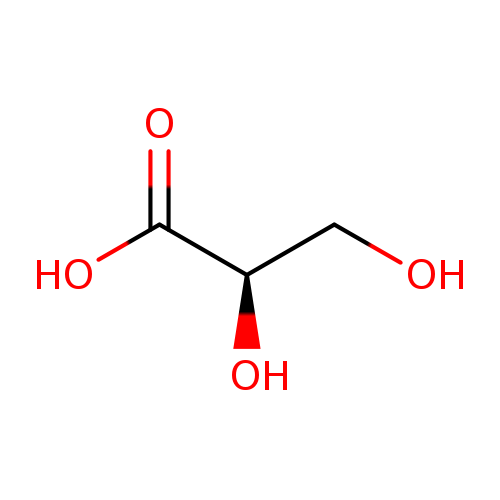
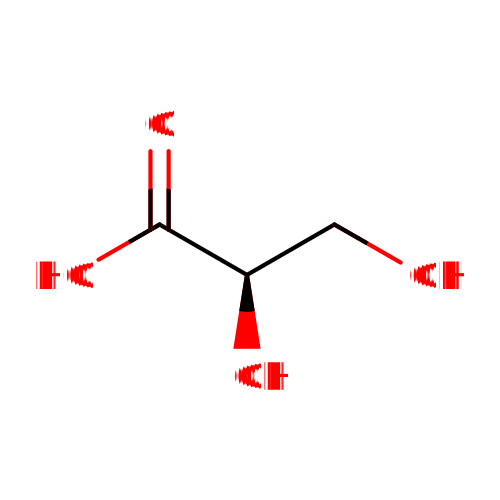
Glyceric acid, also known as glycerate or D-groa, belongs to the class of organic compounds known as sugar acids and derivatives. Sugar acids and derivatives are compounds containing a saccharide unit which bears a carboxylic acid group. Glyceric acid is possibly soluble (in water) and an extremely weak basic (essentially neutral) compound (based on its pKa). Glyceric acid exists in all living species, ranging from bacteria to humans. Glyceric acid is a potentially toxic compound. Glyceric acid has been found to be associated with several diseases known as irritable bowel syndrome, ulcerative colitis, and eosinophilic esophagitis; also glyceric acid has been linked to several inborn metabolic disorders including primary hyperoxaluria and primary hyperoxaluria II.
belongs to the class of organic compounds known as sugar acids and derivatives. Sugar acids and derivatives are compounds containing a saccharide unit which bears a carboxylic acid group.
Three genera including Marvinbryantia, Acetitomaculum, and Intestinimonas in feces showed positive corrections with glyceric acid, spermine, choline, and aspartic acid, and negative corrections with 5-methoxyindole and 2-hydroxyphenylalanine.
Written in the paper as “glyceric acid” and “feces”
ASV_4665 (Prevotella 1) was found both in SAM and LAM, but strongly correlated with IGF-1R in the former and with glyceric acid and CLDN4 in the latter.
When glyceric acid is secreted excessively in milk, the lactating animal may suffer from D-glyceric aciduria and D-glycerate anemia, resulting in metabolic acidosis, progressive neurological impairment, seizures, hypotonia, and other adverse effects (JoRn Oliver et al., 2010).
Written in the paper as “glyceric acid” and “milk”
At 9 h post-overload, glyceric acid, cellobiose, fructose and lactic acid were all increased, whereas at 24 h, sorbitol, lactic acid and fructose levels were all increased >10-fold.
Written in the paper as “glyceric acid” and “Acute ruminal acidosis”
Furthermore, during the week of lameness diagnosis, 2-hydroxyisobutyrate, 3-hydroxy-3-methylglutarte, 4-hydroxyphenylacetate, adipate, glycerate, tyrosine, and valine were less concentrated in the urine of lame-confirmed cows.
Written in the paper as “glycerate” and “Lameness”
It has previously been demonstrated that glycerol oxidation produces glyceric acid, which is mediated by the transfer of glucose carbon to serine in cows (Black et al., 1955).
Written in the paper as “glyceric acid” and “glycerol oxidation”
The chemical reactions and pathways involving glycerolipids, any lipid with a glycerol backbone. Diacylglycerol and phosphatidate are key lipid intermediates of glycerolipid biosynthesis.
Within glycerolipid metabolism, 26 genes including PPAP2C, LIPG, LPIN3, MBOAT1, PPAP2A, PPAP2B, and others were differentially expressed, with 3-phospho-D-glycerate and glyceric acid representing the key metabolites.
Written in the paper as “glyceric acid” and “glycerolipid metabolism”
The chemical reactions and pathways resulting in the breakdown of a carbohydrate into pyruvate, with the concomitant production of a small amount of ATP and the reduction of NAD(P) to NAD(P)H. Glycolysis begins with the metabolism of a carbohydrate to generate products that can enter the pathway and ends with the production of pyruvate. Pyruvate may be converted to acetyl-coenzyme A, ethanol, lactate, or other small molecules.
Specifically, with the change from week 0 to week 1, there were increments (P < 0.05) on glucose 1-phosphate, fructose 6-phosphate, succinic acid, glyceric acid, and ribose 5-phosphate.
Written in the paper as “glyceric acid” and “Embden-Meyerhof-Parnas pathway”
The metabolic process in which glucose-6-phosphate is oxidized to form carbon dioxide (CO2) and ribulose 5-phosphate, coupled to reduction of NADP+ to NADPH; ribulose 5-P then enters a series of reactions that can yield biosynthetic precursors (ribose-5-phosphate and erythrose-4-phosphate) and glycolytic intermediates (fructose-6-phosphate and glyceraldehyde-3-phosphate).
This metabolite was reduced by the PFA supplementation and is part of the pentose phosphate pathway, implying a possible correlation between CLDN4 expression and the utilization of starch in the rumen.
Written in the paper as “glyceric acid” and “pentose phosphate pathway”
All the metabolites measured in the rumen fluid, apart from carnitine, ethylbutyric acid, pyroglutamate, a-d-glucose-1-phosphate, and hydroxyphenyl-propionic acid, were affected either by the diet or by the interaction between the treatment and the diet (Table 3).
Written in the paper as “glyceric acid” and “diet”
Specifically, with the change from week 0 to week 1, there were increments (P < 0.05) on glucose 1-phosphate, fructose 6-phosphate, succinic acid, glyceric acid, and ribose 5-phosphate.
Written in the paper as “glyceric acid” and “high-grain feeding”
These metabolites in both experimental and clinical settings are, in general, substrates and not products of energy metabolic reactions, suggesting that energy production in the liver is disrupted in MASLD.
Written in the paper as “glycerate” and “substrates”
Kyriacou, Demetrios; Tougas, Terrence P. Preparation of glyceric acid by anodic oxidation of glycerol at a silver oxide electrode. Journal of Organic Chemistry (1987), 52(11), 2318-19.
Material Safety Data Sheet (MSDS)
Not Available
General References
Kurt J. Boudonck, Matthew W. Mitchell, Jacob Wulff and John A. Ryals (2009). Kurt J. Boudonck, Matthew W. Mitchell, Jacob Wulff, John A. Ryals. Characterization of the biochemical variability of bovine milk using metabolomics. Metabolomics (2009) 5:375-386 doi: 10.1007/s11306-009-0160-8. Metabolomics.
Kurt J. Boudonck, Matthew W. Mitchell, Jacob Wulff, John A. Ryals (2009). Characterization of the biochemical variability of bovine milk using metabolomics. Metabolomics.
Oxidizes medium and long chain saturated and unsaturated aldehydes. Metabolizes also benzaldehyde. Low activity towards acetaldehyde and 3,4-dihydroxyphenylacetaldehyde. May not metabolize short chain aldehydes. Can use both NADP(+) and NAD(+) as electron acceptor. May have a protective role against the cytotoxicity induced by lipid peroxidation.