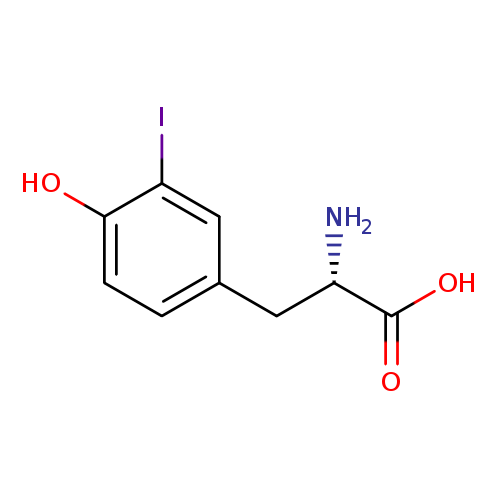
Iodotyrosine, also known as MIT or IYR, belongs to the class of organic compounds known as tyrosine and derivatives. Tyrosine and derivatives are compounds containing tyrosine or a derivative thereof resulting from reaction of tyrosine at the amino group or the carboxy group, or from the replacement of any hydrogen of glycine by a heteroatom. Iodotyrosine exists as a solid, possibly soluble (in water), and a very strong basic compound (based on its pKa) molecule. Iodotyrosine exists in all living organisms, ranging from bacteria to humans. In cattle, iodotyrosine is involved in the metabolic pathway called thyroid hormone synthesis pathway.
belongs to the class of organic compounds known as tyrosine and derivatives. Tyrosine and derivatives are compounds containing tyrosine or a derivative thereof resulting from reaction of tyrosine at the amino group or the carboxy group, or from the replacement of any hydrogen of glycine by a heteroatom.
This digestion releases the hormones T3 and T4 which diffuse into the extracellular space and the residual MIT, DIT which will be deiodinated by a seleno-dependent deiodinase thus releasing tyrosine and iodide which can return to the cycle.
A follicular lumen is the closed cavity within a follicle of the thyroid gland. It is surrounded by follicular cells and filled with colloid, a concentrated solution of thyroglobulin.
Iodide is re-excreted into the follicular space to undergo oxidation (H2O2 peroxidase produced from NADPH) and to be associated with tyrosil derivatives using thyroperoxidase (localised at the membrane level). This provides Mono-iodotyrosine (in red, MIT), di-iodotyrosine (in green, DIT).
Written in the paper as “Mono-iodotyrosine” and “follicular space”
The formation of either of the compounds secreted by the thyroid gland, mainly thyroxine and triiodothyronine. This is achieved by the iodination and joining of tyrosine molecules to form the precursor thyroglobin, proteolysis of this precursor gives rise to the thyroid hormones.
It identified key genes associated with fat deposition, including FASN, ACACA, PLIN1, and FABP4, as well as metabolites such as 3-iodo-L-tyrosine, arachidonic acid, and cis-aconitate (Wang, An, et al., 2023).
Written in the paper as “3-iodo-L-tyrosine” and “fat deposition”