| Record Information |
|---|
| Version | 1.0 |
|---|
| Creation Date | 2016-09-30 22:18:32 UTC |
|---|
| Update Date | 2020-06-04 20:37:20 UTC |
|---|
| BMDB ID | BMDB0000020 |
|---|
| Secondary Accession Numbers | |
|---|
| Metabolite Identification |
|---|
| Common Name | p-Hydroxyphenylacetic acid |
|---|
| Description | 4-Hydroxyphenylacetic acid, also known as (p-hydroxyphenyl)acetate or 4-hydroxybenzeneacetate, belongs to the class of organic compounds known as 1-hydroxy-2-unsubstituted benzenoids. These are phenols that are unsubstituted at the 2-position. 4-Hydroxyphenylacetic acid exists as a solid, possibly soluble (in water), and an extremely weak basic (essentially neutral) compound (based on its pKa) molecule. 4-Hydroxyphenylacetic acid exists in all living species, ranging from bacteria to humans. 4-Hydroxyphenylacetic acid is a potentially toxic compound. 4-Hydroxyphenylacetic acid has been found to be associated with several diseases known as lung cancer, crohn's disease, spina bifida, and epilepsy; also 4-hydroxyphenylacetic acid has been linked to the inborn metabolic disorders including phenylketonuria. |
|---|
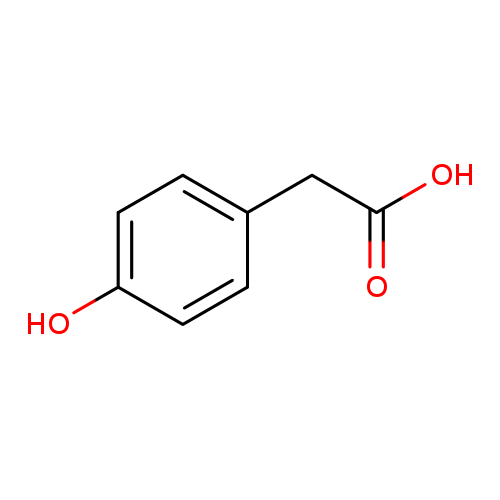
| Structure | |
|---|
| Synonyms | | Value | Source |
|---|
| (p-Hydroxyphenyl)acetic acid | ChEBI | | 4-Carboxymethylphenol | ChEBI | | 4-Hydroxybenzeneacetic acid | ChEBI | | 4-Hydroxyphenylacetate | ChEBI | | 4-Hydroxyphenylacetic acid | Kegg | | (p-Hydroxyphenyl)acetate | Generator | | 4-Hydroxybenzeneacetate | Generator | | p-Hydroxyphenylacetate | Generator | | (4-Hydroxy-phenyl)-acetate | HMDB | | (4-Hydroxy-phenyl)-acetic acid | HMDB | | (4-Hydroxy-phenyl)-essigsaeure | HMDB | | (4-Hydroxyphenyl)acetate | HMDB | | (4-Hydroxyphenyl)acetic acid | HMDB | | (p-Hydroxyphenyl)-acetate | HMDB | | (p-Hydroxyphenyl)-acetic acid | HMDB | | 4-Hydroxy-benzeneacetate | HMDB | | 4-Hydroxy-benzeneacetic acid | HMDB | | 4-Hydroxyphenyl-acetic acid | HMDB | | Parahydroxy phenylacetate | HMDB | | Parahydroxy phenylacetic acid | HMDB | | Parahydroxyphenylacetate | HMDB | | Para-hydroxyphenylacetic acid | HMDB | | p-Hydroxyphenylacetic acid | ChEBI | | 4'-Hydroxyphenylacetic acid | HMDB | | 2-(4-Hydroxyphenyl)acetic acid | HMDB |
|
|---|
| Chemical Formula | C8H8O3 |
|---|
| Average Molecular Weight | 152.1473 |
|---|
| Monoisotopic Molecular Weight | 152.047344122 |
|---|
| IUPAC Name | 2-(4-hydroxyphenyl)acetic acid |
|---|
| Traditional Name | 4-hydroxyphenylacetic acid |
|---|
| CAS Registry Number | 156-38-7 |
|---|
| SMILES | OC(=O)CC1=CC=C(O)C=C1 |
|---|
| InChI Identifier | InChI=1S/C8H8O3/c9-7-3-1-6(2-4-7)5-8(10)11/h1-4,9H,5H2,(H,10,11) |
|---|
| InChI Key | XQXPVVBIMDBYFF-UHFFFAOYSA-N |
|---|
| Chemical Taxonomy |
|---|
| Description | belongs to the class of organic compounds known as 1-hydroxy-2-unsubstituted benzenoids. These are phenols that are unsubstituted at the 2-position. |
|---|
| Kingdom | Organic compounds |
|---|
| Super Class | Benzenoids |
|---|
| Class | Phenols |
|---|
| Sub Class | 1-hydroxy-2-unsubstituted benzenoids |
|---|
| Direct Parent | 1-hydroxy-2-unsubstituted benzenoids |
|---|
| Alternative Parents | |
|---|
| Substituents | - 1-hydroxy-2-unsubstituted benzenoid
- Monocyclic benzene moiety
- Monocarboxylic acid or derivatives
- Carboxylic acid
- Carboxylic acid derivative
- Organic oxygen compound
- Organic oxide
- Hydrocarbon derivative
- Organooxygen compound
- Carbonyl group
- Aromatic homomonocyclic compound
|
|---|
| Molecular Framework | Aromatic homomonocyclic compounds |
|---|
| External Descriptors | |
|---|
| Ontology |
|---|
| Status | Detected and Quantified |
|---|
| Origin | |
|---|
| Biofunction | Not Available |
|---|
| Application | Not Available |
|---|
| Cellular locations | |
|---|
| Physical Properties |
|---|
| State | Solid |
|---|
| Experimental Properties | | Property | Value | Reference |
|---|
| Melting Point | 148 - 150 °C | Not Available | | Boiling Point | Not Available | Not Available | | Water Solubility | 60.7 mg/mL | Not Available | | LogP | 0.75 | HANSCH,C ET AL. (1995) |
|
|---|
| Predicted Properties | |
|---|
| Spectra |
|---|
| Spectra | |
|---|
| Biological Properties |
|---|
| Cellular Locations | |
|---|
| Biospecimen Locations | - Bladder
- Epidermis
- Kidney
- Milk
- Prostate Tissue
- Ruminal Fluid
- Urine
|
|---|
| Pathways | |
|---|
| Normal Concentrations |
|---|
| |
| Bladder | Expected but not Quantified | Not Quantified | Not Specified | Not Specified | Normal | | details | | Epidermis | Expected but not Quantified | Not Quantified | Not Specified | Not Specified | Normal | | details | | Kidney | Expected but not Quantified | Not Quantified | Not Specified | Not Specified | Normal | | details | | Milk | Detected but not Quantified | Not Quantified | Not Specified | Not Specified | Normal | | details | | Prostate Tissue | Expected but not Quantified | Not Quantified | Not Specified | Not Specified | Normal | | details | | Ruminal Fluid | Detected and Quantified | 78510 +/- 12590 uM | Not Specified | Both | Normal | | details | | Urine | Detected but not Quantified | Not Quantified | Not Specified | Not Specified | Normal | | details |
|
|---|
| Abnormal Concentrations |
|---|
| Not Available |
|---|
| External Links |
|---|
| HMDB ID | HMDB0000020 |
|---|
| DrugBank ID | Not Available |
|---|
| Phenol Explorer Compound ID | 573 |
|---|
| FooDB ID | FDB010534 |
|---|
| KNApSAcK ID | Not Available |
|---|
| Chemspider ID | 124 |
|---|
| KEGG Compound ID | C00642 |
|---|
| BioCyc ID | 4-HYDROXYPHENYLACETATE |
|---|
| BiGG ID | 35599 |
|---|
| Wikipedia Link | 4-hydroxyphenylacetic_acid |
|---|
| METLIN ID | 130 |
|---|
| PubChem Compound | 127 |
|---|
| PDB ID | Not Available |
|---|
| ChEBI ID | 18101 |
|---|
| References |
|---|
| Synthesis Reference | Qiao, Xi-long; Tian, Hui; Li, Wen; Zhao, Xiu-yun; Zhang, Jin-fang. Study of 4-hydroxyphenylacetic acid synthesis from glyoxalic acid. Hebei Gongye Keji (2005), 22(5), 264-266. |
|---|
| Material Safety Data Sheet (MSDS) | Not Available |
|---|
| General References | - Mung D, Li L: Development of Chemical Isotope Labeling LC-MS for Milk Metabolomics: Comprehensive and Quantitative Profiling of the Amine/Phenol Submetabolome. Anal Chem. 2017 Apr 18;89(8):4435-4443. doi: 10.1021/acs.analchem.6b03737. Epub 2017 Mar 28. [PubMed:28306241 ]
- Mung D, Li L: Applying quantitative metabolomics based on chemical isotope labeling LC-MS for detecting potential milk adulterant in human milk. Anal Chim Acta. 2018 Feb 25;1001:78-85. doi: 10.1016/j.aca.2017.11.019. Epub 2017 Nov 14. [PubMed:29291809 ]
|
|---|